Japanese
English
- 有料閲覧
PPV購入案内
1,320円 (1,200円+税10%) こちらは、51ページから58ページの文献です。購入には医書.jp本会員登録が必要です。
会員登録完了後に改めて上記「購入サイトへ」を選択してください。
または「購入サイトへ」選択後に「購入ログイン」、「新規会員登録」の順に進んでください。
会員登録について詳しくはをご確認ください。
- Abstract 文献概要
- 1ページ目 Look Inside
- 参考文献 Reference
はじめに
シナプスはいったん形成されると生涯を通じて保たれる構造ではなく,状況に応じて変化し続ける。例えば大脳皮質では外界からの知覚入力に応じて皮質内の神経回路にリモデリングが起こることはよく知られており,この回路変化の基礎にはシナプスの変化が存在する。一方で統合失調症や神経変性疾患のような病態ではシナプスの形態・機能異常が報告されている。神経回路の形成およびその異常を理解するためには,さまざまな方法論が必要であるが,特に神経細胞間での情報伝達に必須の構造であるシナプスに局在する分子の動態を知ることは不可欠と考えられる。
本稿では,シナプスの構造とシナプスを構成する蛋白分子についての概説に引き続き,われわれの研究室で取り組んでいるシナプス形成と維持に関する研究を紹介する。中枢神経系の化学シナプスは興奮性と抑制性の2種類に大別されるが,本稿では興奮性シナプスについて取り上げる。特に断りのない限り,本文中の「シナプス」は「興奮性シナプス」のことを意味する。
Abstract
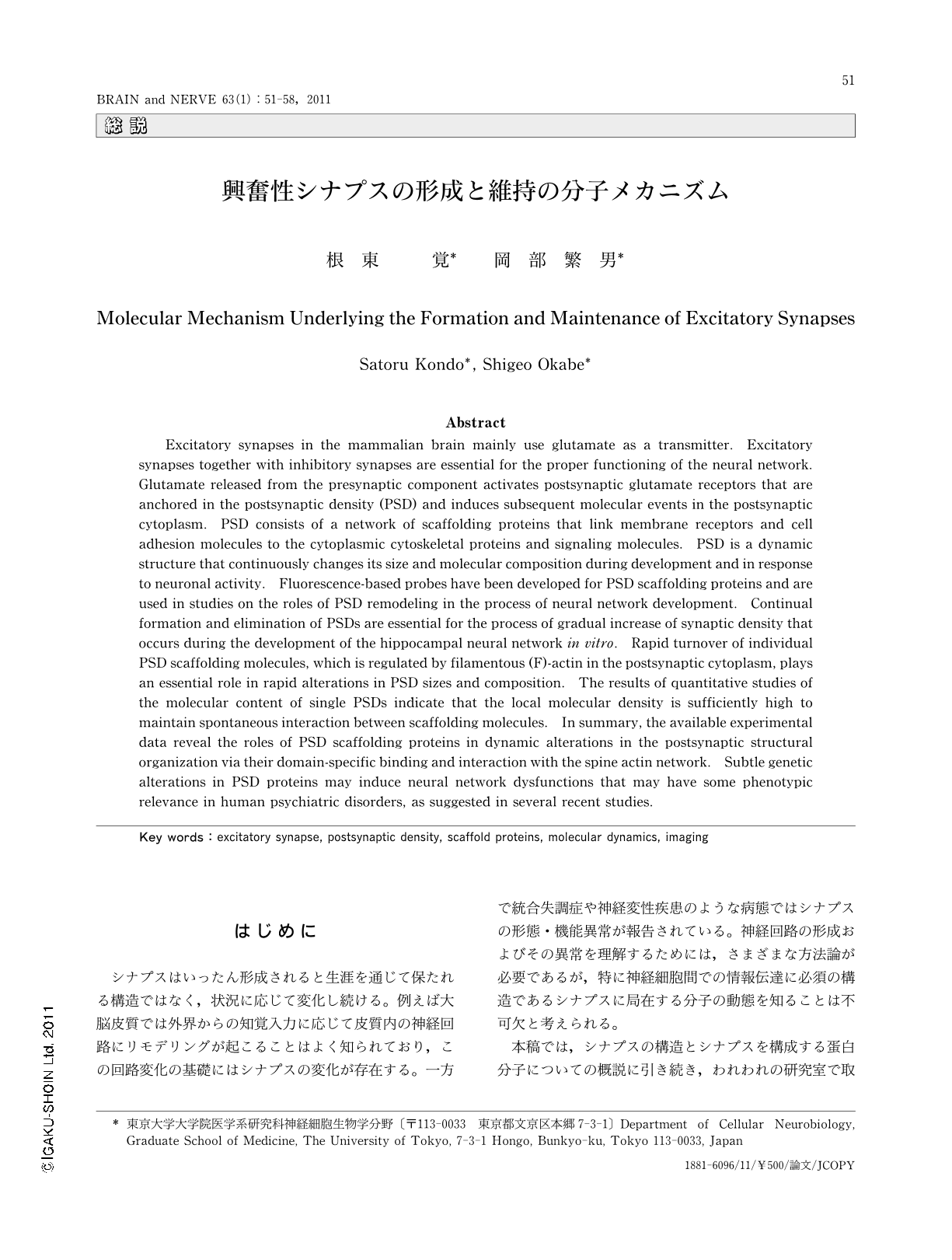
Excitatory synapses in the mammalian brain mainly use glutamate as a transmitter. Excitatory synapses together with inhibitory synapses are essential for the proper functioning of the neural network. Glutamate released from the presynaptic component activates postsynaptic glutamate receptors that are anchored in the postsynaptic density (PSD) and induces subsequent molecular events in the postsynaptic cytoplasm. PSD consists of a network of scaffolding proteins that link membrane receptors and cell adhesion molecules to the cytoplasmic cytoskeletal proteins and signaling molecules. PSD is a dynamic structure that continuously changes its size and molecular composition during development and in response to neuronal activity. Fluorescence-based probes have been developed for PSD scaffolding proteins and are used in studies on the roles of PSD remodeling in the process of neural network development. Continual formation and elimination of PSDs are essential for the process of gradual increase of synaptic density that occurs during the development of the hippocampal neural network in vitro. Rapid turnover of individual PSD scaffolding molecules,which is regulated by filamentous (F)-actin in the postsynaptic cytoplasm,plays an essential role in rapid alterations in PSD sizes and composition. The results of quantitative studies of the molecular content of single PSDs indicate that the local molecular density is sufficiently high to maintain spontaneous interaction between scaffolding molecules. In summary,the available experimental data reveal the roles of PSD scaffolding proteins in dynamic alterations in the postsynaptic structural organization via their domain-specific binding and interaction with the spine actin network. Subtle genetic alterations in PSD proteins may induce neural network dysfunctions that may have some phenotypic relevance in human psychiatric disorders,as suggested in several recent studies.
Copyright © 2011, Igaku-Shoin Ltd. All rights reserved.