Japanese
English
- 有料閲覧
PPV購入案内
1,320円 (1,200円+税10%) こちらは、1061ページから1065ページの文献です。購入には医書.jp本会員登録が必要です。
会員登録完了後に改めて上記「購入サイトへ」を選択してください。
または「購入サイトへ」選択後に「購入ログイン」、「新規会員登録」の順に進んでください。
会員登録について詳しくはをご確認ください。
- Abstract 文献概要
- 1ページ目 Look Inside
- 参考文献 Reference
はじめに
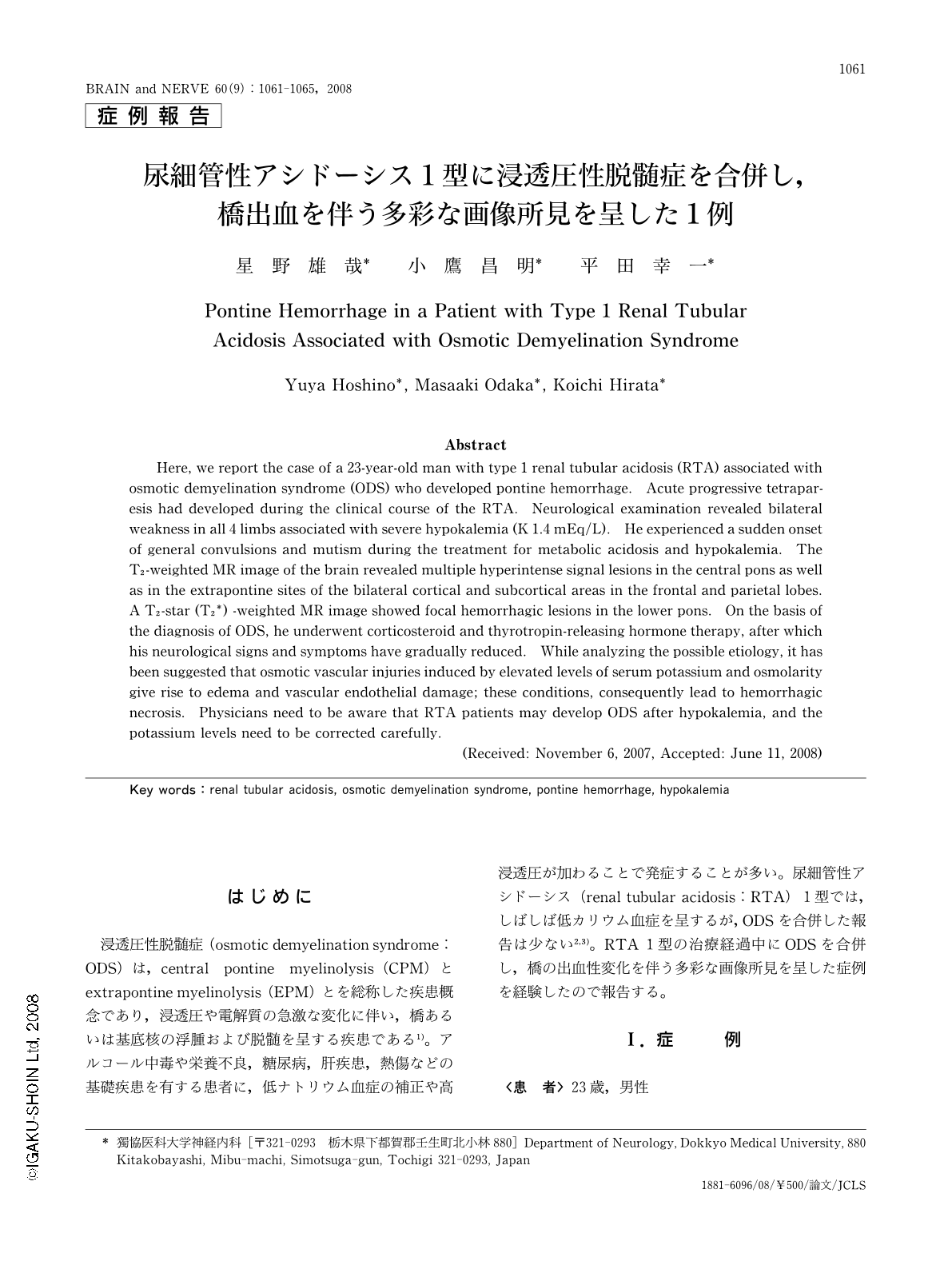
浸透圧性脱髄症(osmotic demyelination syndrome:ODS)は,central pontine myelinolysis(CPM)とextrapontine myelinolysis(EPM)とを総称した疾患概念であり,浸透圧や電解質の急激な変化に伴い,橋あるいは基底核の浮腫および脱髄を呈する疾患である1)。アルコール中毒や栄養不良,糖尿病,肝疾患,熱傷などの基礎疾患を有する患者に,低ナトリウム血症の補正や高浸透圧が加わることで発症することが多い。尿細管性アシドーシス(renal tubular acidosis:RTA)1型では,しばしば低カリウム血症を呈するが,ODSを合併した報告は少ない2,3)。RTA1型の治療経過中にODSを合併し,橋の出血性変化を伴う多彩な画像所見を呈した症例を経験したので報告する。
Abstract
Here, we report the case of a 23-year-old man with type 1 renal tubular acidosis (RTA) associated with osmotic demyelination syndrome (ODS) who developed pontine hemorrhage. Acute progressive tetraparesis had developed during the clinical course of the RTA. Neurological examination revealed bilateral weakness in all 4 limbs associated with severe hypokalemia (K 1.4 mEq/L). He experienced a sudden onset of general convulsions and mutism during the treatment for metabolic acidosis and hypokalemia. The T2-weighted MR image of the brain revealed multiple hyperintense signal lesions in the central pons as well as in the extrapontine sites of the bilateral cortical and subcortical areas in the frontal and parietal lobes. A T2-star (T2*) -weighted MR image showed focal hemorrhagic lesions in the lower pons. On the basis of the diagnosis of ODS, he underwent corticosteroid and thyrotropin-releasing hormone therapy, after which his neurological signs and symptoms have gradually reduced. While analyzing the possible etiology, it has been suggested that osmotic vascular injuries induced by elevated levels of serum potassium and osmolarity give rise to edema and vascular endothelial damage; these conditions, consequently lead to hemorrhagic necrosis. Physicians need to be aware that RTA patients may develop ODS after hypokalemia, and the potassium levels need to be corrected carefully.
(Received: November 6, 2007, Accepted: June 11, 2008)
Copyright © 2008, Igaku-Shoin Ltd. All rights reserved.