Japanese
English
- 有料閲覧
PPV購入案内
1,320円 (1,200円+税10%) こちらは、1081ページから1086ページの文献です。購入には医書.jp本会員登録が必要です。
会員登録完了後に改めて上記「購入サイトへ」を選択してください。
または「購入サイトへ」選択後に「購入ログイン」、「新規会員登録」の順に進んでください。
会員登録について詳しくはをご確認ください。
- Abstract 文献概要
- 1ページ目 Look Inside
- 参考文献 Reference
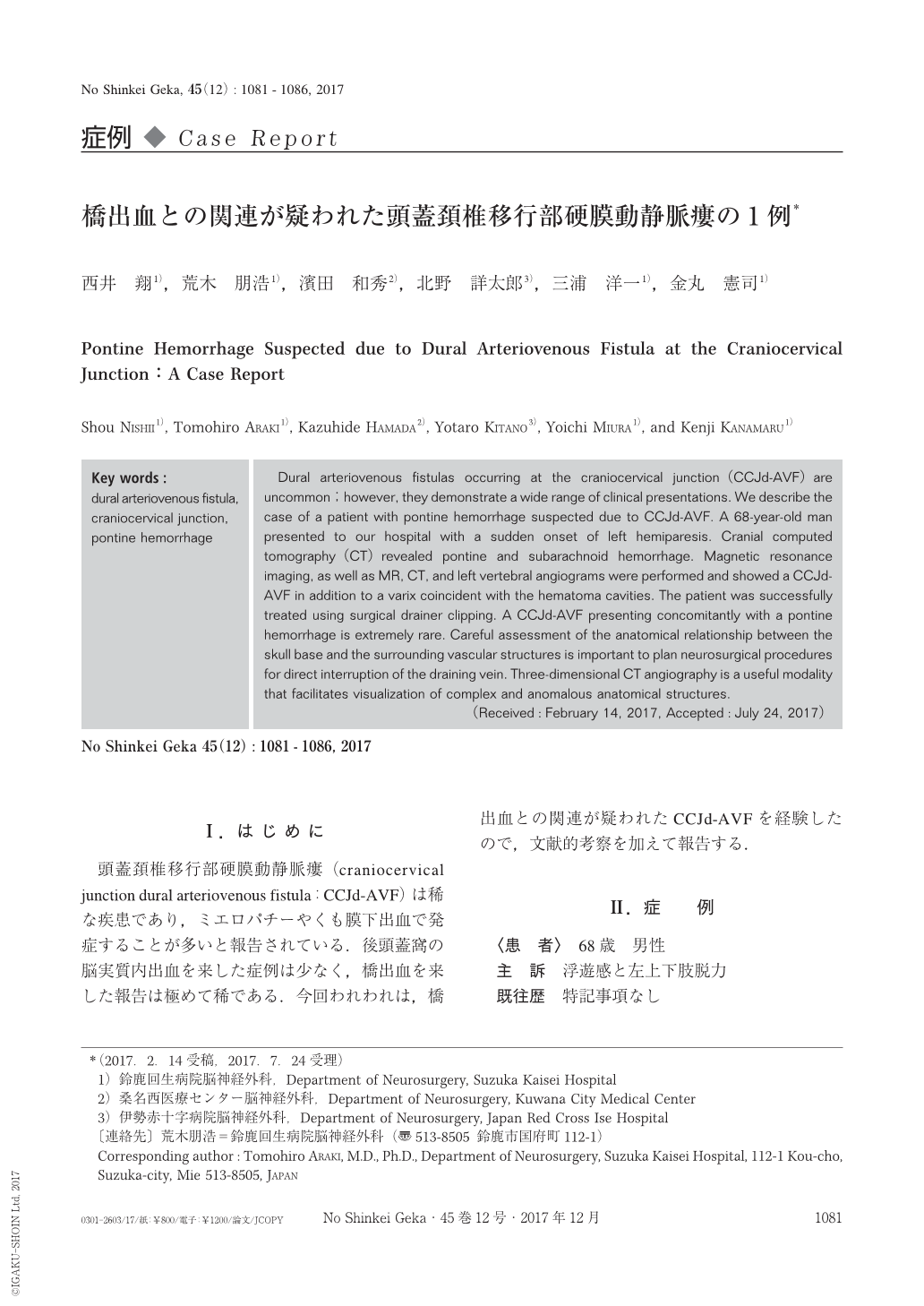
Ⅰ.はじめに
頭蓋頚椎移行部硬膜動静脈瘻(craniocervical junction dural arteriovenous fistula:CCJd-AVF)は稀な疾患であり,ミエロパチーやくも膜下出血で発症することが多いと報告されている.後頭蓋窩の脳実質内出血を来した症例は少なく,橋出血を来した報告は極めて稀である.今回われわれは,橋出血との関連が疑われたCCJd-AVFを経験したので,文献的考察を加えて報告する.
Dural arteriovenous fistulas occurring at the craniocervical junction(CCJd-AVF)are uncommon;however, they demonstrate a wide range of clinical presentations. We describe the case of a patient with pontine hemorrhage suspected due to CCJd-AVF. A 68-year-old man presented to our hospital with a sudden onset of left hemiparesis. Cranial computed tomography(CT)revealed pontine and subarachnoid hemorrhage. Magnetic resonance imaging, as well as MR, CT, and left vertebral angiograms were performed and showed a CCJd-AVF in addition to a varix coincident with the hematoma cavities. The patient was successfully treated using surgical drainer clipping. A CCJd-AVF presenting concomitantly with a pontine hemorrhage is extremely rare. Careful assessment of the anatomical relationship between the skull base and the surrounding vascular structures is important to plan neurosurgical procedures for direct interruption of the draining vein. Three-dimensional CT angiography is a useful modality that facilitates visualization of complex and anomalous anatomical structures.
Copyright © 2017, Igaku-Shoin Ltd. All rights reserved.