Japanese
English
- 有料閲覧
PPV購入案内
1,320円 (1,200円+税10%) こちらは、845ページから853ページの文献です。購入には医書.jp本会員登録が必要です。
会員登録完了後に改めて上記「購入サイトへ」を選択してください。
または「購入サイトへ」選択後に「購入ログイン」、「新規会員登録」の順に進んでください。
会員登録について詳しくはをご確認ください。
- Abstract 文献概要
- 1ページ目 Look Inside
- 参考文献 Reference
はじめに
作話(confabulation)とは,記憶障害を背景に,だまそうとする意図はないが,自己や世界に関する記憶や出来事を作り上げたり,ゆがめたり,誤って解釈して,外界に向けて話をすることである。作話の概念は,Kahlbaum1)が1874年の緊張病論のなかで,意味も脈略もない会話である語唱(Verbigeration)と対比して,空想的かつ生産的な内容である作話(Konfabulation)という語を用いたのに端を発し,Korsakoff2,3)によるコルサコフ症候群の確立によって大きな発展を遂げた。作話にはさまざまな分類があるが,最もよく用いられる作話の生成機転による区分として,促さなくても現れる自発作話(spontaneous confabulation)と,質問に対してのみ受動的に誘発される誘発作話(provoked confabulation)とに大別される。作話は意味記憶領域のもの(例えば「キリンとは何か」に関する作話)もあるが,そのほとんどは自己の生活史と関連した自伝的記憶ないしエピソード記憶領域のものである。
作話の原因疾患は,アルコール性コルサコフ症候群などの中毒性・代謝性疾患,前交通動脈瘤破裂に代表されるくも膜下出血,脳出血,硬膜下血腫,脳腫瘍,脳炎などの感染症,頭部外傷,アルツハイマー病や血管性認知症などの認知症性疾患,低酸素脳症など多岐にわたる。
作話は,妄想や記憶錯誤と類似点があるが,これらとは区別することができる。記憶錯誤は,過去に体験していないのに実際にあったかのように追想することであり,一部の作話は記憶錯誤といえる。妄想は,「主に自己に関する病的な誤った確信であり,訂正不能」であると定義され,基本的には記憶障害に基づくものではない。一方で,作話は背景に記憶障害があり,その確信の程度は低い。作話に基づいて実際に行動してしまう場合も少なくない4,5)が,一般的には妄想に基づく犯罪のような重大な事件に至ることはない。
統合失調症の妄想においては,その形成以前にしばしば離人症が出現し,世界全体の知覚自体にも変化が生じているという考え方6)がある。一方で,作話の場合は,妄想のような世界全体の変容ではなく,記憶障害や現実監視能力の低下といった部分的な欠損から生じているといえる7)。また,嫉妬妄想に代表されるように,妄想性障害は性格や感情の影響が大きいことが知られている。フランスでは恋愛妄想,嫉妬妄想,復権妄想をまとめて熱情精神病と呼んでいる。病的な熱情の上に,強固な信念に支えられ妄想が構築されていき,闘争的で興奮しやすいといわれる。嫉妬妄想の背景には,器質疾患に伴う嫉妬妄想も含めて8),プライドが高い性格や失われたものを取り戻そうとする機制が強く働いている。一方で,作話には性格による影響は少なく,情動的色彩も乏しいと考えられる9)。
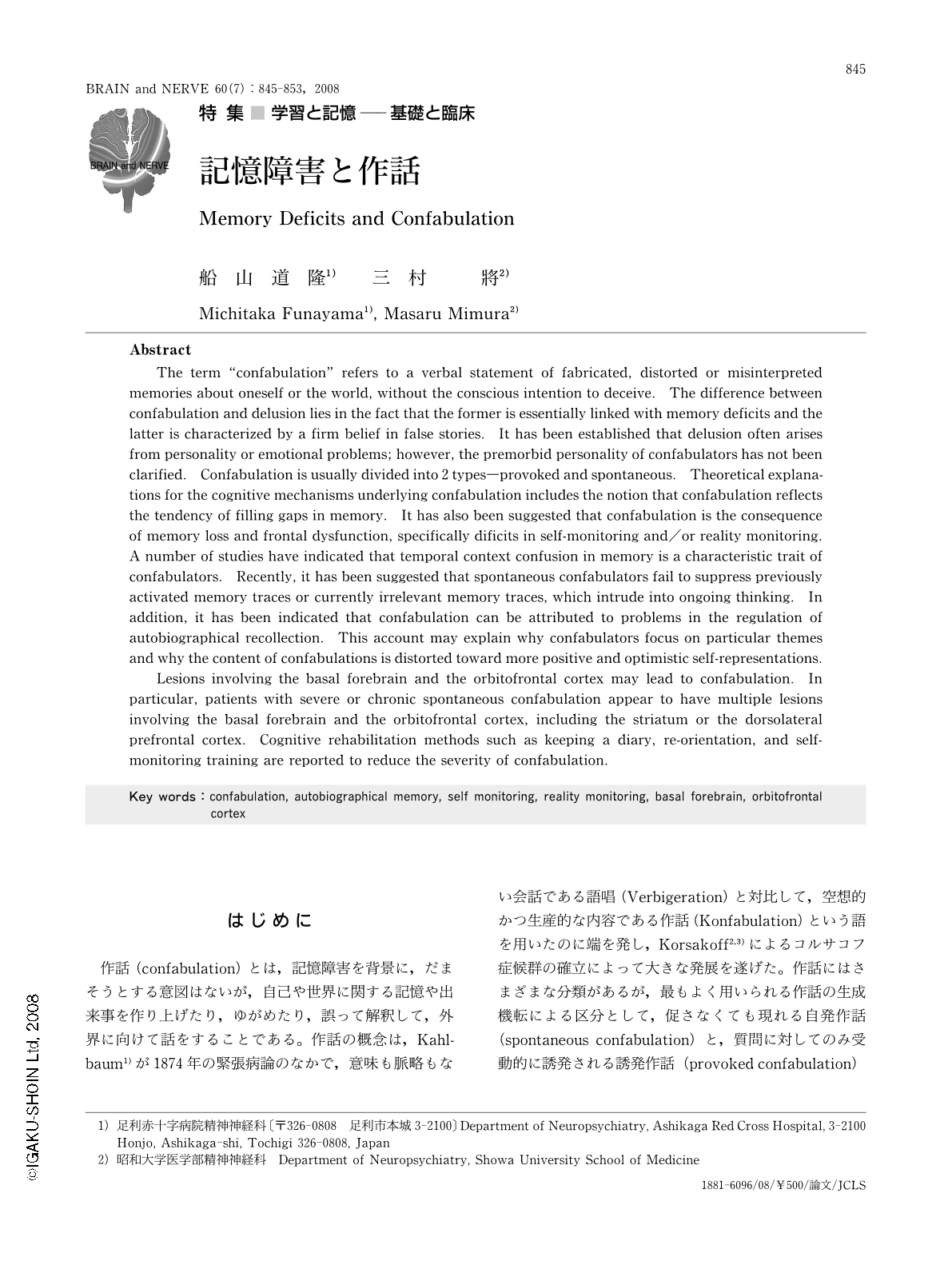
Abstract
The term "confabulation" refers to a verbal statement of fabricated, distorted or misinterpreted memories about oneself or the world, without the conscious intention to deceive. The difference between confabulation and delusion lies in the fact that the former is essentially linked with memory deficits and the latter is characterized by a firm belief in false stories. It has been established that delusion often arises from personality or emotional problems; however, the premorbid personality of confabulators has not been clarified. Confabulation is usually divided into 2 types―provoked and spontaneous. Theoretical explanations for the cognitive mechanisms underlying confabulation includes the notion that confabulation reflects the tendency of filling gaps in memory. It has also been suggested that confabulation is the consequence of memory loss and frontal dysfunction, specifically dificits in self-monitoring and/or reality monitoring. A number of studies have indicated that temporal context confusion in memory is a characteristic trait of confabulators. Recently, it has been suggested that spontaneous confabulators fail to suppress previously activated memory traces or currently irrelevant memory traces, which intrude into ongoing thinking. In addition, it has been indicated that confabulation can be attributed to problems in the regulation of autobiographical recollection. This account may explain why confabulators focus on particular themes and why the content of confabulations is distorted toward more positive and optimistic self-representations.
Lesions involving the basal forebrain and the orbitofrontal cortex may lead to confabulation. In particular, patients with severe or chronic spontaneous confabulation appear to have multiple lesions involving the basal forebrain and the orbitofrontal cortex, including the striatum or the dorsolateral prefrontal cortex. Cognitive rehabilitation methods such as keeping a diary, re-orientation, and self-monitoring training are reported to reduce the severity of confabulation.
Copyright © 2008, Igaku-Shoin Ltd. All rights reserved.