Japanese
English
- 有料閲覧
PPV購入案内
1,320円 (1,200円+税10%) こちらは、747ページから753ページの文献です。購入には医書.jp本会員登録が必要です。
会員登録完了後に改めて上記「購入サイトへ」を選択してください。
または「購入サイトへ」選択後に「購入ログイン」、「新規会員登録」の順に進んでください。
会員登録について詳しくはをご確認ください。
- Abstract 文献概要
- 1ページ目 Look Inside
- 参考文献 Reference
はじめに
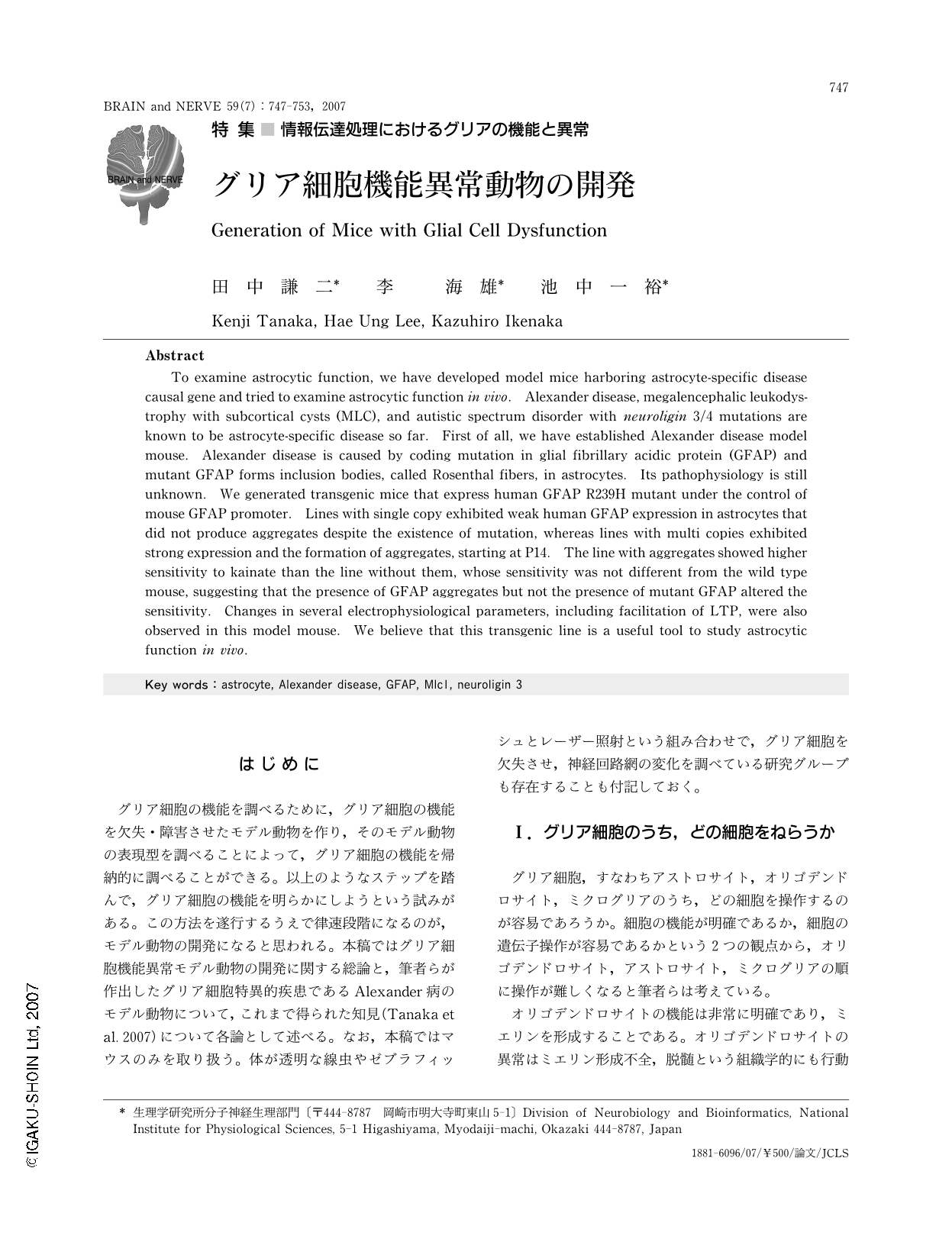
グリア細胞の機能を調べるために,グリア細胞の機能を欠失・障害させたモデル動物を作り,そのモデル動物の表現型を調べることによって,グリア細胞の機能を帰納的に調べることができる。以上のようなステップを踏んで,グリア細胞の機能を明らかにしようという試みがある。この方法を遂行するうえで律速段階になるのが,モデル動物の開発になると思われる。本稿ではグリア細胞機能異常モデル動物の開発に関する総論と,筆者らが作出したグリア細胞特異的疾患であるAlexander病のモデル動物について,これまで得られた知見(Tanaka et al. 2007)について各論として述べる。なお,本稿ではマウスのみを取り扱う。体が透明な線虫やゼブラフィッシュとレーザー照射という組み合わせで,グリア細胞を欠失させ,神経回路網の変化を調べている研究グループも存在することも付記しておく。
Abstract
To examine astrocytic function, we have developed model mice harboring astrocyte-specific disease causal gene and tried to examine astrocytic function in vivo. Alexander disease, megalencephalic leukodystrophy with subcortical cysts (MLC), and autistic spectrum disorder with neuroligin 3/4 mutations are known to be astrocyte-specific disease so far. First of all, we have established Alexander disease model mouse. Alexander disease is caused by coding mutation in glial fibrillary acidic protein (GFAP) and mutant GFAP forms inclusion bodies, called Rosenthal fibers, in astrocytes. Its pathophysiology is still unknown. We generated transgenic mice that express human GFAP R239H mutant under the control of mouse GFAP promoter. Lines with single copy exhibited weak human GFAP expression in astrocytes that did not produce aggregates despite the existence of mutation, whereas lines with multi copies exhibited strong expression and the formation of aggregates, starting at P14. The line with aggregates showed higher sensitivity to kainate than the line without them, whose sensitivity was not different from the wild type mouse, suggesting that the presence of GFAP aggregates but not the presence of mutant GFAP altered the sensitivity. Changes in several electrophysiological parameters, including facilitation of LTP, were also observed in this model mouse. We believe that this transgenic line is a useful tool to study astrocytic function in vivo.
Copyright © 2007, Igaku-Shoin Ltd. All rights reserved.