Japanese
English
- 有料閲覧
PPV購入案内
1,320円 (1,200円+税10%) こちらは、923ページから928ページの文献です。購入には医書.jp本会員登録が必要です。
会員登録完了後に改めて上記「購入サイトへ」を選択してください。
または「購入サイトへ」選択後に「購入ログイン」、「新規会員登録」の順に進んでください。
会員登録について詳しくはをご確認ください。
- Abstract 文献概要
- 1ページ目 Look Inside
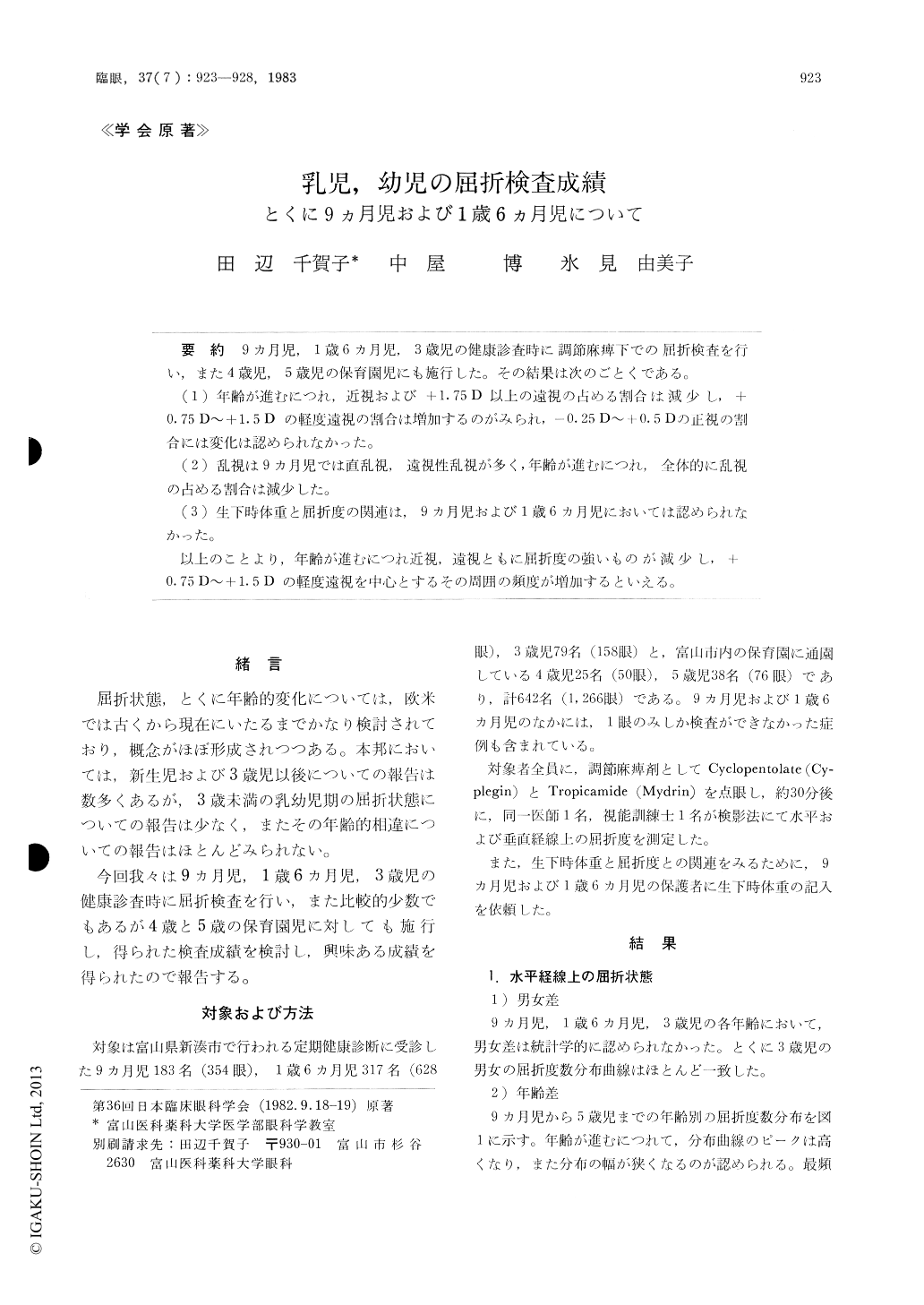
9カ月児,1歳6カ月児,3歳児の健康診査時に調節麻痺下での屈折検査を行い,また4歳児,5歳児の保育園児にも施行した。その結果は次のごとくである。
(1)年齢が進むにつれ,近視および+1.75D以上の遠視の占める割合は減少し,+0.75D〜+1.5Dの軽度遠視の割合は増加するのがみられ,−0.25D〜+0.5Dの正視の割合には変化は認められなかった。
(2)乱視は9カ月児では直乱視,遠視性乱視が多く,年齢が進むにつれ,全体的に乱視の占める割合は減少した。
(3)生下時体重と屈折度の関連は,9カ月児および1歳6カ月児においては認められなかった。
以上のことより,年齢が進むにつれ近視,遠視ともに屈折度の強いものが減少し,+0.75D〜+1.5Dの軽度遠視を中心とするその周囲の頻度が増加するといえる。
We measured the state of refraction in a total of 642 infants and children at ages of 9 months, 18 months, 3, 4 or 5 years. Retinoscopy was used throughout under cyloplegia with topical cyclo-pentrate and tropicamide.
The state of refraction showed an almost normal distribution curve for each age group. While the basic mode of the curve remained constant for each age group, there was a significant tendency for the dispersion to become smaller with advance of age.
Copyright © 1983, Igaku-Shoin Ltd. All rights reserved.