Japanese
English
- 有料閲覧
PPV購入案内
1,320円 (1,200円+税10%) こちらは、749ページから752ページの文献です。購入には医書.jp本会員登録が必要です。
会員登録完了後に改めて上記「購入サイトへ」を選択してください。
または「購入サイトへ」選択後に「購入ログイン」、「新規会員登録」の順に進んでください。
会員登録について詳しくはをご確認ください。
- Abstract 文献概要
- 1ページ目 Look Inside
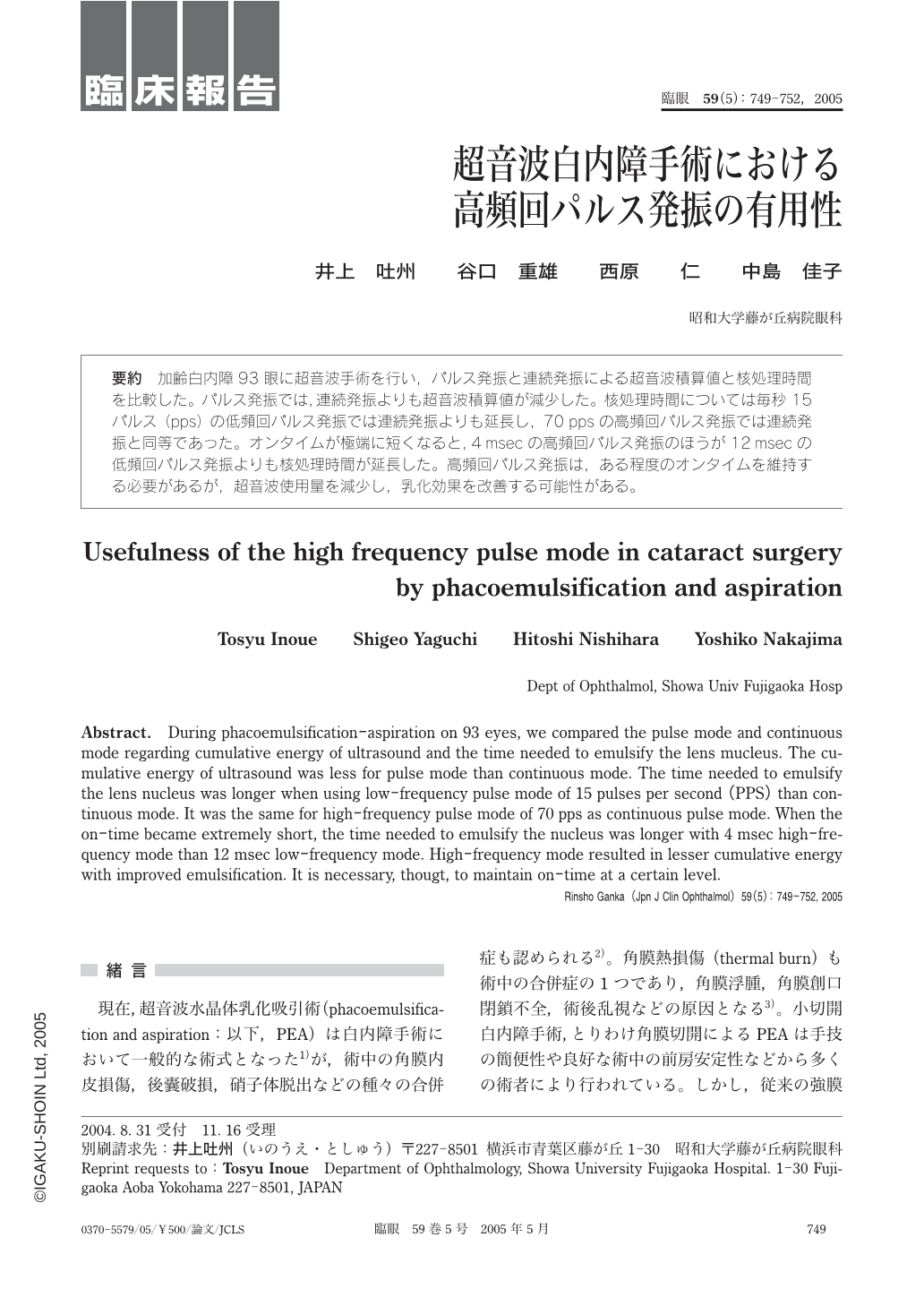
加齢白内障93眼に超音波手術を行い,パルス発振と連続発振による超音波積算値と核処理時間を比較した。パルス発振では,連続発振よりも超音波積算値が減少した。核処理時間については毎秒15パルス(pps)の低頻回パルス発振では連続発振よりも延長し,70 ppsの高頻回パルス発振では連続発振と同等であった。オンタイムが極端に短くなると,4msecの高頻回パルス発振のほうが12msecの低頻回パルス発振よりも核処理時間が延長した。高頻回パルス発振は,ある程度のオンタイムを維持する必要があるが,超音波使用量を減少し,乳化効果を改善する可能性がある。
During phacoemulsification-aspiration on 93 eyes,we compared the pulse mode and continuous mode regarding cumulative energy of ultrasound and the time needed to emulsify the lens mucleus. The cumulative energy of ultrasound was less for pulse mode than continuous mode. The time needed to emulsify the lens nucleus was longer when using low-frequency pulse mode of 15 pulses per second(PPS)than continuous mode. It was the same for high-frequency pulse mode of 70 pps as continuous pulse mode. When the on-time became extremely short,the time needed to emulsify the nucleus was longer with 4 msec high-frequency mode than 12 msec low-frequency mode. High-frequency mode resulted in lesser cumulative energy with improved emulsification. It is necessary,thougt,to maintain on-time at a certain level.
Copyright © 2005, Igaku-Shoin Ltd. All rights reserved.