Japanese
English
- 有料閲覧
PPV購入案内
1,320円 (1,200円+税10%) こちらは、1057ページから1061ページの文献です。購入には医書.jp本会員登録が必要です。
会員登録完了後に改めて上記「購入サイトへ」を選択してください。
または「購入サイトへ」選択後に「購入ログイン」、「新規会員登録」の順に進んでください。
会員登録について詳しくはをご確認ください。
- Abstract 文献概要
- 1ページ目 Look Inside
- 参考文献 Reference
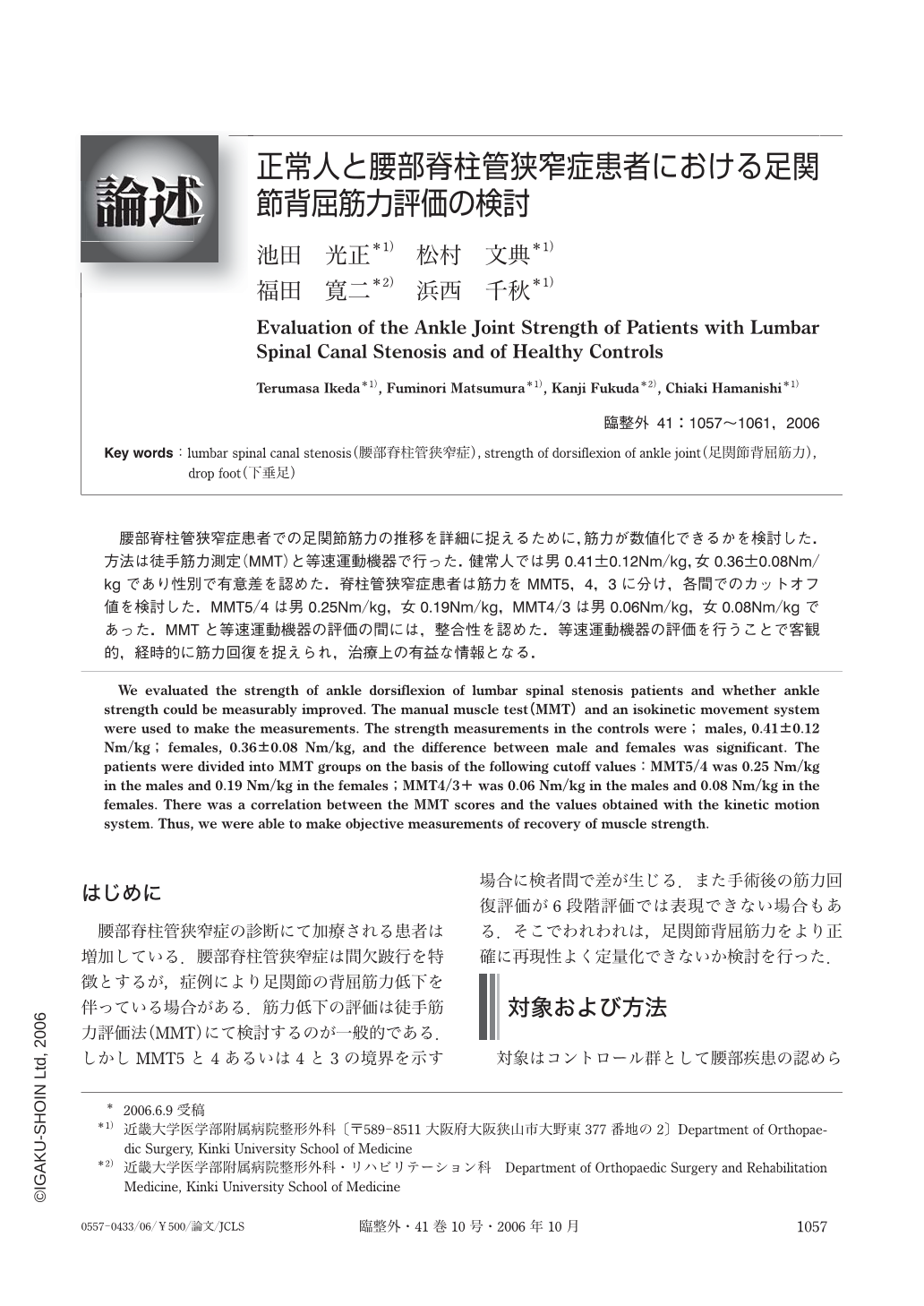
腰部脊柱管狭窄症患者での足関節筋力の推移を詳細に捉えるために,筋力が数値化できるかを検討した.方法は徒手筋力測定(MMT)と等速運動機器で行った.健常人では男0.41±0.12Nm/kg,女0.36±0.08Nm/kgであり性別で有意差を認めた.脊柱管狭窄症患者は筋力をMMT5,4,3に分け,各間でのカットオフ値を検討した.MMT5/4は男0.25Nm/kg,女0.19Nm/kg,MMT4/3は男0.06Nm/kg,女0.08Nm/kgであった.MMTと等速運動機器の評価の間には,整合性を認めた.等速運動機器の評価を行うことで客観的,経時的に筋力回復を捉えられ,治療上の有益な情報となる.
We evaluated the strength of ankle dorsiflexion of lumbar spinal stenosis patients and whether ankle strength could be measurably improved. The manual muscle test (MMT) and an isokinetic movement system were used to make the measurements. The strength measurements in the controls were; males, 0.41±0.12 Nm/kg; females, 0.36±0.08 Nm/kg, and the difference between male and females was significant. The patients were divided into MMT groups on the basis of the following cutoff values:MMT5/4 was 0.25 Nm/kg in the males and 0.19 Nm/kg in the females;MMT4/3+ was 0.06 Nm/kg in the males and 0.08 Nm/kg in the females. There was a correlation between the MMT scores and the values obtained with the kinetic motion system. Thus, we were able to make objective measurements of recovery of muscle strength.
Copyright © 2006, Igaku-Shoin Ltd. All rights reserved.