Japanese
English
- 有料閲覧
PPV購入案内
1,320円 (1,200円+税10%) こちらは、781ページから787ページの文献です。購入には医書.jp本会員登録が必要です。
会員登録完了後に改めて上記「購入サイトへ」を選択してください。
または「購入サイトへ」選択後に「購入ログイン」、「新規会員登録」の順に進んでください。
会員登録について詳しくはをご確認ください。
- Abstract 文献概要
- 1ページ目 Look Inside
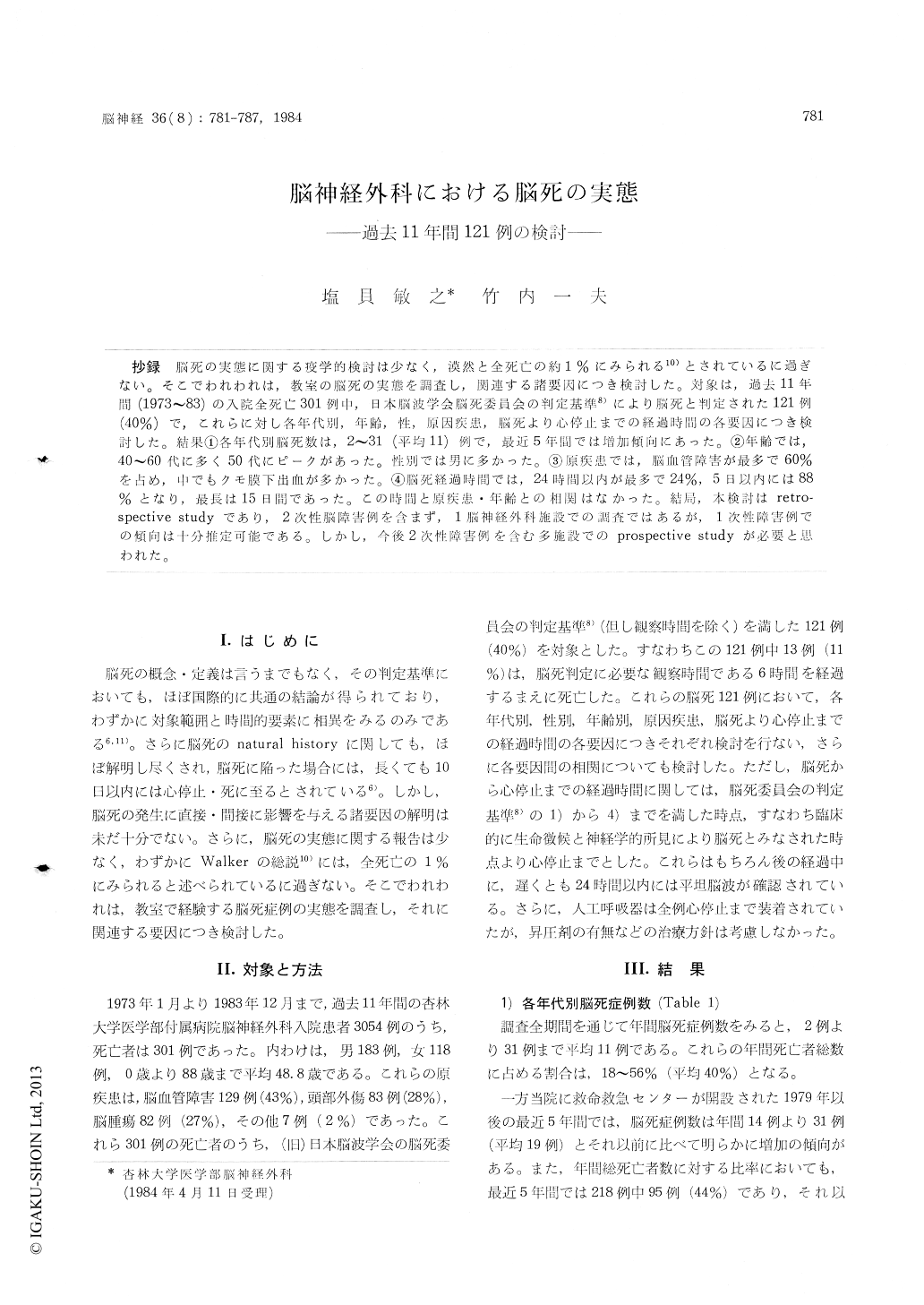
抄録 脳死の実態に関する疫学的検討は少なく,漢然と全死亡の約1%にみられる10)とされているに過ぎない。そこでわれわれは,教室の脳死の実態を調査し,関連する諸要因につき検討した。対象は,過去11年間(1973〜83)の入院全死亡301例中,日本脳波学会脳死委員会の判定基準8)により脳死と判定された121例(40%)で,これらに対し客年代別,年齢,性,原因疾患,脳死より心停止までの経過時間の各要因につき検討した。結果①各年代別脳死数は,2〜31(平均11)例で,最近5年間では増加傾向にあった。②年齢では,40〜60代に多く50代にピークがあった。性別では男に多かった。③原疾患では,脳血管障害が最多で60%を占め,中でもクモ膜下出血が多かった。④脳死経過時間では,24時間以内が最多で24%,5日以内には88%となり,最長は15日間であった。この時間と原疾患・年齢との相関はなかった。結局,本検討はretro—spective studyであり,2次性脳障害例を含まず,1脳神経外科施設での調査ではあるが,1次性障害例での傾向は十分推定可能である。しかし,今後2次性障害例を含む多施設でのprospective studyが必要と思われた。
Walker states that the incidence of brain death accounts for approximately 1% of all deaths, so that brain death is a common state. According to Jennett et al, the occurence of brain death is now a relatively frequent event, with about 4000 cases each year in Britain. But the actual circumstancesof brain death can not be dicovered from any published report.
During the last 11 years (1973-1983) at Kyorin University Hospital, we studied 121 cases diag-nosed as brain death according to Japanese crite-ria. The Japanese criteria requires that the pa-thology be a gross primary brain lesion, so did not concern ourselves with brain deaths due to secondary brain damage. We analysed the factors asscciated with brain death, that is the annual incidence, age, sex distribution, primary diagnosis and elapsed time from brain death to cardiac death.
The increasing incidence of brain death in the last 5 years is probably due to a rise in severely brain-damaged patients (Table 1). In the age distribution, the high number of patients in their fifties presumably reflects the human age tendency for traumatic and vascular disorders respectively (Fig. 1 and Table 2). The fact that males predo-minate relates to the greater risk faced regarding cerebral trauma (Table 3). The primary diagnoseswere cerebrovascular accidents in 60% of the cases especially subarachnoid hemorrhage in 41%, head injury in 31% and brain tumor in 9% (Tables 4 and 5). The elapsed time from brain deaths is measured from diagnosis of clinical brain death to cardiac asystole (Fig. 2). All patients had final cardiac asystole while still being ventilated. Cardiac arrest followed the diagnosis of brain death within 24 hours in 24% of the cases, within 5 days in 88% and within 15 days in all cases (Table 6). The elapsed time of brain death did not cor-relate to primary diagnosis and age (Tables 6 and 7).
We suggest that the problem of the Japanese criteria of brain death is the prerequisite which requires that the patient had sustained a gross primary brain lesion. We recommend that the Japanese Medical Association revise its interpre-tation of brain death to include also causes stem-ming from secondary brain damage.
Copyright © 1984, Igaku-Shoin Ltd. All rights reserved.