Japanese
English
- 有料閲覧
PPV購入案内
1,320円 (1,200円+税10%) こちらは、601ページから606ページの文献です。購入には医書.jp本会員登録が必要です。
会員登録完了後に改めて上記「購入サイトへ」を選択してください。
または「購入サイトへ」選択後に「購入ログイン」、「新規会員登録」の順に進んでください。
会員登録について詳しくはをご確認ください。
- Abstract 文献概要
- 1ページ目 Look Inside
I.はじめに
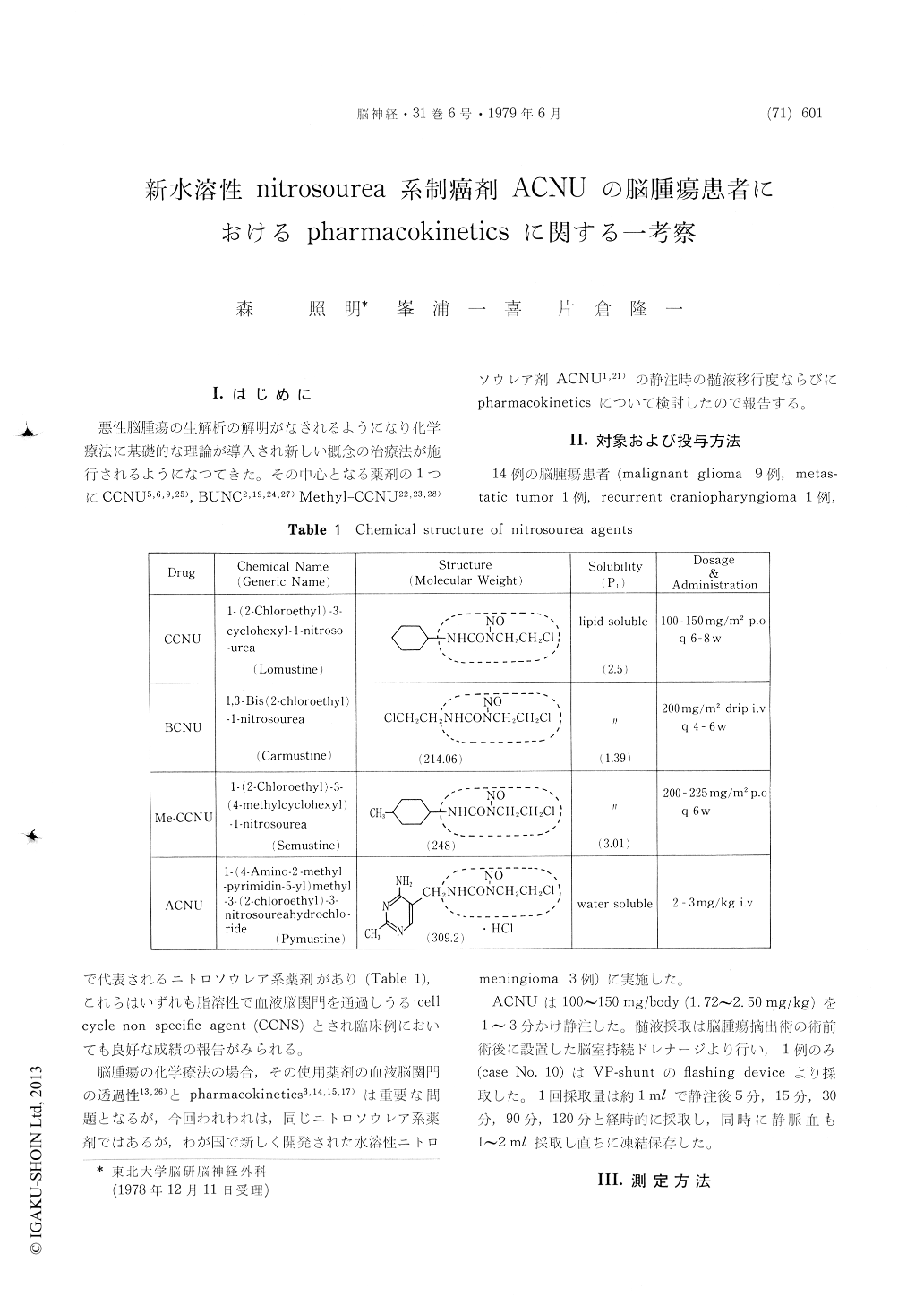
悪性脳腫蕩の生解析の解明がなされるようになり化学療法に基礎的な理論が導入され新しい概念の治療法が施行されるようになつてきた。その中心となる薬剤の1つにCCNU5,6,9,25),BUNC2,19,24,27)Methyl-CCNU22,23,28)で代表されるニトロソウレア系薬剤があり(Table 1),これらはいずれも脂溶性で血液脳関門を通過しうるcellcycle non specific agent (CCNS)とされ臨床例においても良好な成績の報告がみられる。
脳腫瘍の化学療法の場合,その使用薬剤の血液脳関門の透過性13,26)とpharmacokinetics3,14,15,17)は重要な問題となるが,今回われわれは,同じニトロソウレア系薬剤ではあるが,わが国で新しく開発された水溶性ニトロソウレア剤ACNU1,21)の静注時の髄液移行度ならびにpharmacokineticsについて検討したので報告する。
For the purpose of treatment of brain tumor with ACNU1,21), 1-(4-amino-2 methylpyrimidin-5- yl) methyl-3-(2-chloroethyl)-3-nitrosourea hydro-chloride, it was examined to correlate of perme-ability in blood-brain-barrier (B. B. B.) with its pharmacokinetics of ACNU.
ACNU 100-150 mg/boby was injected intra-venously into 14 cases of brain tumor. Transition of ACNU into cerebrospinal fluid (CSF) was noted after 5 minutes, showing the maximum value of 0.59 ±0.13 μg/ml after 30 min.
The pharmacokinetic analysis in CSF level was performed according to the one compartment model BMDP 3R Non-Iinear Regression Program3) (Fig. 2) using an IBM 370/125 Computer. The following formula (1) was simulately established from the relation of CSF level with time (hr), and the transition rate constant (kt) and elimination rate constant (ke1) were then calculated.
Cp=kt/kt-ke1 A0(e-ke1・t-e-kt・t)……………( 1 )
Consequently, kt = 1. 85 hr- and ke1 =1. 42 hr- were obtained. The half-life (t 1/2) in CSF (ventricle) was estimated at O. 49 hr. The maximum concen-tration in the ventricle was approximately 1 μgml achieved at 37 mins. after the intravenous injection, indicating the transition to be considerably slower in comparison with other tissues. Furthermore, kel coincided closely with the blood level, sug-gesting some degree of transition had occurred from the blood to CSF.
The phamacokinetic analysis in blood level was performed according to the two compartment open model7). The drug-concentration in the central compartment (blood and organs having the same behavior as blood) can be described as the following formula (2), where V1 is the distribution volume of central compartment, V2=distribution volume of tissue compartment (all tissues other than central compartment), k12 and k21 =transition rate constant between the two compartments and ke1=elimination rate constant from the central compartment.
Cp=Ae-αt+Be-βt…………… ( 2 )
Values of A, B, α and β to complete the above formula were obtained from blood levels and times (hr), and k12, k21, ke1, V1, V2, t/2 (half life) and [AUC]0∞ were then calculated referring to these known parameters. From the above results, it can be concluded with respect to the in vivo behavior of ACNU i. v. as follows :
(1) The distribution rate is extremely rapid, with half-life of a-phase (αt/2) being 1.3 minutes (0.021 hr).
(2) The elimination rate is also relatively rapid having half life (βt/2) of 35 minutes (0.58 hr).
(3) In comparisons of rate constants, the order was revealed to be k12 kel k21 in individual cases except for Model-I.
(4) In distribution volume, V2 was larger than V1 indicating its higher transition into the tissue compartment.
It is concluded that ACNU transits well into CSF. The authors therefore expect ACNU to be valuable for the treatment of brain tumors.
Copyright © 1979, Igaku-Shoin Ltd. All rights reserved.