Japanese
English
- 有料閲覧
PPV購入案内
1,320円 (1,200円+税10%) こちらは、31ページから39ページの文献です。購入には医書.jp本会員登録が必要です。
会員登録完了後に改めて上記「購入サイトへ」を選択してください。
または「購入サイトへ」選択後に「購入ログイン」、「新規会員登録」の順に進んでください。
会員登録について詳しくはをご確認ください。
- Abstract 文献概要
- 1ページ目 Look Inside
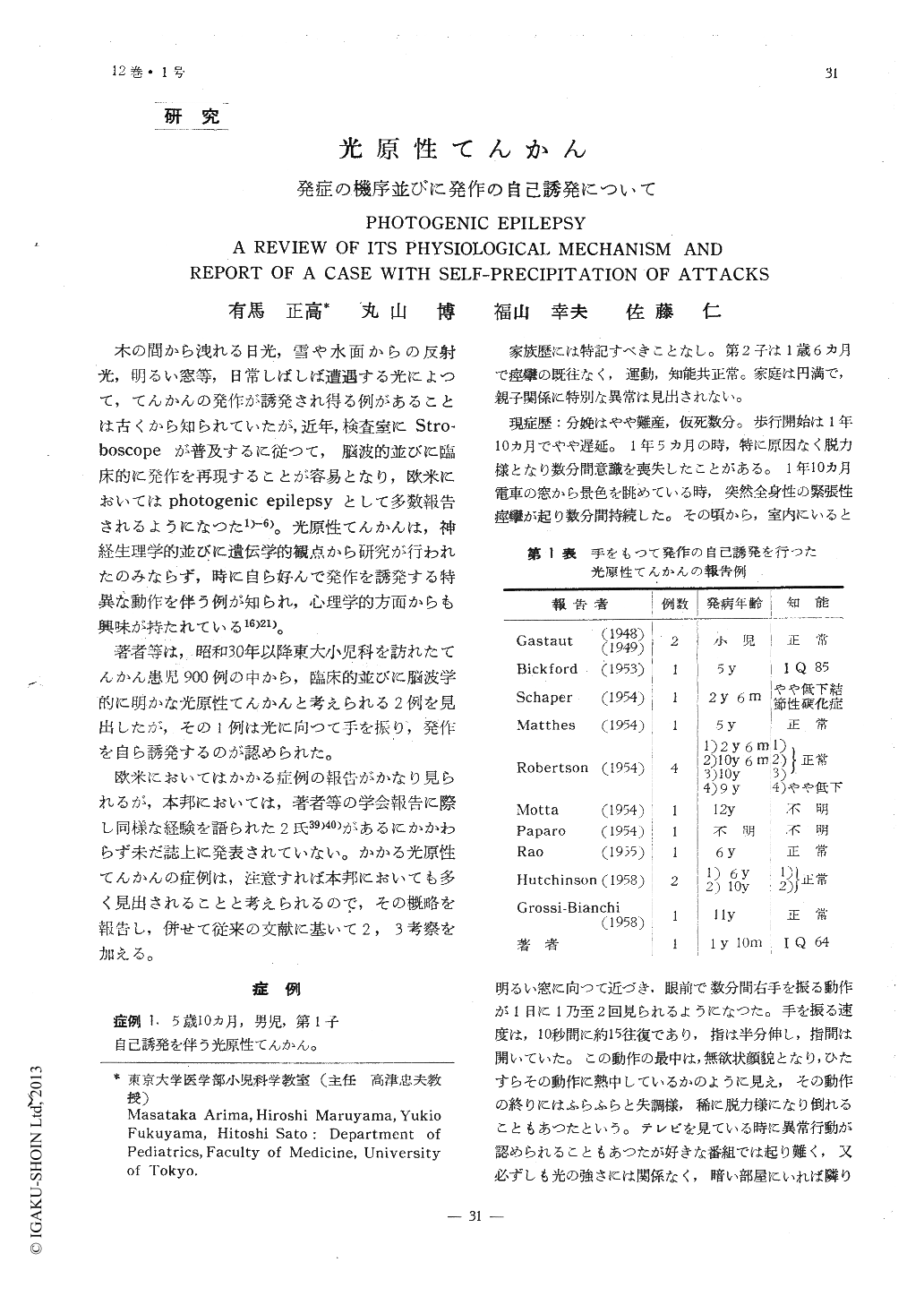
木の間から洩れる日光,雪や水面からの反射光,明るい窓等,日常しばしば遭遇する光によつて,てんかんの発作が誘発され得る例があることは古くから知られていたが,近年,検査室にStro-boscopeが普及するに従つて,脳波的並びに臨床的に発作を再現することが容易となり,欧米においてはphotogenic epilepsyとして多数報告されるようになつた1)−6)。光原性てんかんは,神経生理学的並びに遺伝学的観点から研究が行われたのみならず,時に自ら好んで発作を誘発する特異な動作を伴う例が知られ,心理学的方面からも興味が持たれている16)21)。
著者等は,昭和30年以降東大小児科を訪れたてんかん患児900例の中から,臨床的並びに脳波学的に明かな光原性てんかんと考えられる2例を見出したが,その1例は光に向つて手を振り,発作を自ら誘発するのが認められた。
Two children of photogenic epilepsy were reported. In both cases the attacks were aggravated by exposure of the patients to bright light. One of the patients, a boy of 5 years and 10 months, would turn towards the light and wave his hand before his eyes, continuing this for as long as 5 to 10 minu-tes, and this behavior would precipitate his attacks.
On some occasions, he called his brother's name during the waving of his hand. Some-times, after opening the door of his room in order to face bright light, he waved his hand before his eyes towards the light. Such an episode could be interrupted by speaking sha-rply to him or covering the light. In EEG during sleep, both of them showed sporadi-cal, bilaterally synchronous spikes or spike & wave predominantly in the occipital and parietal regions. By stroboscopic activation, the bursts of bilaterally synchronous spikes and spike & wave activity associated with clinical attacks could be precipitated.
In both patients a seizure discharge would result from a series of rhythmical flashes of the 3 to 50 per second frequency range.
Copyright © 1960, Igaku-Shoin Ltd. All rights reserved.