Japanese
English
- 有料閲覧
PPV購入案内
1,320円 (1,200円+税10%) こちらは、983ページから989ページの文献です。購入には医書.jp本会員登録が必要です。
会員登録完了後に改めて上記「購入サイトへ」を選択してください。
または「購入サイトへ」選択後に「購入ログイン」、「新規会員登録」の順に進んでください。
会員登録について詳しくはをご確認ください。
- Abstract 文献概要
- 1ページ目 Look Inside
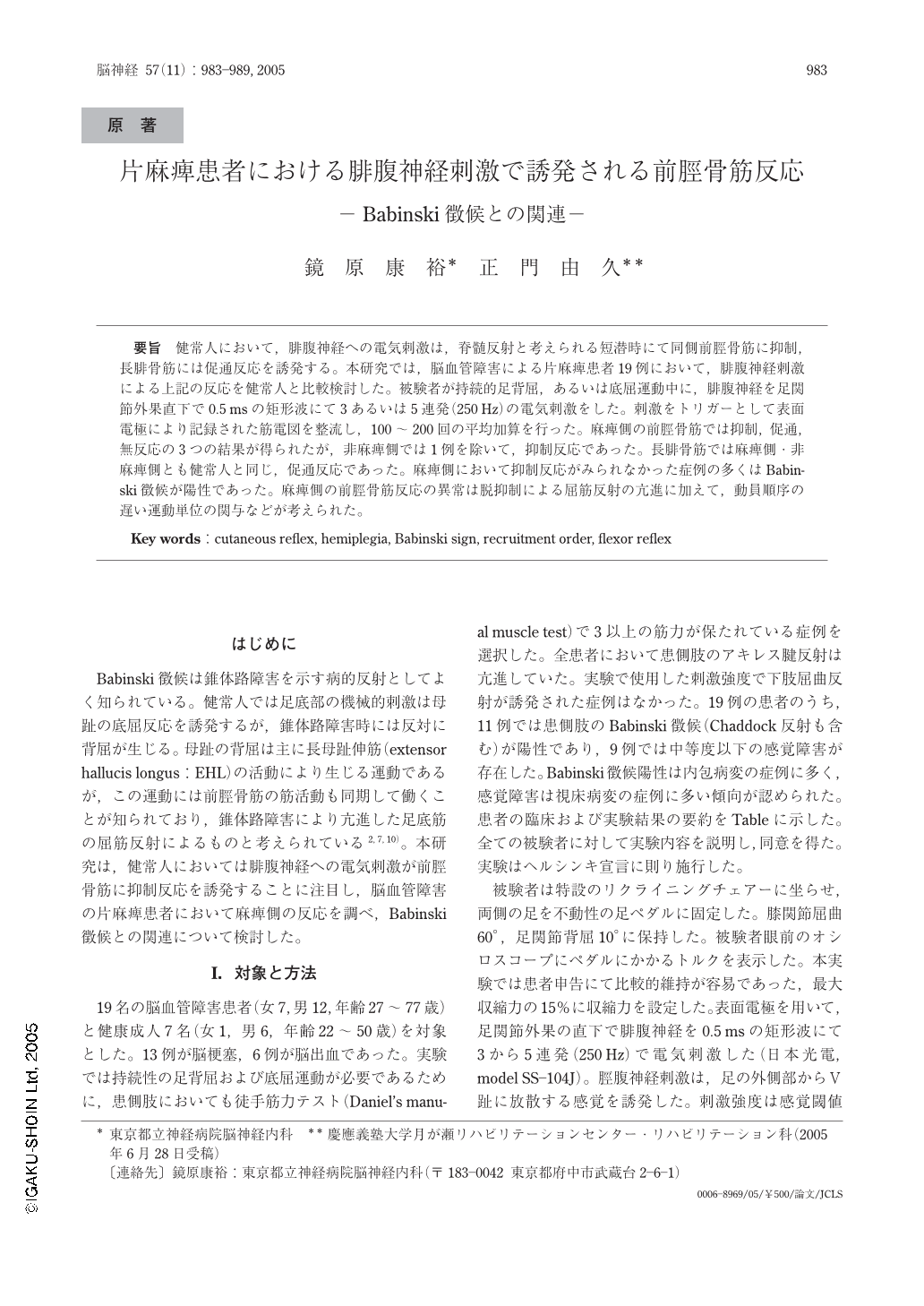
要旨 健常人において,腓腹神経への電気刺激は,脊髄反射と考えられる短潜時にて同側前脛骨筋に抑制,長腓骨筋には促通反応を誘発する。本研究では,脳血管障害による片麻痺患者19例において,腓腹神経刺激による上記の反応を健常人と比較検討した。被験者が持続的足背屈,あるいは底屈運動中に,腓腹神経を足関節外果直下で0.5 msの矩形波にて3あるいは5連発(250 Hz)の電気刺激をした。刺激をトリガーとして表面電極により記録された筋電図を整流し,100~200回の平均加算を行った。麻痺側の前脛骨筋では抑制,促通,無反応の3つの結果が得られたが,非麻痺側では1例を除いて,抑制反応であった。長腓骨筋では麻痺側・非麻痺側とも健常人と同じ,促通反応であった。麻痺側において抑制反応がみられなかった症例の多くはBabinski徴候が陽性であった。麻痺側の前脛骨筋反応の異常は脱抑制による屈筋反射の亢進に加えて,動員順序の遅い運動単位の関与などが考えられた。
Stimulation of the sural nerve of healthy subjects induced short latency inhibition in the ipsilateral tibialis anterior muscle and facilitation in peroneal muscle. We examined lower limb muscle responses after stimulation of the sural nerve in 19 patients with hemiplegia caused by cerebro-vascular disease and compared them with the control responses. The sural nerve was stimulated electrically (3 or 5 square wave pulses of 0.5 ms repeated at 250 Hz) during weak tonic contraction. Stimulation was triggered to average the rectified surface electromyography (EMG) of the test muscle. Usually 100 - 200 sweeps were averaged. After stimulation, the tibialis anterior muscle on the affected side of the hemiplegic patients showed the patterns of inhibition, facilitation, and no response, whereas all responses on the unaffected side, except those of one patient, were inhibition. The peroneal muscle on both sides showed only facilitation as in the controls. Abnormal responses of the tibialis anterior muscle on the affected side were present in many patients who had the Babinski sign. Abnormal responses in the tibialis anterior muscle of the affected side may have been due to contributions by disinhibition of the flexor reflex, late-recruited motor units or both.
(Received : June 28, 2005)
Copyright © 2005, Igaku-Shoin Ltd. All rights reserved.