Japanese
English
- 有料閲覧
PPV購入案内
1,320円 (1,200円+税10%) こちらは、627ページから633ページの文献です。購入には医書.jp本会員登録が必要です。
会員登録完了後に改めて上記「購入サイトへ」を選択してください。
または「購入サイトへ」選択後に「購入ログイン」、「新規会員登録」の順に進んでください。
会員登録について詳しくはをご確認ください。
- Abstract 文献概要
- 1ページ目 Look Inside
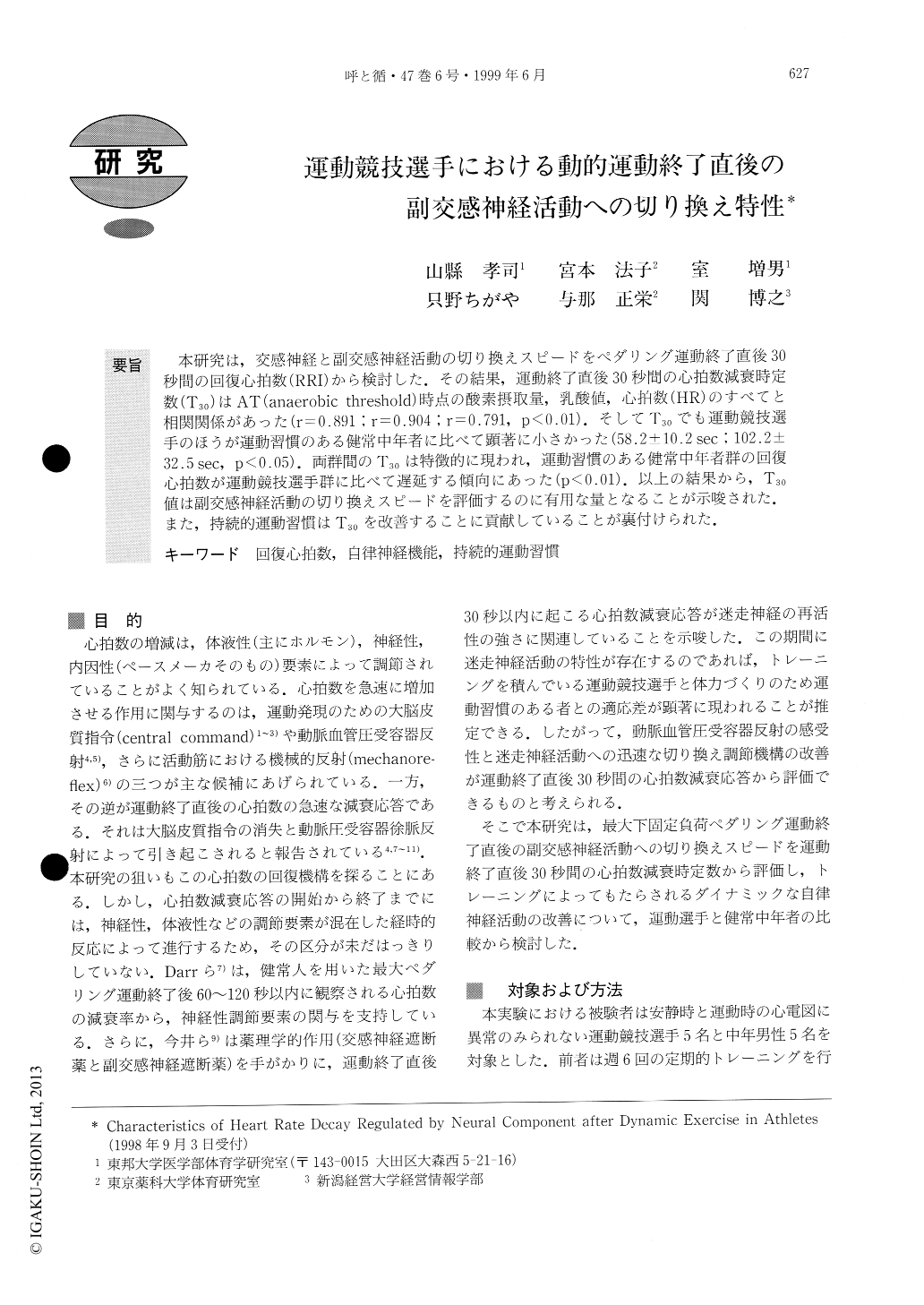
本研究は,交感神経と副交感神経活動の切り換えスピードをペダリング運動終了直後30秒間の回復心拍数(RRI)から検討した.その結果,運動終了直後30秒間の心拍数減衰時定数(T30)はAT(anaerobic threshold)時点の酸素摂取量,乳酸値,心拍数(HR)のすべてと相関関係があった(r=0.891;r=0.904;r=0.791,p<0.01).そしてT30でも運動競技選手のほうが運動習慣のある健常中年者に比べて顕著に小さかった(58.2±10.2sec;102.2±32.5sec,p<0.05).両群間のT30は特徴的に現われ,運動習慣のある健常中年者群の回復心拍数が運動競技選手群に比べて遅延する傾向にあった(p<0.01).以上の結果から,T30値は副交感神経活動の切り換えスピードを評価するのに有用な量となることが示唆された.また,持続的運動習慣はT30を改善することに貢献していることが裏付けられた.
Heart rate (HR) recovery after exercise is not onlydelayed with physical fitness levels but also decay time of HR after exercise becomes prolonged due to lack of habitual exercise. The present study is carried out to assess a vagally mediated HR decay time after pedaling exercise at the anaerobic threshold (AT) level. The time constant (T30) of beat by beat heart rate for 30s were obtained from athletes and recreational subjects. T30 was measured as the recovery to FIR in subjects who rested immediately after pedaling exercise. Subjects were tested while resting for 5 minutes after pedaling exercise at AT level. Overall, T30 was prolongedsignificantly in the recreational group (102.2sec±32.5, p<0.05) more than in the athlete group (58.2sec±10.2, p<0.05), indicating that the time constants is mediated rapidly by switching vagal reactivation from sympathetic nerve activity. These results suggested that the T30 value could be a dominant index of vagal mediated HR damping after exercise.
Copyright © 1999, Igaku-Shoin Ltd. All rights reserved.