Japanese
English
- 有料閲覧
PPV購入案内
1,320円 (1,200円+税10%) こちらは、187ページから191ページの文献です。購入には医書.jp本会員登録が必要です。
会員登録完了後に改めて上記「購入サイトへ」を選択してください。
または「購入サイトへ」選択後に「購入ログイン」、「新規会員登録」の順に進んでください。
会員登録について詳しくはをご確認ください。
- Abstract 文献概要
- 1ページ目 Look Inside
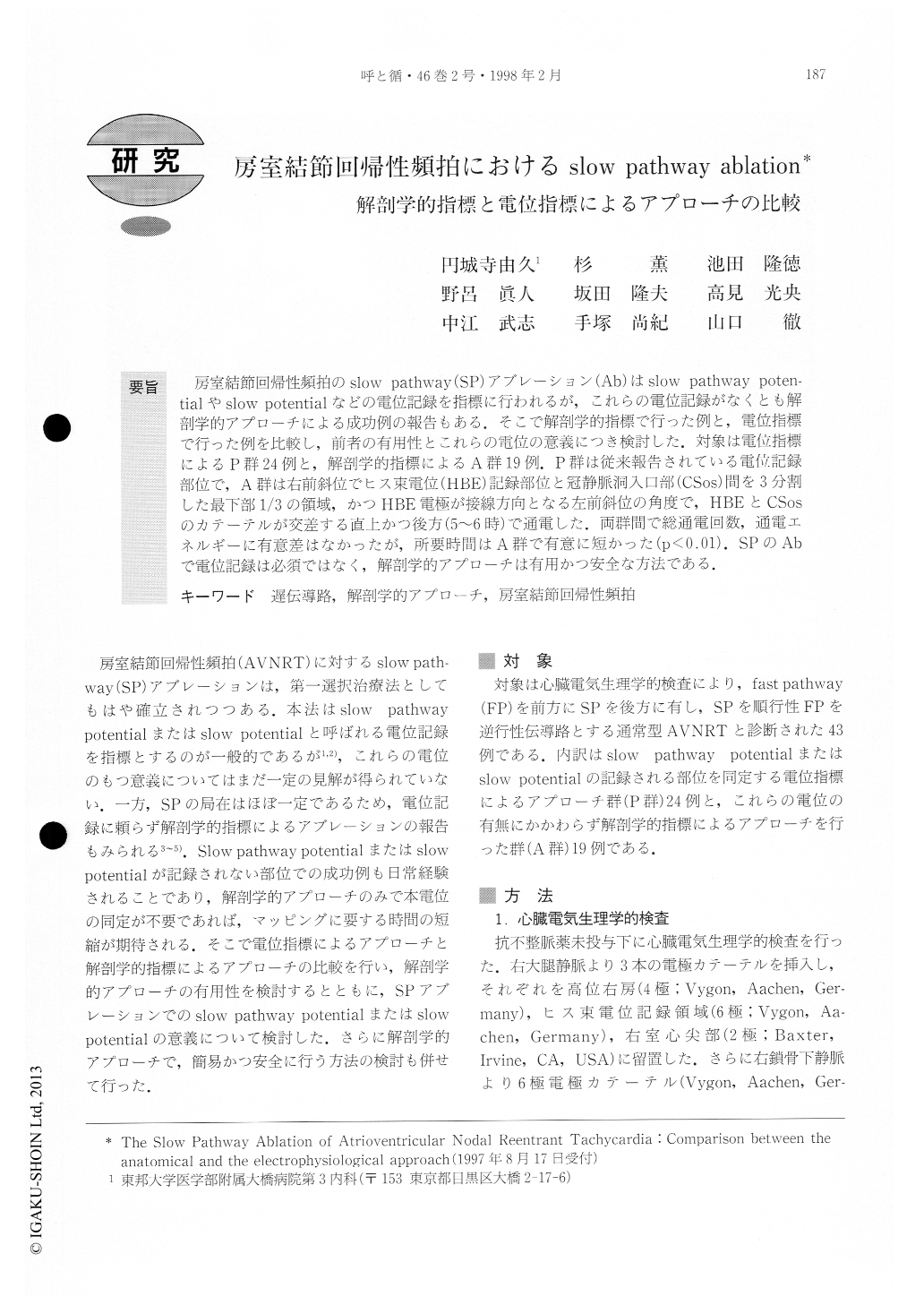
房室結節回帰性頻拍のslow pathway(SP)アブレーション(Ab)はslow pathway poten—tialやslow potentialなどの電位記録を指標に行われるが,これらの電位記録がなくとも解剖学的アプローチによる成功例の報告もある.そこで解剖学的指標で行った例と,電位指標で行った例を比較し,前者の有用性とこれらの電位の意義につき検討した.対象は電位指標によるP群24例と,解剖学的指標によるA群19例.P群は従来報告されている電位記録部位で,A群は右前斜位でヒス束電位(HBE)記録部位と冠静脈洞入口部(CSos)間を3分割した最下部1/3の領域,かつHBE電極が接線方向となる左前斜位の角度で,HBEとCSosのカテーテルが交差する直上かつ後方(5〜6時)で通電した.両群間で総通電回数,通電エネルギーに有意差はなかったが,所要時間はA群で有意に短かった(p<0.01).SPのAbで電位記録は必須ではなく,解剖学的アプローチは有用かつ安全な方法である.
The slow pathway potential or slow potential are useful markers for ablation of the slow pathway in patients with AV nodal reentrant tachycardia (AVNRT). On the other hand, the anatomical approach without detecting these potentials has also been perfor-med because the slow pathway exists near the coronary sinus ostium. We hypothesized that to detect the poten-tial was not always necessary for slow pathway abla-tion. To confirm this hypothesis, we compared both approaches in 33 patients with AVNRT ; the electrical parameters approach as Group P (24 patients) and the anatomical approach as Group A (19 patients). In group A, the ablation catheter was positioned at the lowest one third of the area between the position of the elec-trode catheter recording His bundle potential (HBE) and the orifice of the coronary sinus (CS) at the right anterior oblique view, and just above the CS also posterior to the HBE catheter at the left anterior oblique view where the HBE catheter was seen tan gentially. In both groups the AN ratio was less than 1.0. The group A presented the same success rate as group P, and there was less proce-dure time without complications compared to group P (p<0.01).
Conclusion : The slow pathway potential or slow potential is not always necessary for slow pathway ablation. The anatomical approach without detecting these potentials can be safely and effectively performed, and this approach is recommended when it is difficult of find the electrical parameters or when too much time may be taken for mapping.
Copyright © 1998, Igaku-Shoin Ltd. All rights reserved.