Japanese
English
- 有料閲覧
PPV購入案内
1,320円 (1,200円+税10%) こちらは、1105ページから1109ページの文献です。購入には医書.jp本会員登録が必要です。
会員登録完了後に改めて上記「購入サイトへ」を選択してください。
または「購入サイトへ」選択後に「購入ログイン」、「新規会員登録」の順に進んでください。
会員登録について詳しくはをご確認ください。
- Abstract 文献概要
- 1ページ目 Look Inside
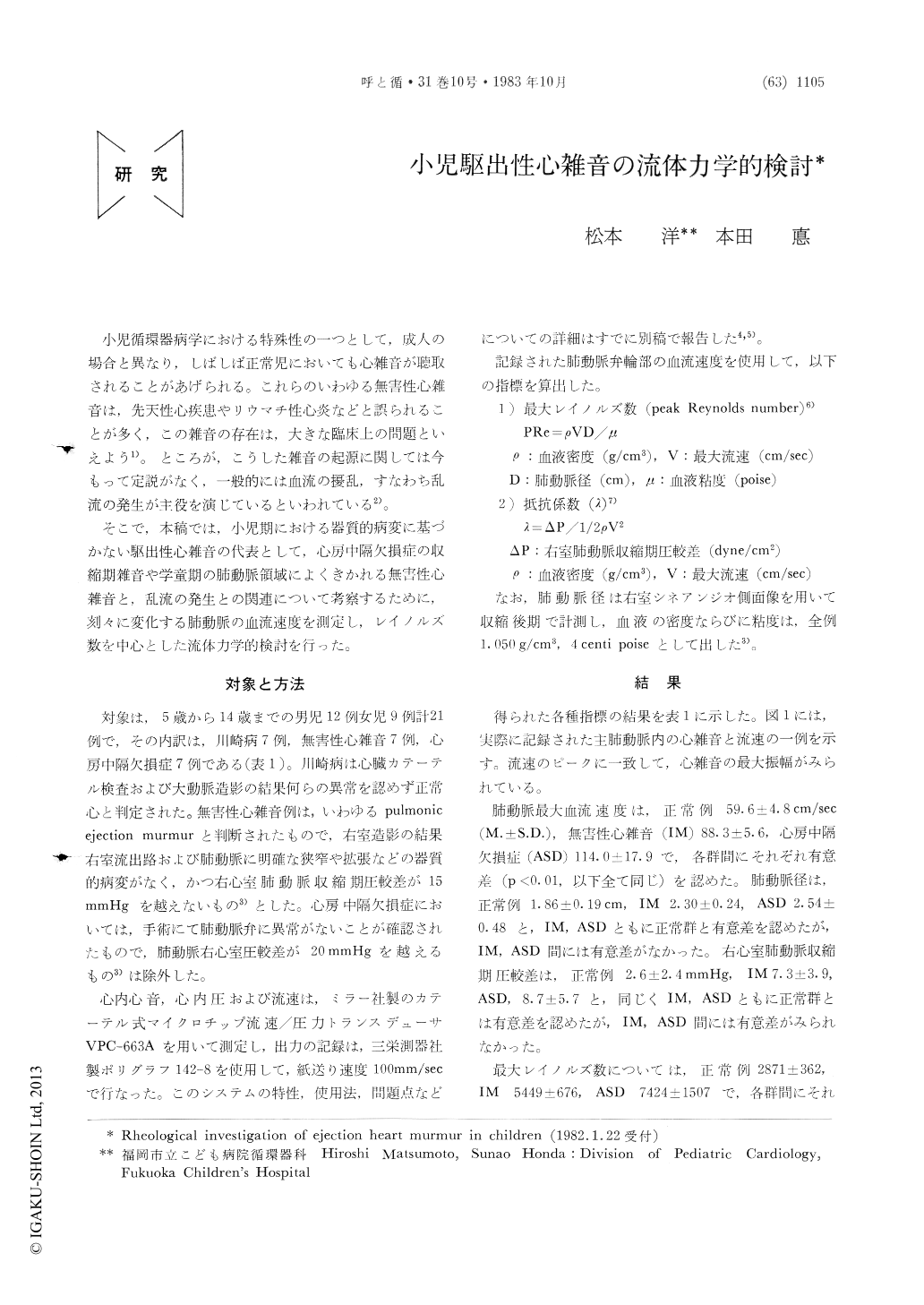
小児循環器病学における特殊性の一つとして,成人の場合と異なり,しばしば正常児においても心雑音が聴取されることがあげられる。これらのいわゆる無害性心雑音は,先天性心疾患やリウマチ性心炎などと誤られることが多く,この雑音の存在は,大きな臨床上の問題といえよう1)。ところが,こうした雑音の起源に関しては今もって定説がなく.一般的には血流の擾乱,すなわち乱流の発生が主役を演じているといわれている2)。
そこで,本稿では,小児期における器質的病変に基づかない駆出性心雑音の代表として,心房中隔欠損症の収縮期雑音や学童期の肺動脈領域によくきかれる無害性心雑音と,乱流の発生との関連について考察するために,刻々に変化する肺動脈の血流速度を測定し,レイノルズ数を中心とした流体力学的検討を行った。
To clarify the postulate that turbulence may produce ejection systolic murmurs in children without organic heart disease, blood flow velocity and sound were measured in the main pulmonary artery of 21 cases: 7 with no heart murmurs, 7 with pulmonic ejection murmurs, and 7 with atrial septal defects.
Velocity was measured with a catheter-tip electromagnetic velocity probe, and sound was measured with a catheter-tip micromanometer. Peak Reynolds number and coefficient of resistance were derived from the pulmonary peak velocity.
Ejection murmurs detected intra-arterially were found to be associated with highly peak Reynolds nuber more than 4000. Conversely, in the absence of intra-arterial sound during ejection, only minor peak Reynolds number were detected. A linear relation between the pulmonary peak velocity and peak Reynolds number was shown (r=0.91) and a linear relation between the pulmonary peak velocity and pressure gradient between the right ventricle and the pulmonary artery (r=0.73) also was shown. But peak Reynolds number were no significantly correlated with coefficient of resistance. The clinical gradation of the intensity of the murmurs increased as peak Reynolds number increased.
In conclusion, in this study we have demonstrated a clear association between peak Reynolds number and systolic ejection murmurs.
Copyright © 1983, Igaku-Shoin Ltd. All rights reserved.