Japanese
English
- 有料閲覧
PPV購入案内
1,320円 (1,200円+税10%) こちらは、863ページから868ページの文献です。購入には医書.jp本会員登録が必要です。
会員登録完了後に改めて上記「購入サイトへ」を選択してください。
または「購入サイトへ」選択後に「購入ログイン」、「新規会員登録」の順に進んでください。
会員登録について詳しくはをご確認ください。
- Abstract 文献概要
- 1ページ目 Look Inside
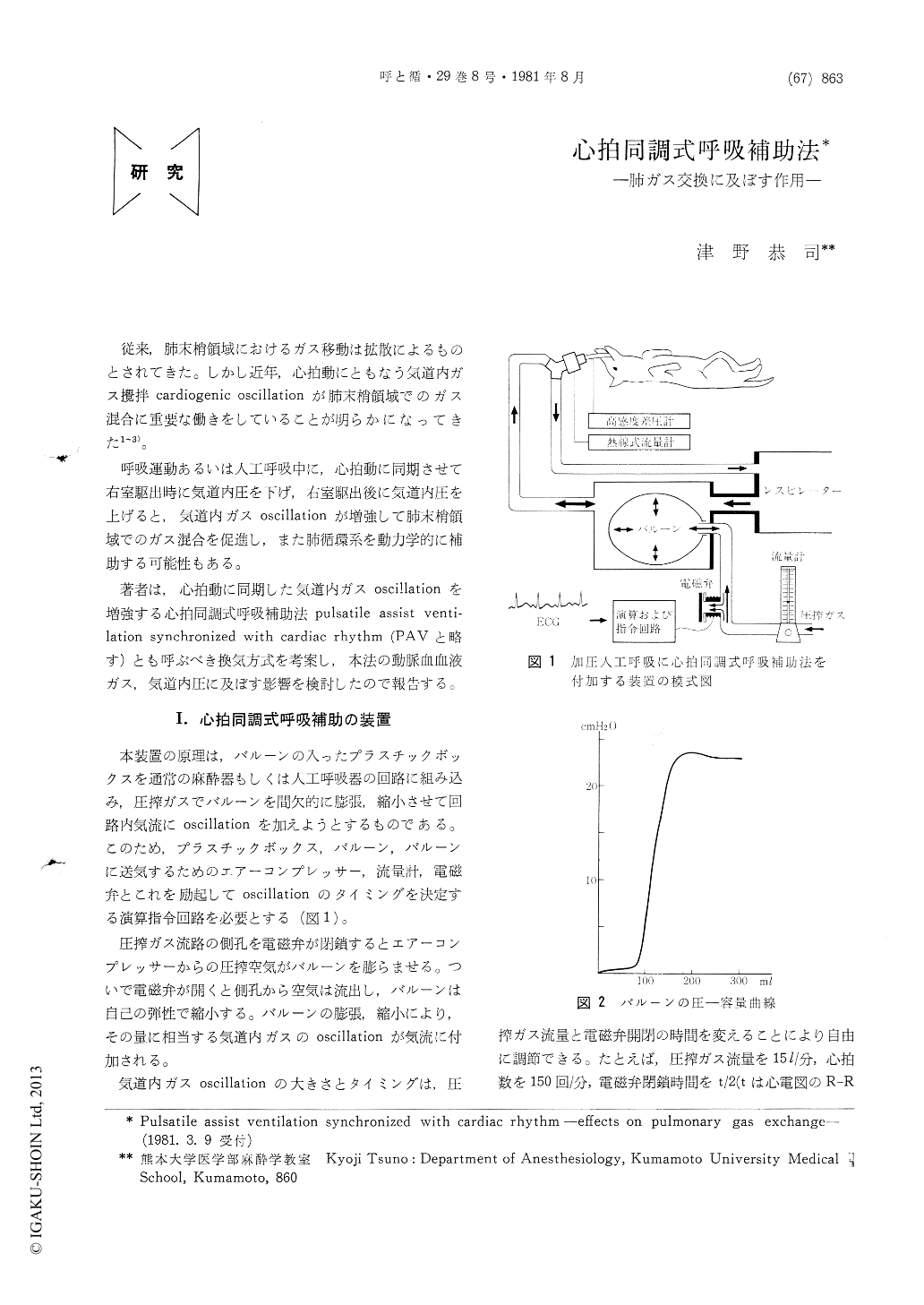
従来,肺末梢領域におけるガス移動は拡散によるものとされてきた。しかし近年,心拍動にともなう気道内ガス撹拌cardiogenic oscillationが肺末梢領域でのガス混合に重要な働きをしていることが明らかになってきた1〜3)。
呼吸運動あるいは人工呼吸中に,心拍動に同期させて右室駆出時に気道内圧を下げ,右室駆出後に気道内圧を上げると,気道内ガスoscillationが増強して肺末梢領域でのガス混合を促進し,また肺循環系を動力学的に補助する可能性もある。
Intratracheal cardiogenic gas oscillation has been known to play a role in gas transport in the lungs. To promote this gas oscillation a new pulsatile assist ventilation synchronized with cardiac rhythm (PAV) was devised. An inflat-able balloon, with a capacity of about 100 ml, is placed in the respiratory circuit of a conventional respirator. The balloon is inflated intermittently by compressed gas using a solenoid valve. The solenoid valve is activated by a simple computer which reads the R-wave of the ECG and emits triggering signals to the solenoid after a preset delay-time for a preset duration. The balloon is inflated during the diastolic phase of the heart and deflated in the systolic phase.
The usual intermittent positive pressure venti-lation (IPPV), and IPPV+PAV were alternatelyrepeated on mongrel dogs at 10 minute intervals. When PAV was added to IPPV, the intratracheal airway pressure and respiratory gas flow were oscillated in harmoney with the sequence of the ECG.
Copyright © 1981, Igaku-Shoin Ltd. All rights reserved.