Japanese
English
- 有料閲覧
PPV購入案内
1,320円 (1,200円+税10%) こちらは、741ページから745ページの文献です。購入には医書.jp本会員登録が必要です。
会員登録完了後に改めて上記「購入サイトへ」を選択してください。
または「購入サイトへ」選択後に「購入ログイン」、「新規会員登録」の順に進んでください。
会員登録について詳しくはをご確認ください。
- Abstract 文献概要
- 1ページ目 Look Inside
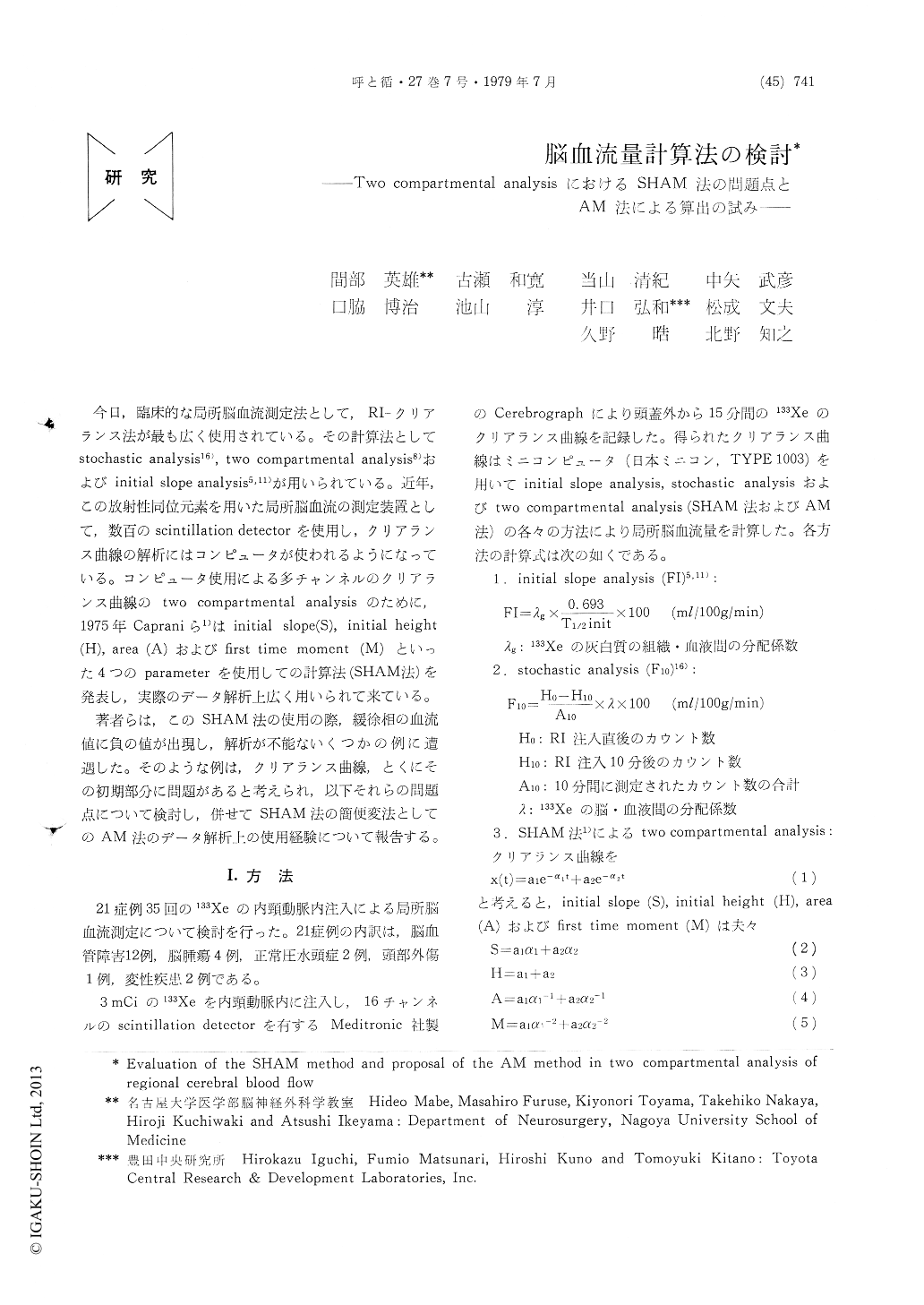
今日,臨床的な局所脳血流測定法として,RI—クリアランス法が最も広く使用されている。その計算法としてstochastic analysis16), two compartmental analysis8)およびinitial slope analysis5,11)が用いられている。近年,この放射性同位元素を用いた局所脳血流の測定装置として,数百のscintillation detectorを使用し,クリアランス曲線の解析にはコンピュータが使われるようになっている。コンピュータ使用による多チャンネルのクリアランス曲線のtwo compartmental analysisのために,1975年Capraniら1)はinitial slope (S), initial height(H),area (A)およびfirst time moment (M)といった4つのparameterを使用しての計算法(SHAM法)を発表し,実際のデータ解析上広く用いられて来ている。
著者らは,このSHAM法の使用の際,緩徐相の血流値に負の値が出現し,解析が不能ないくつかの例に遭遇した。
For calculating rCBF values from 133Xe clearance curves, the SHAM method for two compartmental analysis (Caprani, et al., 1975) was examined in 560 clearance curves in 21 patients with various brain diseases, such as cerebro-vascular disease, brain tumor and hydrocephalus.
In 60 curves of them (10.7%), the SHAM method failed to analyse the clearance curve, showing negative values in FW. In 37 of these cases (6.6%) the SHAM method was unable to calculate rCBF due to abnormal shape of the curves. The remaining 23 clearance curves (4.1 %) had a low counting rate below 1000 counts/ sec. and a blunt initial slope.
Copyright © 1979, Igaku-Shoin Ltd. All rights reserved.