Japanese
English
- 有料閲覧
PPV購入案内
1,320円 (1,200円+税10%) こちらは、1319ページから1326ページの文献です。購入には医書.jp本会員登録が必要です。
会員登録完了後に改めて上記「購入サイトへ」を選択してください。
または「購入サイトへ」選択後に「購入ログイン」、「新規会員登録」の順に進んでください。
会員登録について詳しくはをご確認ください。
- Abstract 文献概要
- 1ページ目 Look Inside
- 参考文献 Reference
- サイト内被引用 Cited by
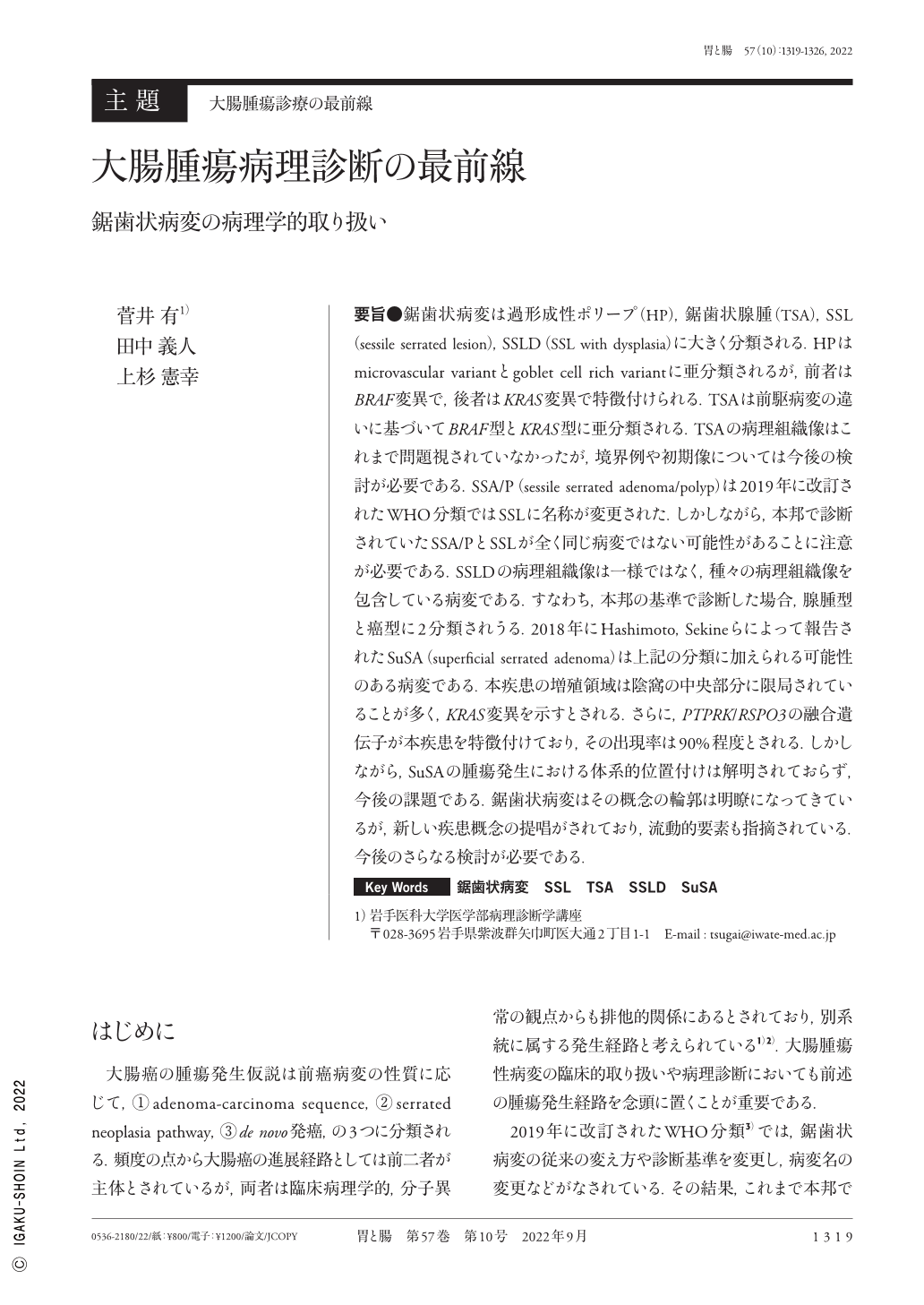
要旨●鋸歯状病変は過形成性ポリープ(HP),鋸歯状腺腫(TSA),SSL(sessile serrated lesion),SSLD(SSL with dysplasia)に大きく分類される.HPはmicrovesicular variantとgoblet cell rich variantに亜分類されるが,前者はBRAF変異で,後者はKRAS変異で特徴付けられる.TSAは前駆病変の違いに基づいてBRAF型とKRAS型に亜分類される.TSAの病理組織像はこれまで問題視されていなかったが,境界例や初期像については今後の検討が必要である.SSA/P(sessile serrated adenoma/polyp)は2019年に改訂されたWHO分類ではSSLに名称が変更された.しかしながら,本邦で診断されていたSSA/PとSSLが全く同じ病変ではない可能性があることに注意が必要である.SSLDの病理組織像は一様ではなく,種々の病理組織像を包含している病変である.すなわち,本邦の基準で診断した場合,腺腫型と癌型に2分類されうる.2018年にHashimoto,Sekineらによって報告されたSuSA(superficial serrated adenoma)は上記の分類に加えられる可能性のある病変である.本疾患の増殖領域は陰窩の中央部分に限局されていることが多く,KRAS変異を示すとされる.さらに,PTPRK/RSPO3の融合遺伝子が本疾患を特徴付けており,その出現率は90%程度とされる.しかしながら,SuSAの腫瘍発生における体系的位置付けは解明されておらず,今後の課題である.鋸歯状病変はその概念の輪郭は明瞭になってきているが,新しい疾患概念の提唱がされており,流動的要素も指摘されている.今後のさらなる検討が必要である.
Serrated lesions are broadly classified into HP(hyperplastic polyps), TSA(traditional serrated adenomas), SSL(sessile serrated lesions), and SSLD(SSL with dysplasia). Furthermore, HP is divided into microvesicular and goblet cell-rich variants. Whereas the former is distinguished by BRAF mutation, the latter is closely related to KRAS mutation. The histopathological picture of TSA has not been considered problematic, but further studies are needed on borderline cases and the initial picture of TSA. Although the criteria of histological diagnosis of SSA/P(sessile serrated adenoma/polyp)were widely used based on the diagnostic criteria of the Japanese Society for Research on Colorectal Cancer, the nomenclature was changed to SSL in the 2019 revision of the WHO classification. It should be noted that previously diagnosed SSA/P in Japan may not be the same as the SSL diagnosed using WHO criteria. However, no specific detailed histological features of SSLD have been identified. Based on Japanese criteria, SSLD can be classified into two subtypes:adenomatous and carcinomatous types. The newly described SuSA(superficial serrated adenoma)by Hashimoto, Sekine et al. may be a lesion that could be added to the traditional classification of serrated lesions. According to their research, the proliferative zone of this disease is often confined to the central portion of the crypts and KRAS mutation is often found in this disease. Furthermore, the PTPRK/RSPO3 adhesion gene characterizes the disease, with an incidence of approximately 90%. However, the systematic status of SuSA in colorectal tumor classification remains unknown. Although the concept of serrated lesions is becoming clearer, new disease concepts are being proposed. Further study will be required.
Copyright © 2022, Igaku-Shoin Ltd. All rights reserved.