Japanese
English
- 有料閲覧
PPV購入案内
1,320円 (1,200円+税10%) こちらは、121ページから128ページの文献です。購入には医書.jp本会員登録が必要です。
会員登録完了後に改めて上記「購入サイトへ」を選択してください。
または「購入サイトへ」選択後に「購入ログイン」、「新規会員登録」の順に進んでください。
会員登録について詳しくはをご確認ください。
- Abstract 文献概要
- 1ページ目 Look Inside
- 参考文献 Reference
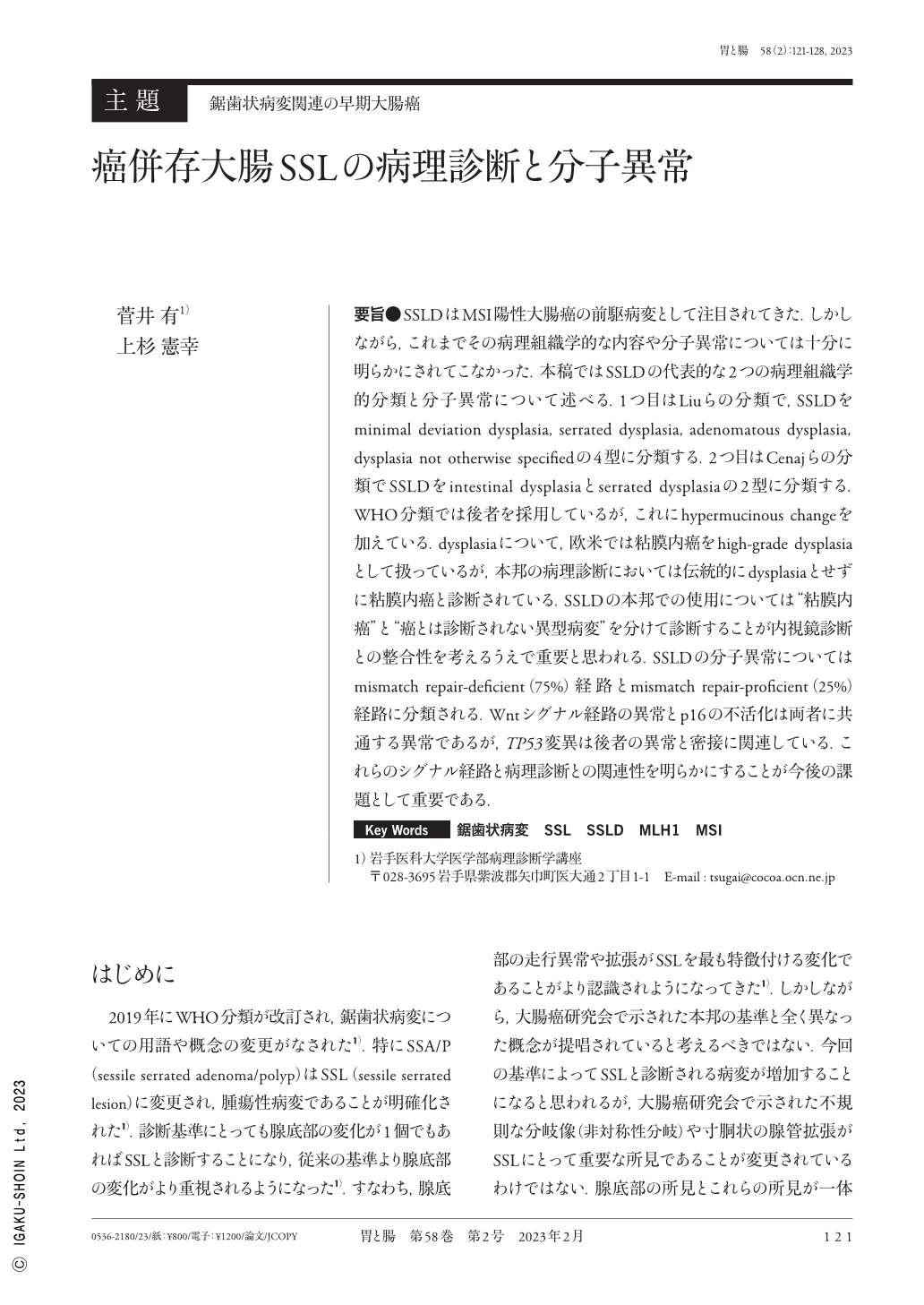
要旨●SSLDはMSI陽性大腸癌の前駆病変として注目されてきた.しかしながら,これまでその病理組織学的な内容や分子異常については十分に明らかにされてこなかった.本稿ではSSLDの代表的な2つの病理組織学的分類と分子異常について述べる.1つ目はLiuらの分類で,SSLDをminimal deviation dysplasia,serrated dysplasia,adenomatous dysplasia,dysplasia not otherwise specifiedの4型に分類する.2つ目はCenajらの分類でSSLDをintestinal dysplasiaとserrated dysplasiaの2型に分類する.WHO分類では後者を採用しているが,これにhypermucinous changeを加えている.dysplasiaについて,欧米では粘膜内癌をhigh-grade dysplasiaとして扱っているが,本邦の病理診断においては伝統的にdysplasiaとせずに粘膜内癌と診断されている.SSLDの本邦での使用については“粘膜内癌”と“癌とは診断されない異型病変”を分けて診断することが内視鏡診断との整合性を考えるうえで重要と思われる.SSLDの分子異常についてはmismatch repair-deficient(75%)経路とmismatch repair-proficient(25%)経路に分類される.Wntシグナル経路の異常とp16の不活化は両者に共通する異常であるが,TP53変異は後者の異常と密接に関連している.これらのシグナル経路と病理診断との関連性を明らかにすることが今後の課題として重要である.
A SSLD(sessile serrated lesion with dysplasia)has been well-known as a precursor lesion of CRC(colorectal carcinoma)with MSI(microsatellite instability)phenotype(MSI positive CRC). Recent studies have suggested several histological classifications of SSLD. Among the classifications, two representative classifications have been proposed as useful classifications. Liu et al. revealed that SSLD can be classified into four histological types, namely, minimal deviation dysplasia, serrated dysplasia, adenomatous dysplasia, and dysplasia not otherwise specified. Conversely, Cenaj et al. reported that SSLD could be classified into intestinal and serrated dysplasia. According to the World Health Organization classification, hypermucinous change is added in addition to Canaj's classification. However, separate classification into carcinoma and noncarcinoma types may be favorable in Japanese pathologists, given that Japanese pathologists can diagnose intramucosal carcinoma. A recent study showed that the mismatch repair status separates these lesions into distinct clinicopathological subgroups although WNT activation and p16 silencing are common to both. However, TP53 mutation is only commonly observed in patients with mismatch repair-procient. Collectively, the malignant progression of SSLs occurs by combining MLH1 and CDKN2A silencing, WNT pathway activation, and TP53 mutation.
Copyright © 2023, Igaku-Shoin Ltd. All rights reserved.