Japanese
English
- 有料閲覧
PPV購入案内
1,320円 (1,200円+税10%) こちらは、927ページから929ページの文献です。購入には医書.jp本会員登録が必要です。
会員登録完了後に改めて上記「購入サイトへ」を選択してください。
または「購入サイトへ」選択後に「購入ログイン」、「新規会員登録」の順に進んでください。
会員登録について詳しくはをご確認ください。
- Abstract 文献概要
- 1ページ目 Look Inside
- 参考文献 Reference
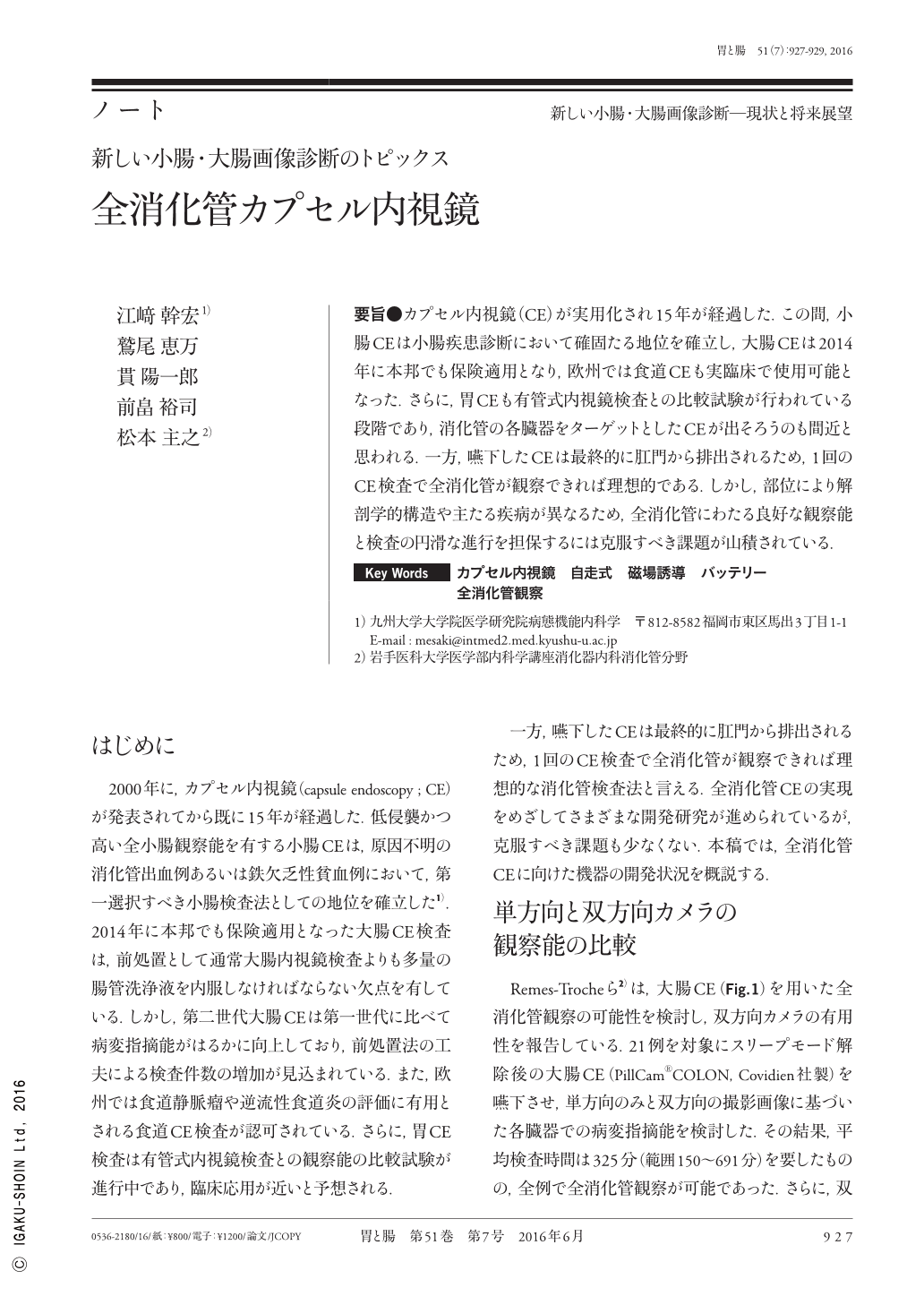
要旨●カプセル内視鏡(CE)が実用化され15年が経過した.この間,小腸CEは小腸疾患診断において確固たる地位を確立し,大腸CEは2014年に本邦でも保険適用となり,欧州では食道CEも実臨床で使用可能となった.さらに,胃CEも有管式内視鏡検査との比較試験が行われている段階であり,消化管の各臓器をターゲットとしたCEが出そろうのも間近と思われる.一方,嚥下したCEは最終的に肛門から排出されるため,1回のCE検査で全消化管が観察できれば理想的である.しかし,部位により解剖学的構造や主たる疾病が異なるため,全消化管にわたる良好な観察能と検査の円滑な進行を担保するには克服すべき課題が山積されている.
Since its introduction to clinical practice 15 years ago, capsule endoscopy has become a crucial diagnostic tool for the investigation of small intestinal pathologies, particularly in patients with obscure gastrointestinal bleeding. It has also been clinically used for the investigation of the esophagus and colorectum. Furthermore, the comparative study between gastric capsule endoscopy and conventional gastroscopy has been ongoing. When considering that a swallowed capsule is eventually excreted from the anus, it seems ideal to investigate the whole gastrointestinal tract by capsule endoscopy in a single session. However, several issues may need to be resolved to assure a favorable diagnostic yield and high completion rate because the characteristics of each segment of the gastrointestinal tract are anatomically different.
Copyright © 2016, Igaku-Shoin Ltd. All rights reserved.