Japanese
English
- 有料閲覧
PPV購入案内
1,320円 (1,200円+税10%) こちらは、951ページから958ページの文献です。購入には医書.jp本会員登録が必要です。
会員登録完了後に改めて上記「購入サイトへ」を選択してください。
または「購入サイトへ」選択後に「購入ログイン」、「新規会員登録」の順に進んでください。
会員登録について詳しくはをご確認ください。
- Abstract 文献概要
- 1ページ目 Look Inside
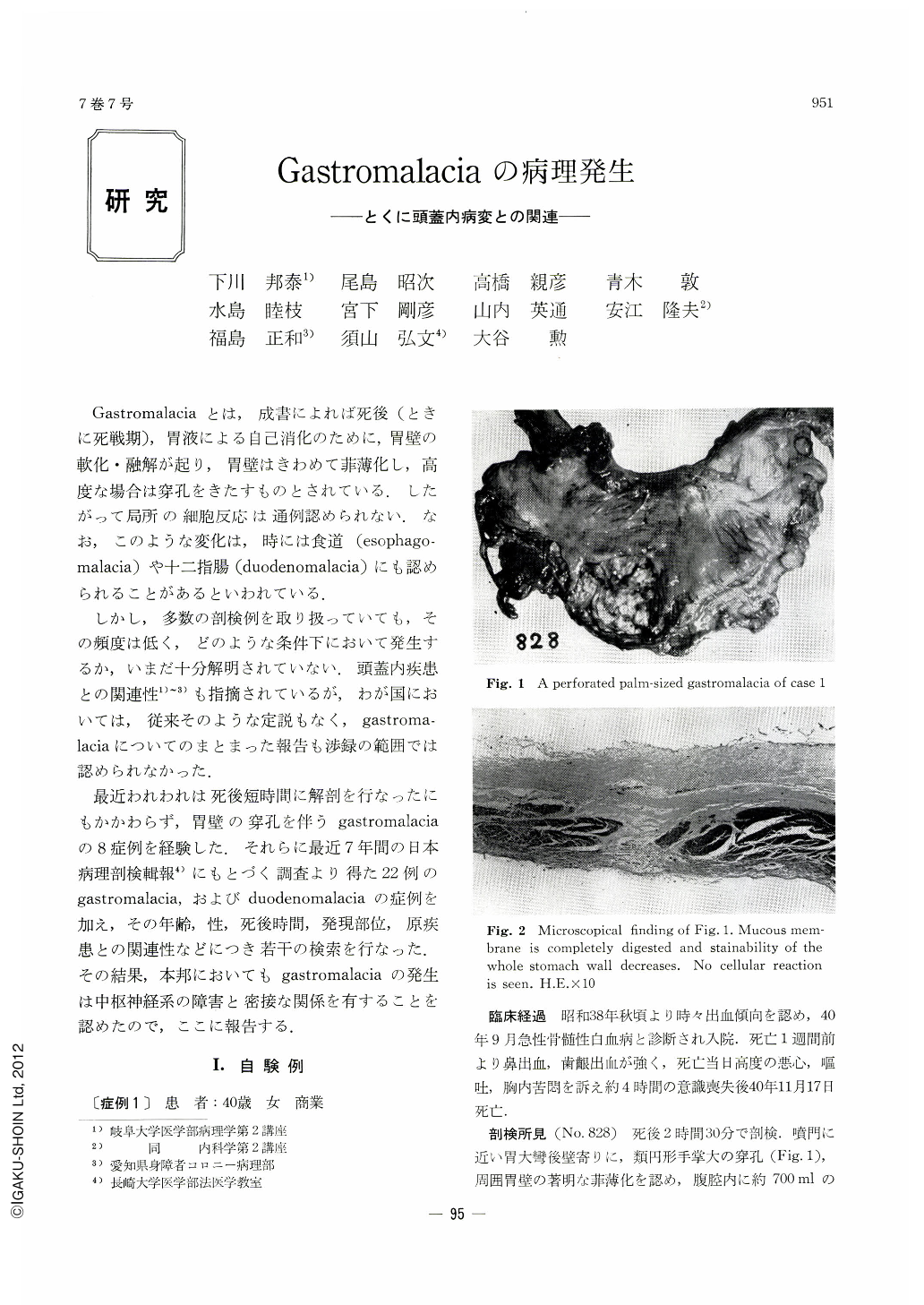
Gastromalaciaとは,成書によれば死後(ときに死戦期),胃液による自己消化のために,胃壁の軟化・融解が起り,胃壁はきわめて菲薄化し,高度な場合は穿孔をきたすものとされている.したがって局所の細胞反応は通例認められない.なお,このような変化は,時には食道(esophagomalacia)や十二指腸(duodenomalacia)にも認められることがあるといわれている.
しかし,多数の剖検例を取り扱っていても,その頻度は低く,どのような条件下において発生するか,いまだ十分解明されていない.頭蓋内疾患との関連性1)~3)も指摘されているが,わが国においては,従来そのような定説もなく,gastromalaciaについてのまとまった報告も渉録の範囲では認められなかった.
Thirty cases of gastromalacia (8 from our autopey series and 22 from those hitherto reported in Japan) have been investigated to clarify its pathogenesis.
Gastromalacia was seen in all ages and men and women were almost equally affected. Two thirds of the cases developed within 6 postmortem hours, the earliest one was found already one hour after death. It also occurred in all seasons. Most frequently the cardia and fundus were involved, and perforation ranged in size from a red bean to as large as the palm of the hand.
Since gastromalacia was found in a fairly fresh corpse with no relation to the summer season, some different mechanism from that of ordinary postmortem changes was suspected. Accordingly, we have investigated the primary diseases that led to death or chief pathological changes at the time of death in order to find out whether or not they were related in causing gastromalacia. Of 25 cases whose craniums were examined, intracranial hemorrhage was seen in 7, brain tumor in 6, intracranial inflammation in 5, kernicterus in 2, status epilepticus in 2, spinal diseases in 2 and sepsis in 1. These results show that intracranial lesions were found in nearly all cases of gastromalacia. The most dominant clinical symptoms before death were vomiting and disturbance of consciousness. Therefore, possible increase of intracranial pressure in those patients was presumed. Accordingly, an assumption was made that gastromalacia can be induced within comparatively shorter postmortem hours unrelated to seasons not only by hypersecretion of gastric juice caused by the stimulation of the hypothalamus with intracranial lesions (increase of aggressive factors for gastric ulcer) but also by lesser amount of mucus coating the gastric mucosa (decrease of defensive factors for gastric ulcer). It is to be emphasized that intracranial lesions can play an important role in the development of gastromalacia.
Copyright © 1972, Igaku-Shoin Ltd. All rights reserved.