Japanese
English
- 有料閲覧
PPV購入案内
1,320円 (1,200円+税10%) こちらは、473ページから478ページの文献です。購入には医書.jp本会員登録が必要です。
会員登録完了後に改めて上記「購入サイトへ」を選択してください。
または「購入サイトへ」選択後に「購入ログイン」、「新規会員登録」の順に進んでください。
会員登録について詳しくはをご確認ください。
- Abstract 文献概要
- 1ページ目 Look Inside
- 参考文献 Reference
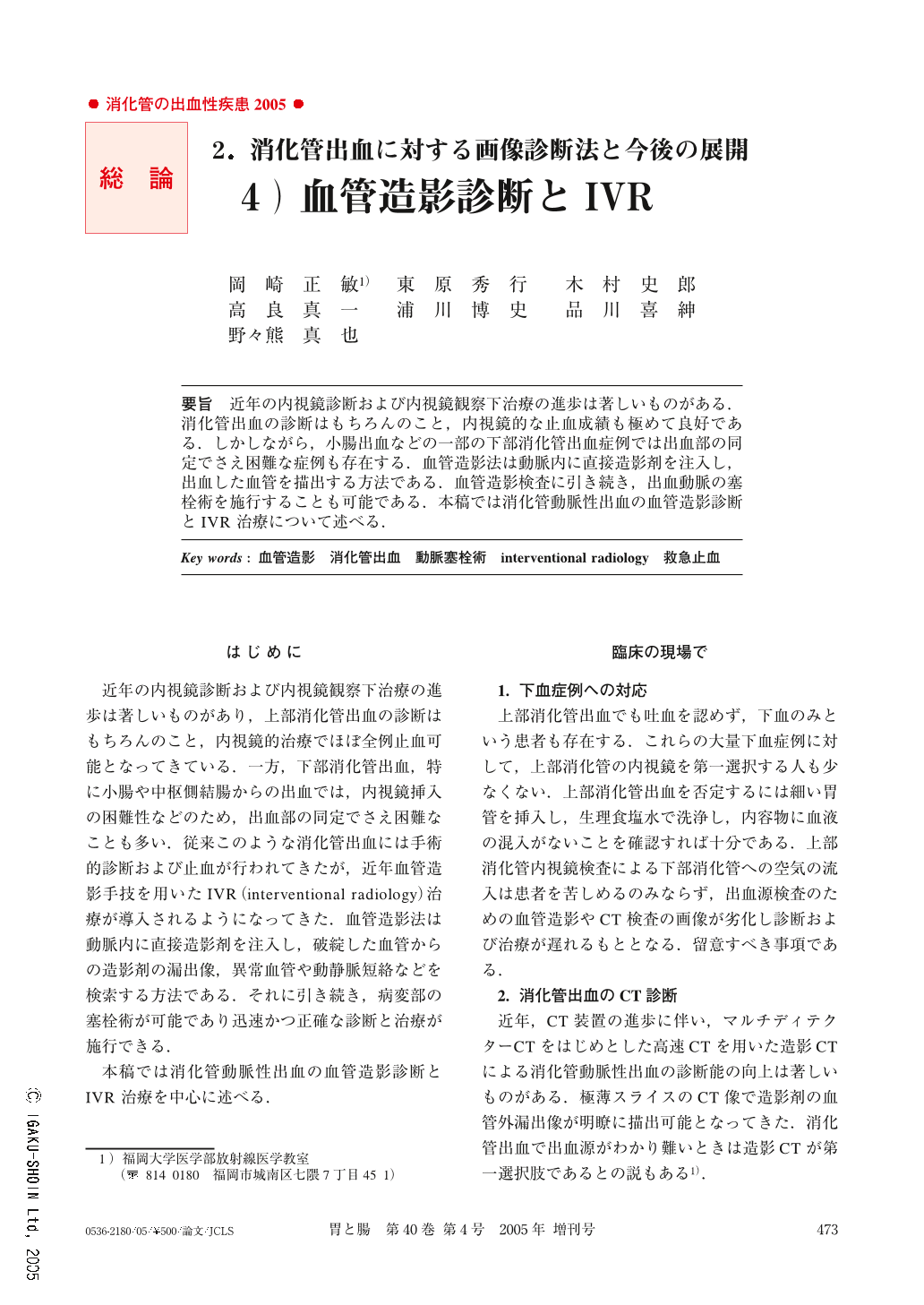
要旨 近年の内視鏡診断および内視鏡観察下治療の進歩は著しいものがある.消化管出血の診断はもちろんのこと,内視鏡的な止血成績も極めて良好である.しかしながら,小腸出血などの一部の下部消化管出血症例では出血部の同定でさえ困難な症例も存在する.血管造影法は動脈内に直接造影剤を注入し,出血した血管を描出する方法である.血管造影検査に引き続き,出血動脈の塞栓術を施行することも可能である.本稿では消化管動脈性出血の血管造影診断とIVR治療について述べる.
With recent advances in endoscopic techniques, the location, cause and state of upper gastrointestinal (GI) hemorrhage and colonic hemorrhage can be accurately determined by endoscopy. However, these factors are often difficult to asses, either clinically or endoscopically in lower GI hemorrhage especially in the small intestine. Emergent embolization, a nonsurgical and therefore less invasive procedure, has been introduced for controlling GI hemorrhage. It can be carried out concomitantly with diagnostic angiography, and in emergency situations, it may be safer than immediate surgery in patients with massive hemorrhage. We report our experience of emergent diagnostic angiography and embolization for the treatment of massive GI hemorrhage.
Copyright © 2005, Igaku-Shoin Ltd. All rights reserved.