Japanese
English
- 有料閲覧
- Abstract 文献概要
- 1ページ目 Look Inside
- 参考文献 Reference
要旨
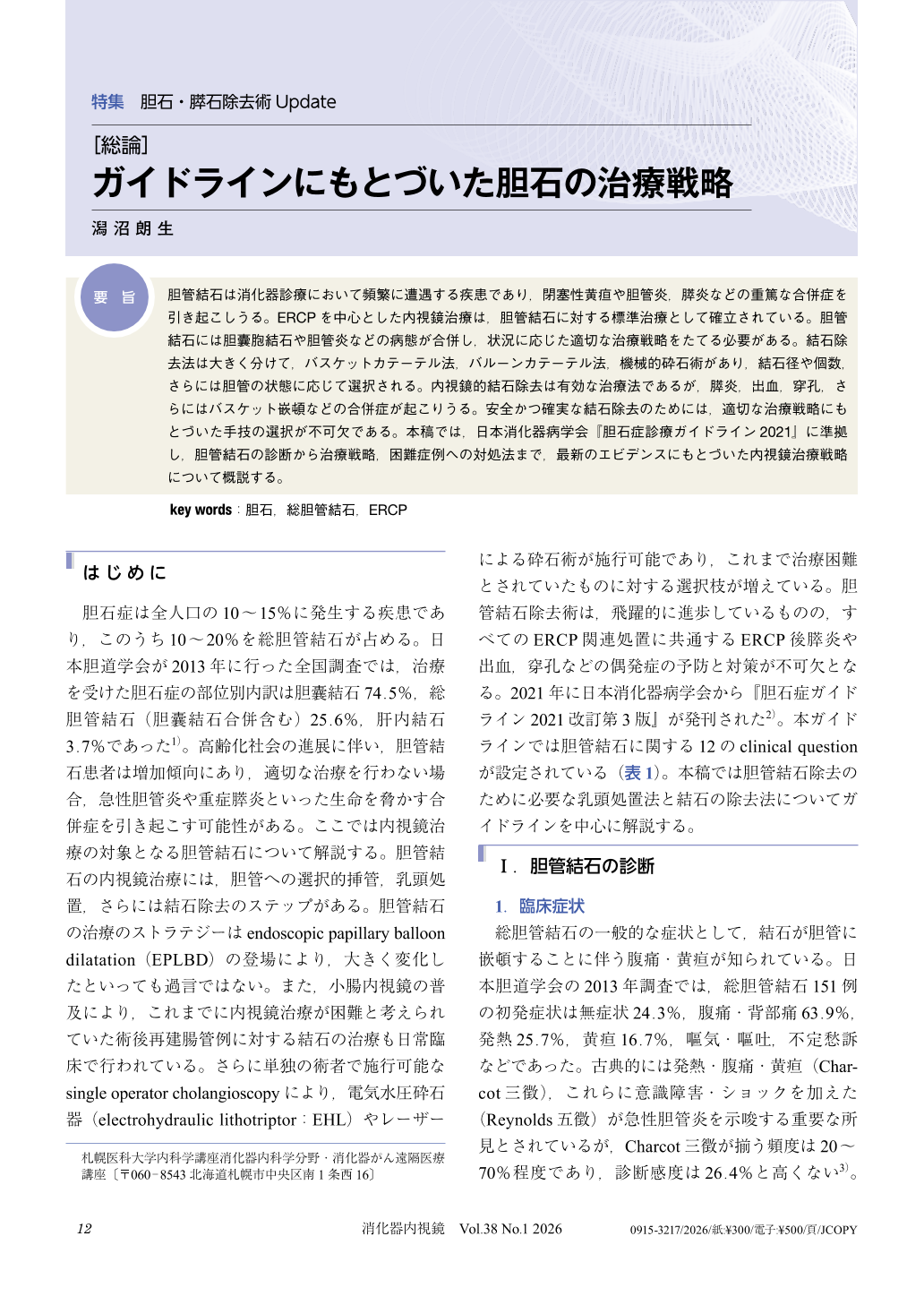
胆管結石は消化器診療において頻繁に遭遇する疾患であり,閉塞性黄疸や胆管炎,膵炎などの重篤な合併症を引き起こしうる。ERCPを中心とした内視鏡治療は,胆管結石に対する標準治療として確立されている。胆管結石には胆囊胞結石や胆管炎などの病態が合併し,状況に応じた適切な治療戦略をたてる必要がある。結石除去法は大きく分けて,バスケットカテーテル法,バルーンカテーテル法,機械的砕石術があり,結石径や個数,さらには胆管の状態に応じて選択される。内視鏡的結石除去は有効な治療法であるが,膵炎,出血,穿孔,さらにはバスケット嵌頓などの合併症が起こりうる。安全かつ確実な結石除去のためには,適切な治療戦略にもとづいた手技の選択が不可欠である。本稿では,日本消化器病学会『胆石症診療ガイドライン2021』に準拠し,胆管結石の診断から治療戦略,困難症例への対処法まで,最新のエビデンスにもとづいた内視鏡治療戦略について概説する。
Bile duct stones are a frequently encountered disease in gastroenterological practice and can cause severe complications such as obstructive jaundice, cholangitis, and pancreatitis. Endoscopic treatment centered on endoscopic retrograde cholangiopancreatography (ERCP) has been established as the standard treatment for bile duct stones. Bile duct stones may be accompanied by conditions such as gallbladder stones and acute cholangitis, requiring appropriate treatment strategies according to the situation. Stone removal methods are broadly classified into basket catheter technique, balloon catheter technique, and mechanical lithotripsy, which are selected according to stone diameter, number, and bile duct conditions. Although endoscopic stone removal is an effective treatment method, complications such as pancreatitis, bleeding, perforation, and basket impaction may occur. For safe and reliable stone removal, selection of techniques based on appropriate treatment strategies is essential. This review, in accordance with the “Clinical Practice Guidelines for Cholelithiasis 2021” by the Japanese Society of Gastroenterology, provides a comprehensive overview of evidence-based endoscopic treatment strategies for bile duct stones, from diagnosis and treatment strategies to management of difficult cases.
© tokyo-igakusha.co.jp. All right reserved.