Japanese
English
- 有料閲覧
- Abstract 文献概要
- 1ページ目 Look Inside
- 参考文献 Reference
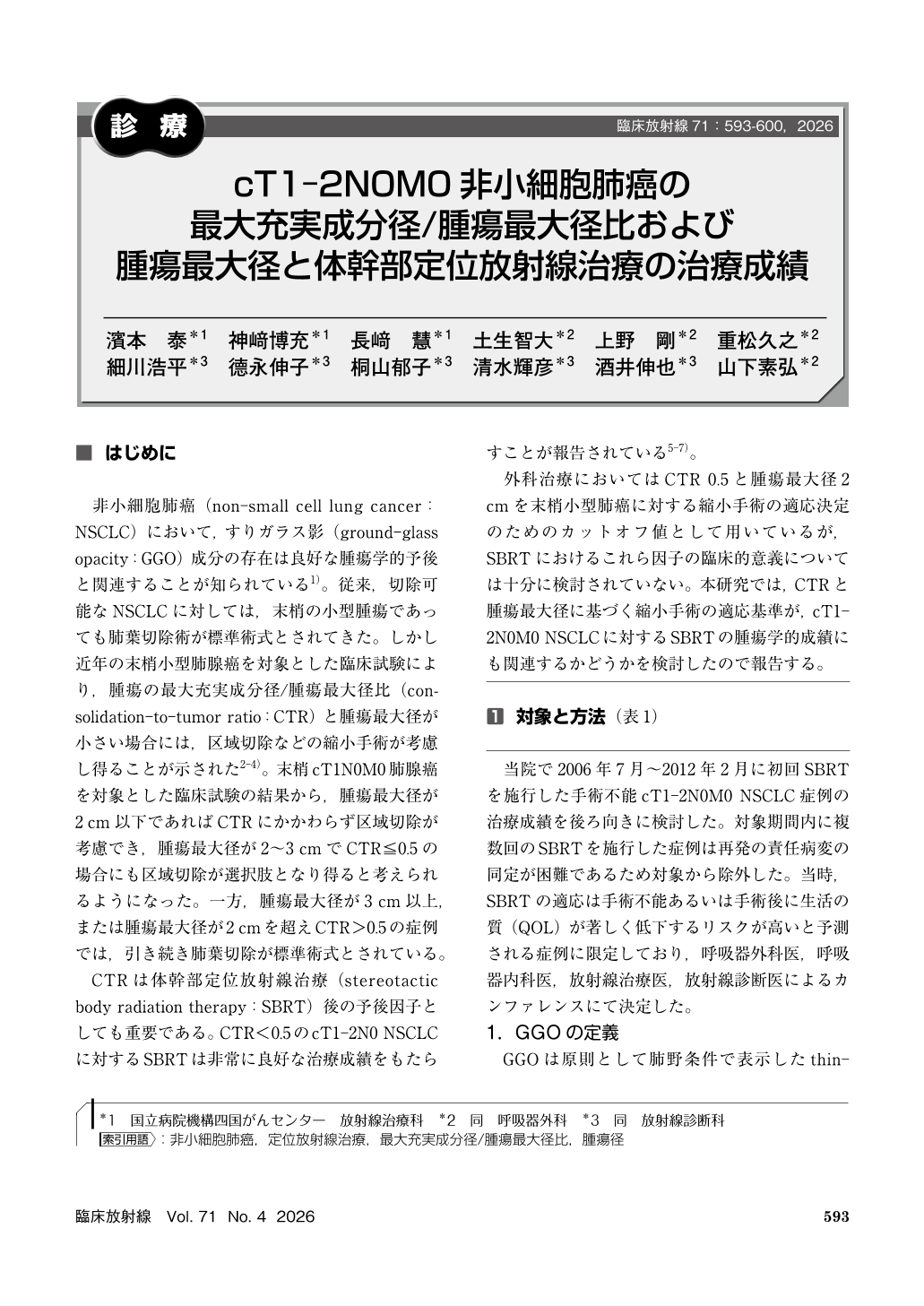
非小細胞肺癌(non-small cell lung cancer:NSCLC)において,すりガラス影(ground-glass opacity:GGO)成分の存在は良好な腫瘍学的予後と関連することが知られている1)。従来,切除可能なNSCLCに対しては,末梢の小型腫瘍であっても肺葉切除術が標準術式とされてきた。しかし近年の末梢小型肺腺癌を対象とした臨床試験により,腫瘍の最大充実成分径/腫瘍最大径比(consolidation-to-tumor ratio:CTR)と腫瘍最大径が小さい場合には,区域切除などの縮小手術が考慮し得ることが示された2-4)。末梢cT1N0M0肺腺癌を対象とした臨床試験の結果から,腫瘍最大径が2cm以下であればCTRにかかわらず区域切除が考慮でき,腫瘍最大径が2~3cmでCTR≦0.5の場合にも区域切除が選択肢となり得ると考えられるようになった。一方,腫瘍最大径が3cm以上,または腫瘍最大径が2cmを超えCTR>0.5の症例では,引き続き肺葉切除が標準術式とされている。
In peripheral cT1N0M0 non-small cell lung cancer(NSCLC), sublobar resection is considered for tumors≤2 cm or 2-3 cm with consolidation-to-tumor ratio(CTR)≤0.5. We examined whether these surgical criteria predict outcomes after stereotactic body radiation therapy(SBRT)for cT1-2N0M0 NSCLC. We retrospectively reviewed 150 patients treated with SBRT(48 Gy/4 fractions). Tumors were grouped by CTR and tumor size. Five-year local, regional, and distant failure-free rates were markedly higher in small-CTR tumors, regardless of tumor size. In SBRT for cT1-2N0M0 NSCLC, 0.5 cutoff of CTR strongly correlated with treatment outcomes, whereas the 2 cm cutoff of tumor size showed small prognostic impact.
Copyright © 2026, KANEHARA SHUPPAN Co.LTD. All rights reserved.