Japanese
English
- 有料閲覧
- Abstract 文献概要
- 1ページ目 Look Inside
- 参考文献 Reference
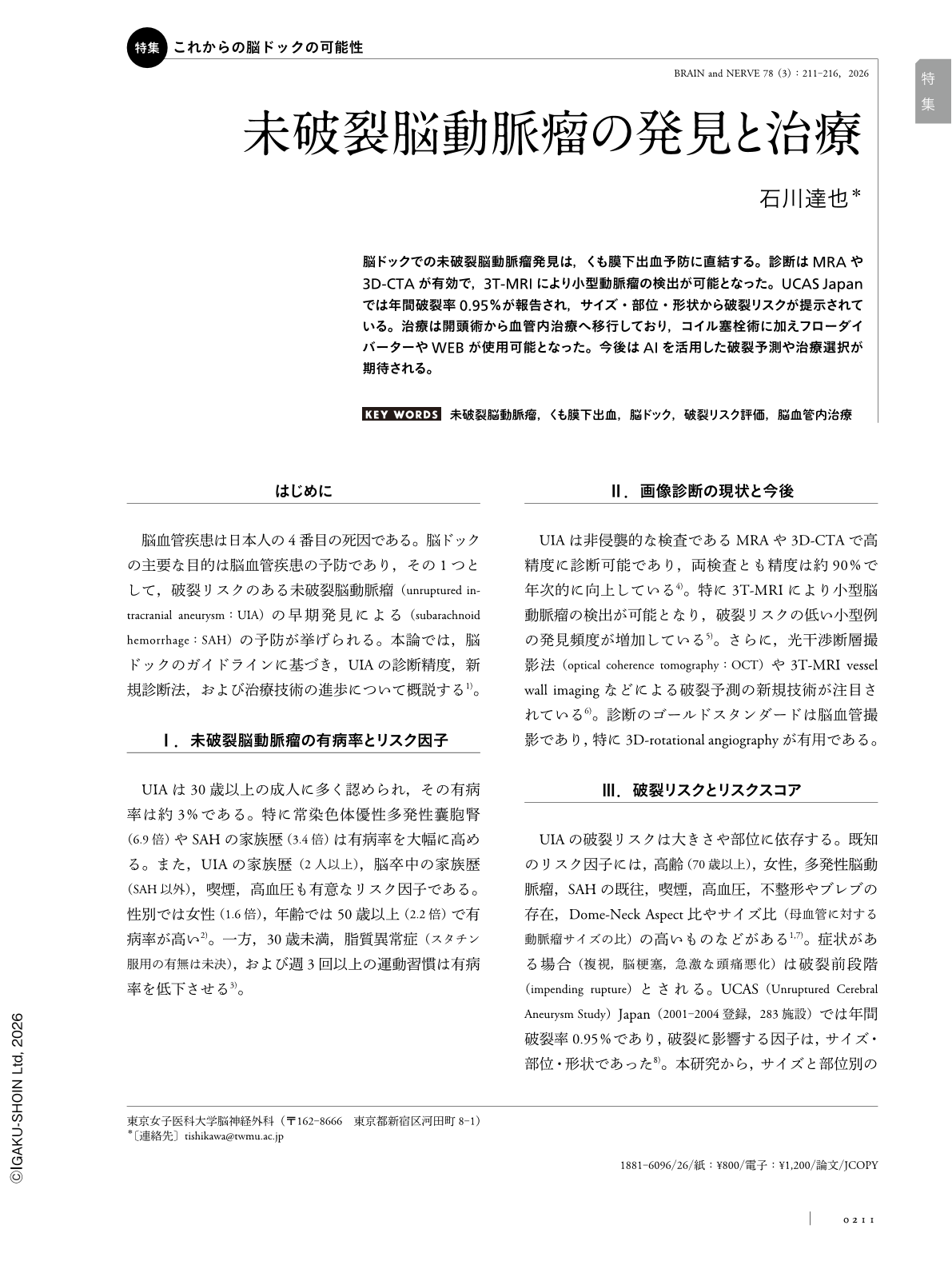
脳ドックでの未破裂脳動脈瘤発見は,くも膜下出血予防に直結する。診断はMRAや3D-CTAが有効で,3T-MRIにより小型動脈瘤の検出が可能となった。UCAS Japanでは年間破裂率0.95%が報告され,サイズ・部位・形状から破裂リスクが提示されている。治療は開頭術から血管内治療へ移行しており,コイル塞栓術に加えフローダイバーターやWEBが使用可能となった。今後はAIを活用した破裂予測や治療選択が期待される。
Abstract
The detection of unruptured intracranial aneurysms (UIAs) through brain health screening is crucial for preventing subarachnoid hemorrhage. Magnetic resonance angiography (MRA) and three-dimensional computed tomographic angiography (3D-CTA) are effective diagnostic tools, and the use of 3T-MRI further enables the identification of small aneurysms. The UCAS Japan study reported an annual rupture rate of 0.95%, with aneurysm size, location, and morphology identified as key predictors of rupture risk. Treatment strategies have increasingly shifted from microsurgical clipping to endovascular therapy. Coil embolization remains a primary method, augmented by flow diverters and Woven EndoBridge (WEB) devices, which have broadened therapeutic options for complex or wide-neck aneurysms. Looking forward, artificial intelligence is expected to enhance rupture risk prediction and support individualized treatment planning. Therefore, brain health screening plays a vital role in identifying high-risk aneurysms and ensuring timely intervention, while avoiding unnecessary procedures in patients with low-risk lesions.
Copyright © 2026, Igaku-Shoin Ltd. All rights reserved.