Japanese
English
- 有料閲覧
PPV購入案内
1,320円 (1,200円+税10%) こちらは、239ページから250ページの文献です。購入には医書.jp本会員登録が必要です。
会員登録完了後に改めて上記「購入サイトへ」を選択してください。
または「購入サイトへ」選択後に「購入ログイン」、「新規会員登録」の順に進んでください。
会員登録について詳しくはをご確認ください。
- Abstract 文献概要
- 1ページ目 Look Inside
- 参考文献 Reference
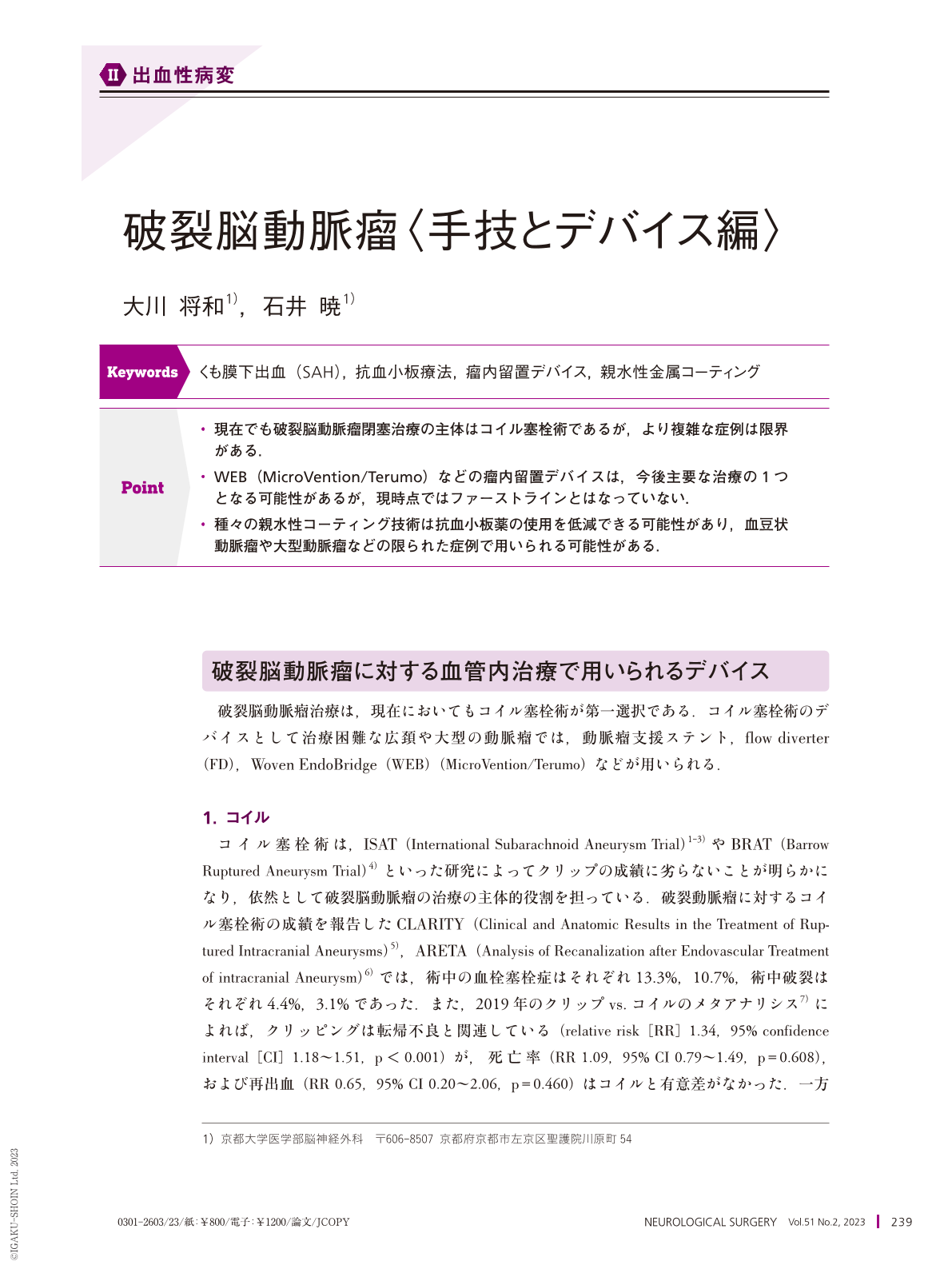
Point
・現在でも破裂脳動脈瘤閉塞治療の主体はコイル塞栓術であるが,より複雑な症例は限界がある.
・WEB(MicroVention/Terumo)などの瘤内留置デバイスは,今後主要な治療の1つとなる可能性があるが,現時点ではファーストラインとはなっていない.
・種々の親水性コーティング技術は抗血小板薬の使用を低減できる可能性があり,血豆状動脈瘤や大型動脈瘤などの限られた症例で用いられる可能性がある.
Coil embolization remains the first-line treatment for ruptured aneurysms. Coil embolization alone has limitations for wide-neck aneurysms. On the other hand, devices implanted in the parent vessel, such as coil-assisted stents and flow diverters, require antiplatelet therapy; therefore, intrasaccular devices are likely to be the mainstay in ruptured cases. Currently, developed intrasaccular embolization devices are limited in size and require large-diameter catheters for guidance. Recently, the Woven EndoBridge device has been reported to work well and may be used in an increasing number of patients in the future. For large/giant aneurysms, staged embolization may improve the curative effect. Various hydrophilic metal coating techniques have been developed that may reduce the use of antiplatelet agents; however, sufficient data for ruptured cases have not been obtained.
Copyright © 2023, Igaku-Shoin Ltd. All rights reserved.