Japanese
English
- 有料閲覧
- Abstract 文献概要
- 1ページ目 Look Inside
- 参考文献 Reference
- サイト内被引用 Cited by
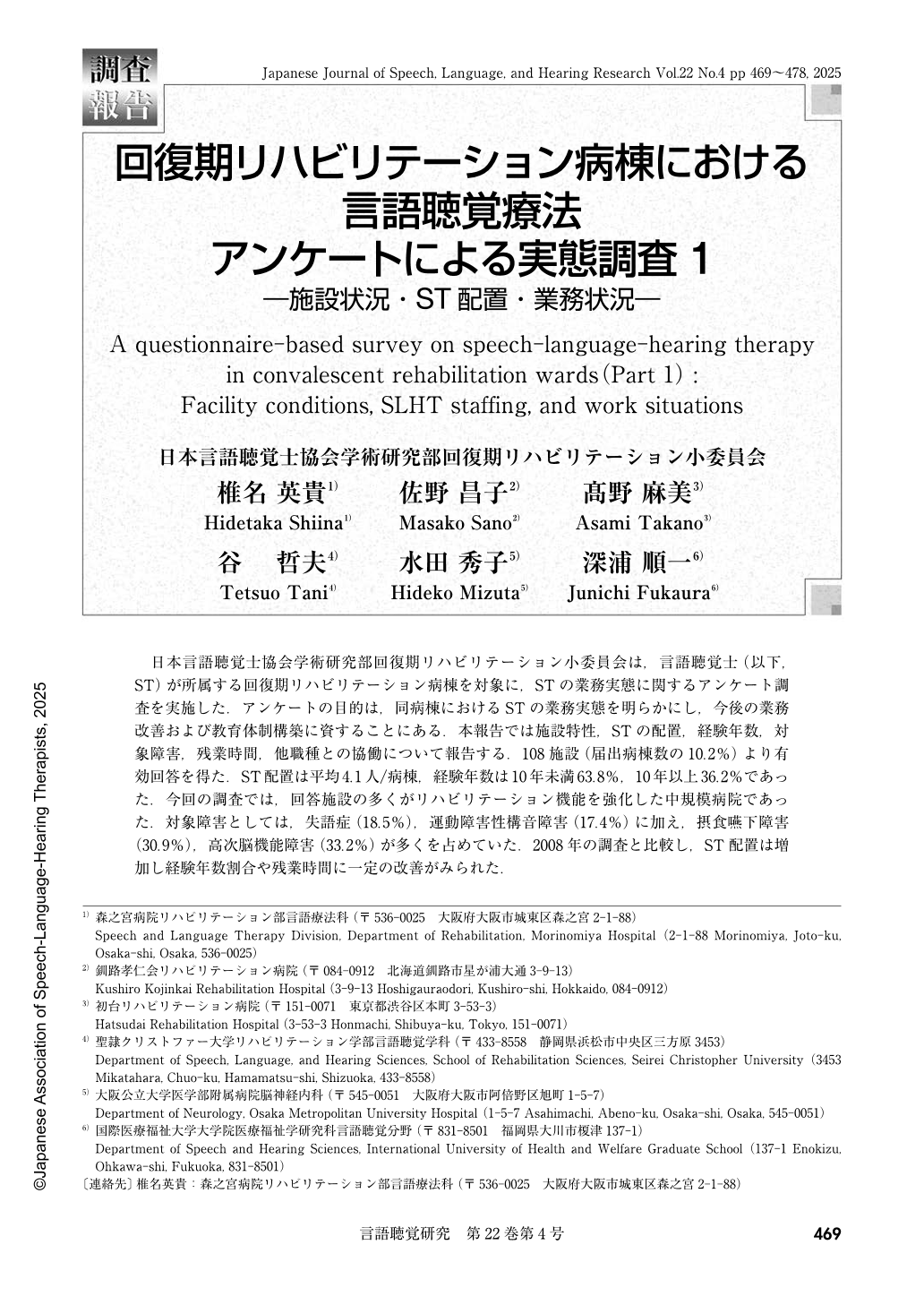
日本言語聴覚士協会学術研究部回復期リハビリテーション小委員会は,言語聴覚士(以下,ST)が所属する回復期リハビリテーション病棟を対象に,STの業務実態に関するアンケート調査を実施した.アンケートの目的は,同病棟におけるSTの業務実態を明らかにし,今後の業務改善および教育体制構築に資することにある.本報告では施設特性,STの配置,経験年数,対象障害,残業時間,他職種との協働について報告する.108施設(届出病棟数の10.2%)より有効回答を得た.ST配置は平均4.1人/病棟,経験年数は10年未満63.8%,10年以上36.2%であった.今回の調査では,回答施設の多くがリハビリテーション機能を強化した中規模病院であった.対象障害としては,失語症(18.5%),運動障害性構音障害(17.4%)に加え,摂食嚥下障害(30.9%),高次脳機能障害(33.2%)が多くを占めていた.2008年の調査と比較し,ST配置は増加し経験年数割合や残業時間に一定の改善がみられた.
The Subcommittee on Convalescent Rehabilitation of the Academic Research Department of the Japanese Association of Speech-Language-Hearing Therapists conducted a survey on the work practices of speech-language-hearing therapists (SLHTs) in convalescent rehabilitation wards. The purpose of the survey was to clarify the actual work conditions of SLHTs in these wards and to contribute to future work improvements and the establishment of an educational system. This report presents findings on facility characteristics, SLHT staffing, years of experience, target disorders, overtime hours, and collaboration with other professionals. A total of 108 facilities (10.2% of registered wards) provided valid responses. The average number of SLHTs per ward was 4.1, with 63.8% of the SLHTs having less than 10 years of experience and 36.2% having 10 years or more. The distribution of target disorders was as follows : higher brain dysfunction (33.2%), dysphagia (30.9%), aphasia (18.5%), and motor speech disorders (17.4%) . The survey revealed that many responding facilities were medium-sized hospitals that had strengthened their rehabilitation functions, and that, in addition to aphasia and motor speech disorders, a significant proportion of cases involved higher brain dysfunction. Compared to the 2008 survey, an increase in SLHT staffing was observed, along with some improvements in experience levels and overtime hours.
Copyright © 2025, Japanese Association of Speech-Language-Hearing Therapists. All rights reserved.