Japanese
English
- 有料閲覧
- Abstract 文献概要
- 1ページ目 Look Inside
- 参考文献 Reference
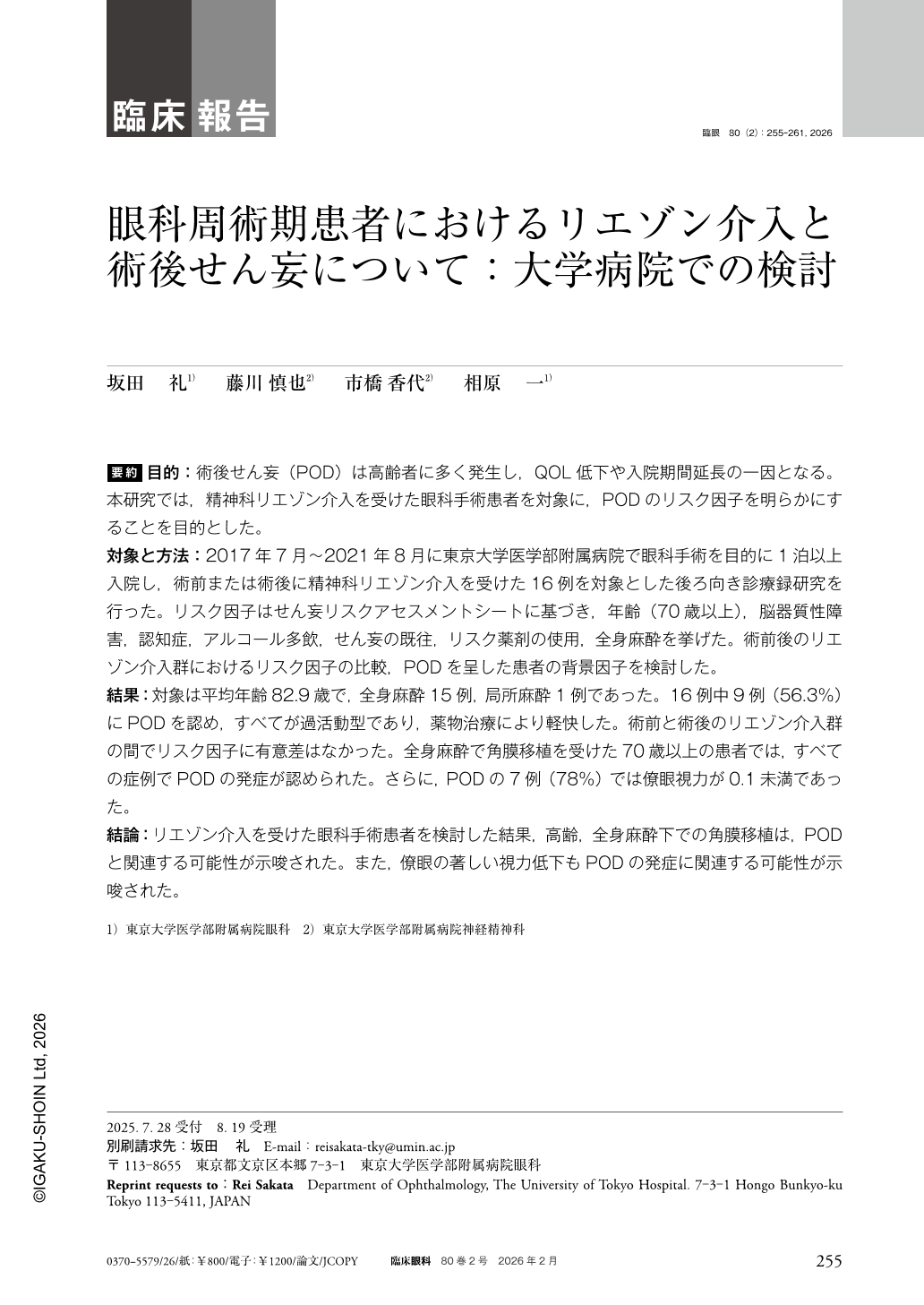
要約 目的:術後せん妄(POD)は高齢者に多く発生し,QOL低下や入院期間延長の一因となる。本研究では,精神科リエゾン介入を受けた眼科手術患者を対象に,PODのリスク因子を明らかにすることを目的とした。
対象と方法:2017年7月〜2021年8月に東京大学医学部附属病院で眼科手術を目的に1泊以上入院し,術前または術後に精神科リエゾン介入を受けた16例を対象とした後ろ向き診療録研究を行った。リスク因子はせん妄リスクアセスメントシートに基づき,年齢(70歳以上),脳器質性障害,認知症,アルコール多飲,せん妄の既往,リスク薬剤の使用,全身麻酔を挙げた。術前後のリエゾン介入群におけるリスク因子の比較,PODを呈した患者の背景因子を検討した。
結果:対象は平均年齢82.9歳で,全身麻酔15例,局所麻酔1例であった。16例中9例(56.3%)にPODを認め,すべてが過活動型であり,薬物治療により軽快した。術前と術後のリエゾン介入群の間でリスク因子に有意差はなかった。全身麻酔で角膜移植を受けた70歳以上の患者では,すべての症例でPODの発症が認められた。さらに,PODの7例(78%)では僚眼視力が0.1未満であった。
結論:リエゾン介入を受けた眼科手術患者を検討した結果,高齢,全身麻酔下での角膜移植は,PODと関連する可能性が示唆された。また,僚眼の著しい視力低下もPODの発症に関連する可能性が示唆された。
Abstract Purpose:Postoperative delirium(POD) frequently occurs in elderly patients and is associated with a decreased quality of life and prolonged hospital stay. This study aimed to identify risk factors for POD in patients who underwent ophthalmic surgery and received psychiatric liaison interventions.
Subjects and Methods:A retrospective medical record review was conducted on 16 patients who were hospitalized for at least one night for ophthalmic surgery at the University of Tokyo Hospital between July 2017 and August 2021, and who received psychiatric liaison interventions either preoperatively or postoperatively. Risk assessment was based on the following factors:age≥70 years, presence of organic brain disease or dementia, history of alcohol abuse or delirium, use of high-risk medications, and administration of general anesthesia. The risk factors between the preoperative and postoperative liaison intervention groups were compared, and the background characteristics of patients who developed POD were analyzed.
Results:The mean age of the 16 patients included in the study was 82.9 years. Of these, 15 patients underwent surgery under general anesthesia, and one underwent surgery under local anesthesia. POD occurred in 9 of 16 patients(56.3%), all of whom presented with hyperactive POD, which improved with pharmacological treatment. No significant differences in the risk factors were observed between the preoperative and postoperative liaison intervention groups. Most POD cases occurred in patients who underwent corneal transplantation, all of whom were aged≧70 years and received general anesthesia. Furthermore, seven of the nine patients who developed POD(78%) had a fellow eye visual acuity of less than 0.1.
Conclusion:In patients who underwent ophthalmic surgery and received psychiatric liaison interventions, advanced age and corneal transplantation under general anesthesia were associated with POD development. Poor visual acuity in the fellow eye may also be a potential risk factor for POD.
Copyright © 2026, Igaku-Shoin Ltd. All rights reserved.