Japanese
English
- 有料閲覧
- Abstract 文献概要
- 1ページ目 Look Inside
- 参考文献 Reference
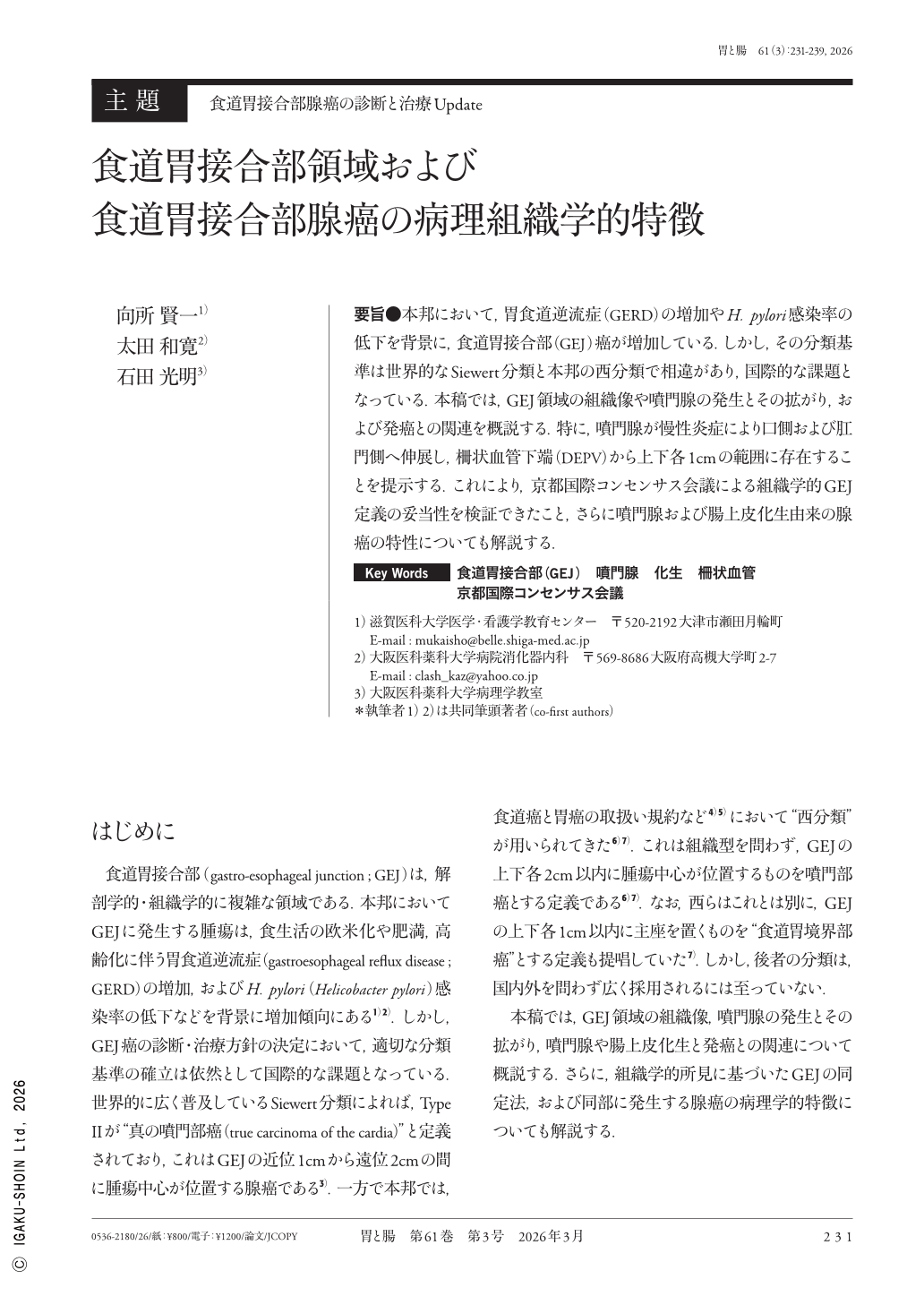
要旨●本邦において,胃食道逆流症(GERD)の増加やH. pylori感染率の低下を背景に,食道胃接合部(GEJ)癌が増加している.しかし,その分類基準は世界的なSiewert分類と本邦の西分類で相違があり,国際的な課題となっている.本稿では,GEJ領域の組織像や噴門腺の発生とその拡がり,および発癌との関連を概説する.特に,噴門腺が慢性炎症により口側および肛門側へ伸展し,柵状血管下端(DEPV)から上下各1cmの範囲に存在することを提示する.これにより,京都国際コンセンサス会議による組織学的GEJ定義の妥当性を検証できたこと,さらに噴門腺および腸上皮化生由来の腺癌の特性についても解説する.
In Japan, the incidence of gastroesophageal junction(GEJ)cancer is increasing against a backdrop of rising gastroesophageal reflux disease and declining H. pylori infection rates. However, classification criteria differ between the globally employed Siewert classification and Japan's Nishi classification, presenting an international challenge. This review outlines the histological features of the GEJ region, the development and spread of cardiac glands, and their association with carcinogenesis. Specifically, it demonstrates that cardiac-type glands exist within 1cm above and below the distal end of the distal end of the palisade vessels, with possible extension distally and proximally due to chronic inflammation. This finding allows us to validate the histological GEJ definition established by the Kyoto International Consensus Conference, and it also explains the features of adenocarcinoma originating from cardia glands and intestinal metaplasia.
Copyright © 2026, Igaku-Shoin Ltd. All rights reserved.