Japanese
English
- 有料閲覧
PPV購入案内
1,320円 (1,200円+税10%) こちらは、663ページから671ページの文献です。購入には医書.jp本会員登録が必要です。
会員登録完了後に改めて上記「購入サイトへ」を選択してください。
または「購入サイトへ」選択後に「購入ログイン」、「新規会員登録」の順に進んでください。
会員登録について詳しくはをご確認ください。
- Abstract 文献概要
- 1ページ目 Look Inside
- 参考文献 Reference
はじめに
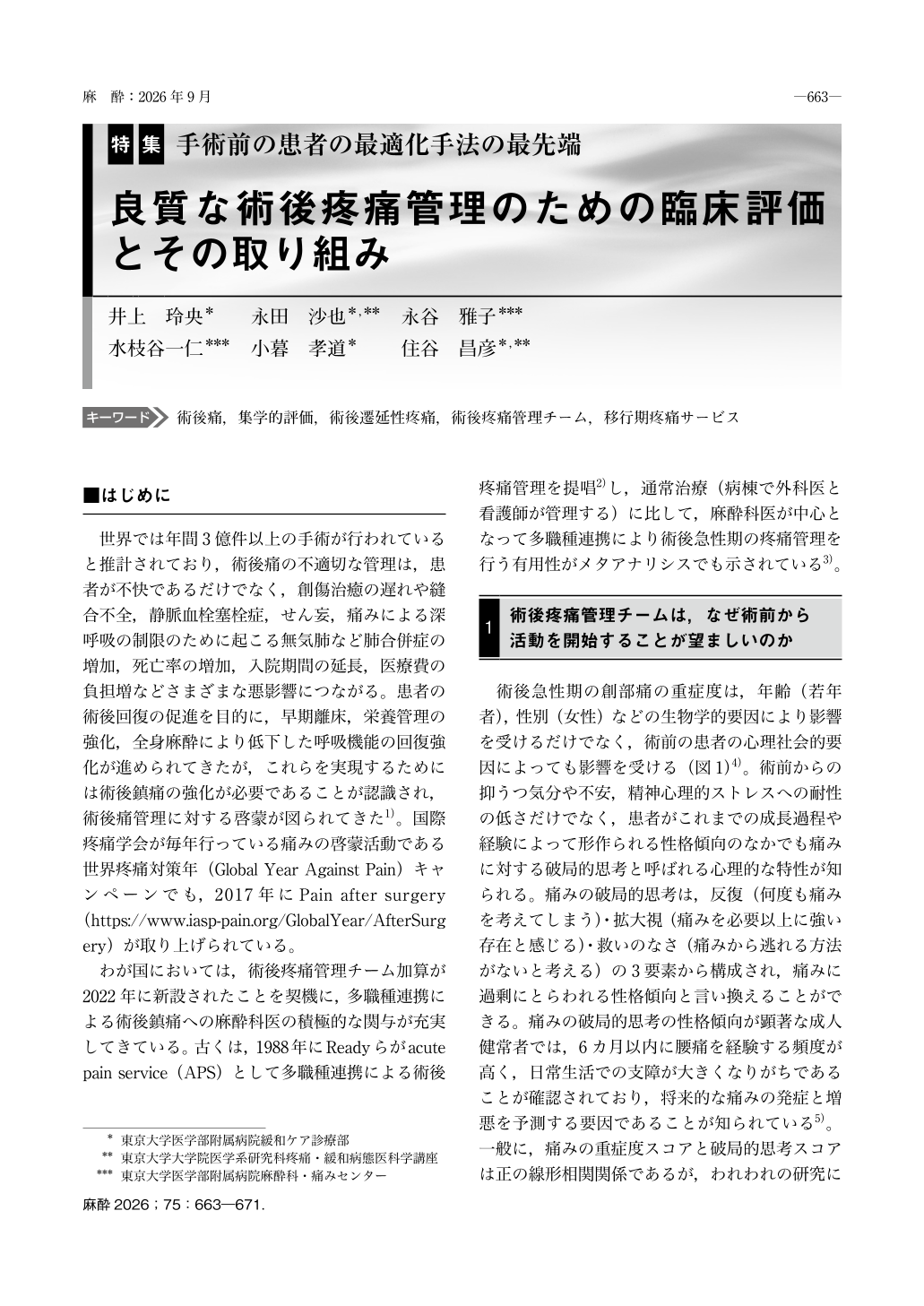
世界では年間3億件以上の手術が行われていると推計されており,術後痛の不適切な管理は,患者が不快であるだけでなく,創傷治癒の遅れや縫合不全,静脈血栓塞栓症,せん妄,痛みによる深呼吸の制限のために起こる無気肺など肺合併症の増加,死亡率の増加,入院期間の延長,医療費の負担増などさまざまな悪影響につながる。患者の術後回復の促進を目的に,早期離床,栄養管理の強化,全身麻酔により低下した呼吸機能の回復強化が進められてきたが,これらを実現するためには術後鎮痛の強化が必要であることが認識され,術後痛管理に対する啓蒙が図られてきた1)。国際疼痛学会が毎年行っている痛みの啓蒙活動である世界疼痛対策年(Global Year Against Pain)キャンペーンでも,2017年にPain after surgery(https://www.iasp-pain.org/GlobalYear/AfterSurgery)が取り上げられている。
わが国においては,術後疼痛管理チーム加算が2022年に新設されたことを契機に,多職種連携による術後鎮痛への麻酔科医の積極的な関与が充実してきている。古くは,1988年にReadyらがacute pain service(APS)として多職種連携による術後疼痛管理を提唱2)し,通常治療(病棟で外科医と看護師が管理する)に比して,麻酔科医が中心となって多職種連携により術後急性期の疼痛管理を行う有用性がメタアナリシスでも示されている3)。
Improving the management of pain has been recognized as an important task in efforts to enhance patients’ postoperative recovery. Acute pain service(APS)has been proposed as a method for achieving improved pain management, and in 2022 Japan’s government initiated the reimbursement of medical fees for APS that is provided within 3 postoperative days. In addition to the improvement of patients’ postoperative recovery with multimodal pain management, the prevention of both postoperative delirium and chronic post-surgical pain is desired. Several predictors that are associated with severe postoperative pain and chronic post-surgery pain are known, including patients’ psychosocial aspects such as pain catastrophizing, depression, anxiety, and poor health literacy. Pre-surgery inter-disciplinary assessments of these predictors in patients who are scheduled to undergo surgery are thus required. An APS should include the planning of multimodal pain management strategies that are optimized for individual patients. In addition, regional anesthesia and peripheral nerve blockade can provide higher-quality postoperative pain management and a lower incidence of postoperative delirium compared to the use of general anesthesia alone. Another recent proposal described transitional pain service, the goal of which is to prevent chronic post-surgical pain and ensure moderate opioid use. Transitional pain service can bridge the gap between APS and the inter-disciplinary pain service that is provided in Japan at~3 months after surgery. Evidence regarding the effectiveness of transitional pain service for achieving quality sub-acute postoperative pain management and appropriate opioid use is beginning to accumulate.
Copyright © 2026 KOKUSEIDO CO., LTD. All Rights Reserved.