Japanese
English
- 有料閲覧
PPV購入案内
1,320円 (1,200円+税10%) こちらは、466ページから476ページの文献です。購入には医書.jp本会員登録が必要です。
会員登録完了後に改めて上記「購入サイトへ」を選択してください。
または「購入サイトへ」選択後に「購入ログイン」、「新規会員登録」の順に進んでください。
会員登録について詳しくはをご確認ください。
- Abstract 文献概要
- 1ページ目 Look Inside
- 参考文献 Reference
はじめに
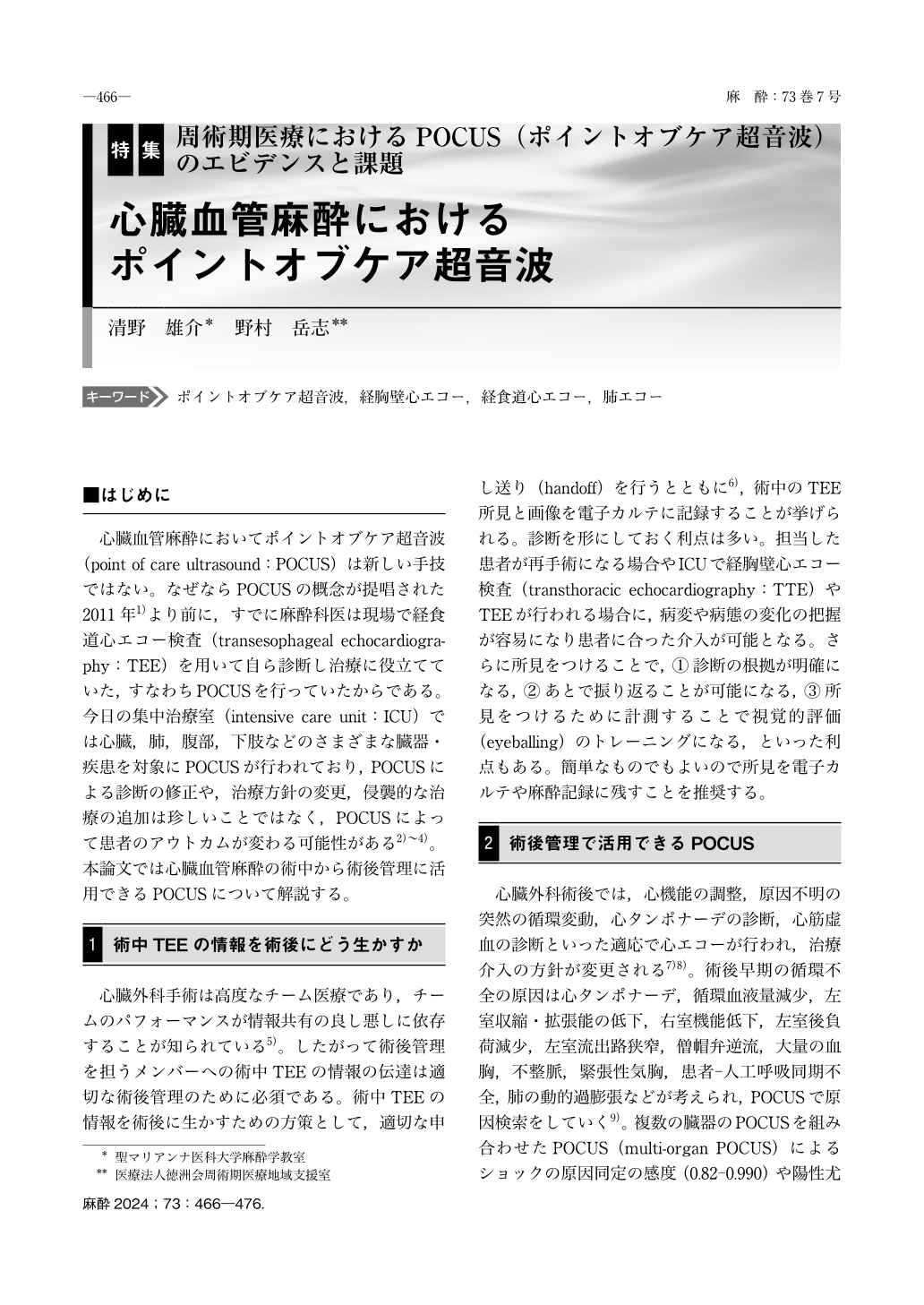
心臓血管麻酔においてポイントオブケア超音波(point of care ultrasound:POCUS)は新しい手技ではない。なぜならPOCUSの概念が提唱された2011年1)より前に,すでに麻酔科医は現場で経食道心エコー検査(transesophageal echocardiography:TEE)を用いて自ら診断し治療に役立てていた,すなわちPOCUSを行っていたからである。今日の集中治療室(intensive care unit:ICU)では心臓,肺,腹部,下肢などのさまざまな臓器・疾患を対象にPOCUSが行われており,POCUSによる診断の修正や,治療方針の変更,侵襲的な治療の追加は珍しいことではなく,POCUSによって患者のアウトカムが変わる可能性がある2)~4)。本論文では心臓血管麻酔の術中から術後管理に活用できるPOCUSについて解説する。
In cardiovascular anesthesia, transesophageal echocardiography(TEE)serves as an intraoperative diagnostic tool, aligning with the point of care ultrasonography(POCUS)method for image acquisition, interpretation, diagnosis, and immediate treatment at patients’ bedside. In modern intensive care units, POCUS is applied across various organs including the heart, lungs, abdomen, and lower extremities. The use of POCUS frequently leads to diagnostic modifications, alterations in treatment plans, and/or the incorporation of invasive interventions. During the perioperative phase of cardiovascular surgery, POCUS primarily aids in hemodynamic adjustments and investigations of the causes of respiratory and circulatory dysfunction. The amalgamation of POCUS assessments across multiple organs enhances the diagnostic accuracy in complex scenarios. Postoperatively, managing cardiovascular surgery benefits from POCUS-based examinations such as transthoracic echocardiography, TEE, lung ultrasound, and venous excess Doppler ultrasound. Additionally, ultrasound-guided vascular access has been confirmed to be valuable in reducing complications, enhancing overall and first-time success rates, and minimizing the cannulation time. Recognizing both the strengths and the weaknesses of POCUS is crucial. Clinicians must comprehend POCUS’s limitations and supplement a POCUS examination with other monitoring and diagnostic modalities to contextualize clinical information and make decisions.
Copyright © 2024 KOKUSEIDO CO., LTD. All Rights Reserved.