Japanese
English
- 有料閲覧
PPV購入案内
1,320円 (1,200円+税10%) こちらは、681ページから687ページの文献です。購入には医書.jp本会員登録が必要です。
会員登録完了後に改めて上記「購入サイトへ」を選択してください。
または「購入サイトへ」選択後に「購入ログイン」、「新規会員登録」の順に進んでください。
会員登録について詳しくはをご確認ください。
- Abstract 文献概要
- 1ページ目 Look Inside
- 参考文献 Reference
要旨
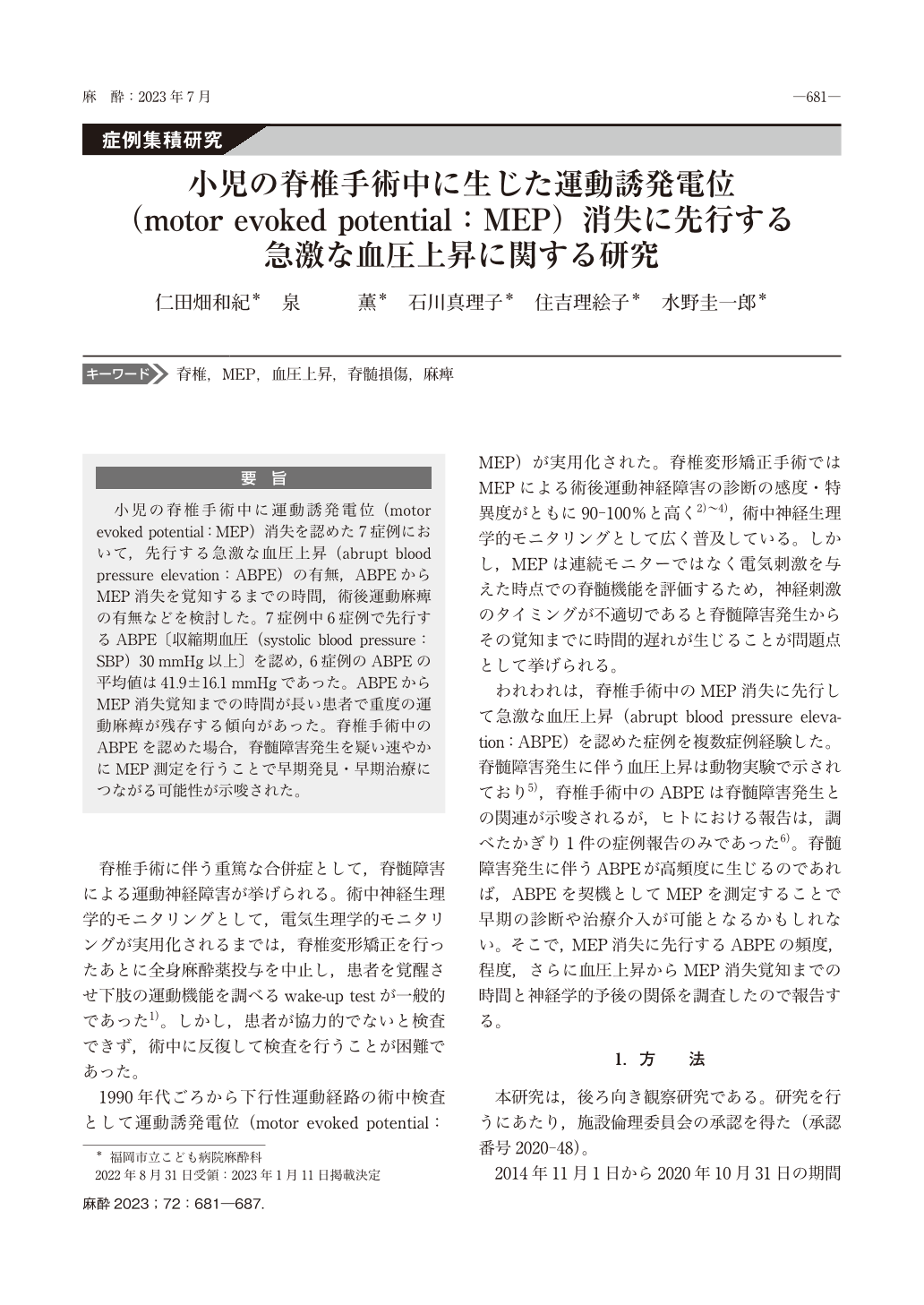
小児の脊椎手術中に運動誘発電位(motor evoked potential:MEP)消失を認めた7症例において,先行する急激な血圧上昇(abrupt blood pressure elevation:ABPE)の有無,ABPEからMEP消失を覚知するまでの時間,術後運動麻痺の有無などを検討した。7症例中6症例で先行するABPE〔収縮期血圧(systolic blood pressure:SBP)30mmHg以上〕を認め,6症例のABPEの平均値は41.9±16.1mmHgであった。ABPEからMEP消失覚知までの時間が長い患者で重度の運動麻痺が残存する傾向があった。脊椎手術中のABPEを認めた場合,脊髄障害発生を疑い速やかにMEP測定を行うことで早期発見・早期治療につながる可能性が示唆された。
We reviewed seven pediatric patients who presented with loss of lower limb motor evoked potentials(MEPs)during spine surgery. We investigated the presence or absence of preceding transient abrupt blood pressure elevation(ABPE)before MEP disappearance, the interval between the ABPE and the recognition of MEP disappearance, and postoperative motor paralysis. Six of seven patients had an ABPE(over 30 mmHg in systole)preceding MEP disappearance, and the average ABPE in the 6 patients was 41.9±16.1 mmHg. Patients with a longer interval between the ABPE and the recognition of MEP disappearance tended to have more severe residual motor paralysis. When an ABPE is observed during spine surgery, it is suggested that prompt MEP measurement with suspision of spinal cord injury may lead to early detection and treatment.
Copyright © 2023 KOKUSEIDO CO., LTD. All Rights Reserved.