Japanese
English
- 有料閲覧
PPV購入案内
1,650円 (1,500円+税10%) こちらは、754ページから760ページの文献です。購入には医書.jp本会員登録が必要です。
会員登録完了後に改めて上記「購入サイトへ」を選択してください。
または「購入サイトへ」選択後に「購入ログイン」、「新規会員登録」の順に進んでください。
会員登録について詳しくはをご確認ください。
- Abstract 文献概要
- 1ページ目 Look Inside
- 参考文献 Reference
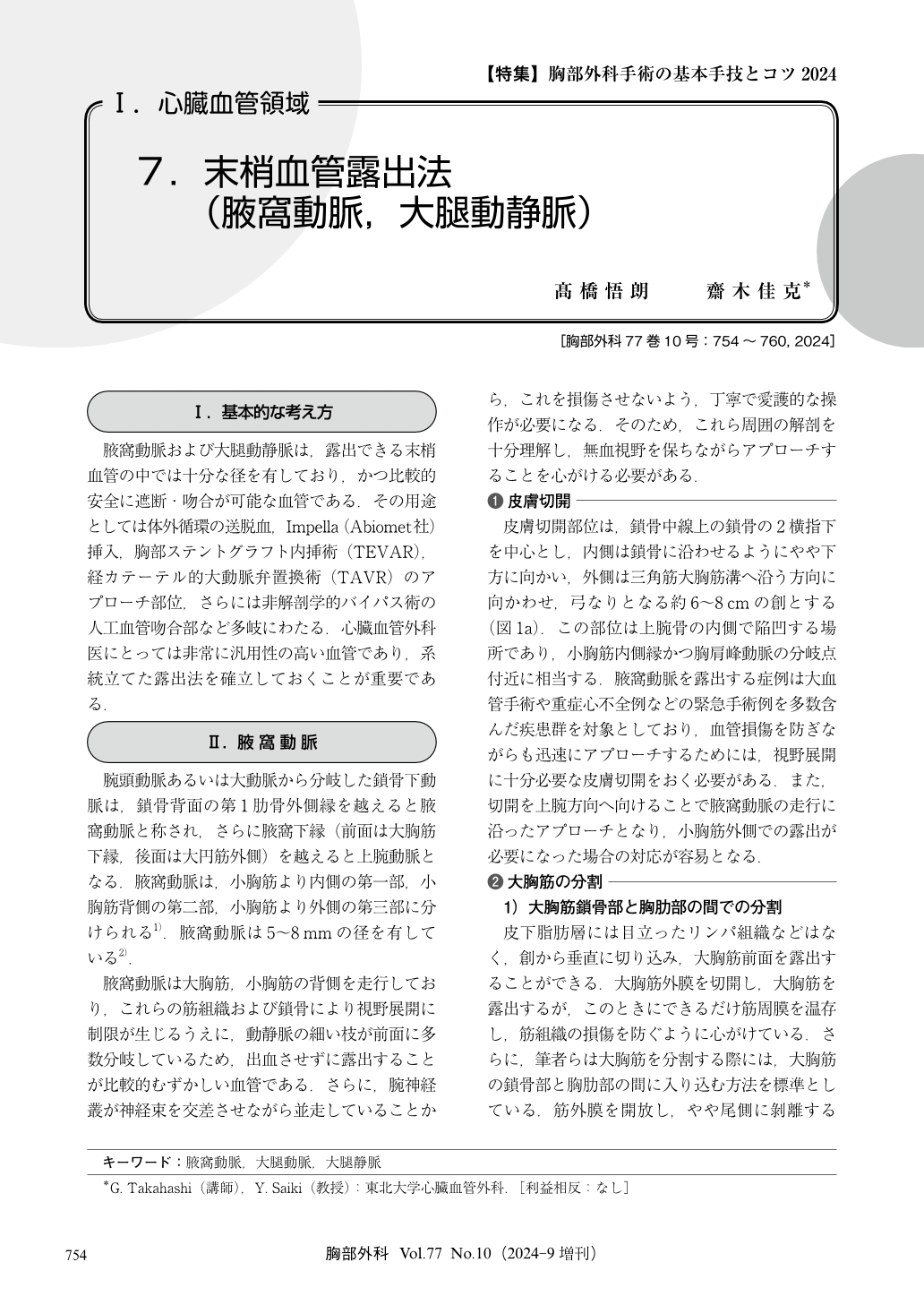
腋窩動脈および大腿動静脈は,露出できる末梢血管の中では十分な径を有しており,かつ比較的安全に遮断・吻合が可能な血管である.その用途としては体外循環の送脱血,Impella(Abiomet社)挿入,胸部ステントグラフト内挿術(TEVAR),経カテーテル的大動脈弁置換術(TAVR)のアプローチ部位,さらには非解剖学的バイパス術の人工血管吻合部など多岐にわたる.心臓血管外科医にとっては非常に汎用性の高い血管であり,系統立てた露出法を確立しておくことが重要である.
The axillary artery and femoral artery and vein have much versatility for cardiovascular surgeons among the peripheral vessels that can be exposed, and they are able to be cannulated and anastomosed safely. They can be used for inflow or drainage line for extracorporeal circulation, approach site for impeller insertion, thoracic endovascular aortic repair (TEVAR) and transcatheter aortic valve replacement (TAVR). Therefore, it is important to establish a systematic exposure method for these vessels. The axillary artery has complex surrounding tissues, and unusual anatomical vessels reported in Japanese patients. A thorough understanding of its anatomy should be obtained to manipulate these vessels comfortably. The femoral artery is the most frequently used peripheral vessel, because it is relatively easy to expose. However, the difficulty may increase when exposing it in a semi-supine position taken in thoracoabdominal aortic aneurysm repair or minimal invasive cardiac surgery. The individual anatomical conditions of the femoral artery and vein should be assessed by preoperative computed tomography (CT) and intraoperative echocardiography to ensure an appropriate approach.
© Nankodo Co., Ltd., 2024