Japanese
English
- 有料閲覧
PPV購入案内
1,650円 (1,500円+税10%) こちらは、273ページから277ページの文献です。購入には医書.jp本会員登録が必要です。
会員登録完了後に改めて上記「購入サイトへ」を選択してください。
または「購入サイトへ」選択後に「購入ログイン」、「新規会員登録」の順に進んでください。
会員登録について詳しくはをご確認ください。
- Abstract 文献概要
- 1ページ目 Look Inside
- 参考文献 Reference
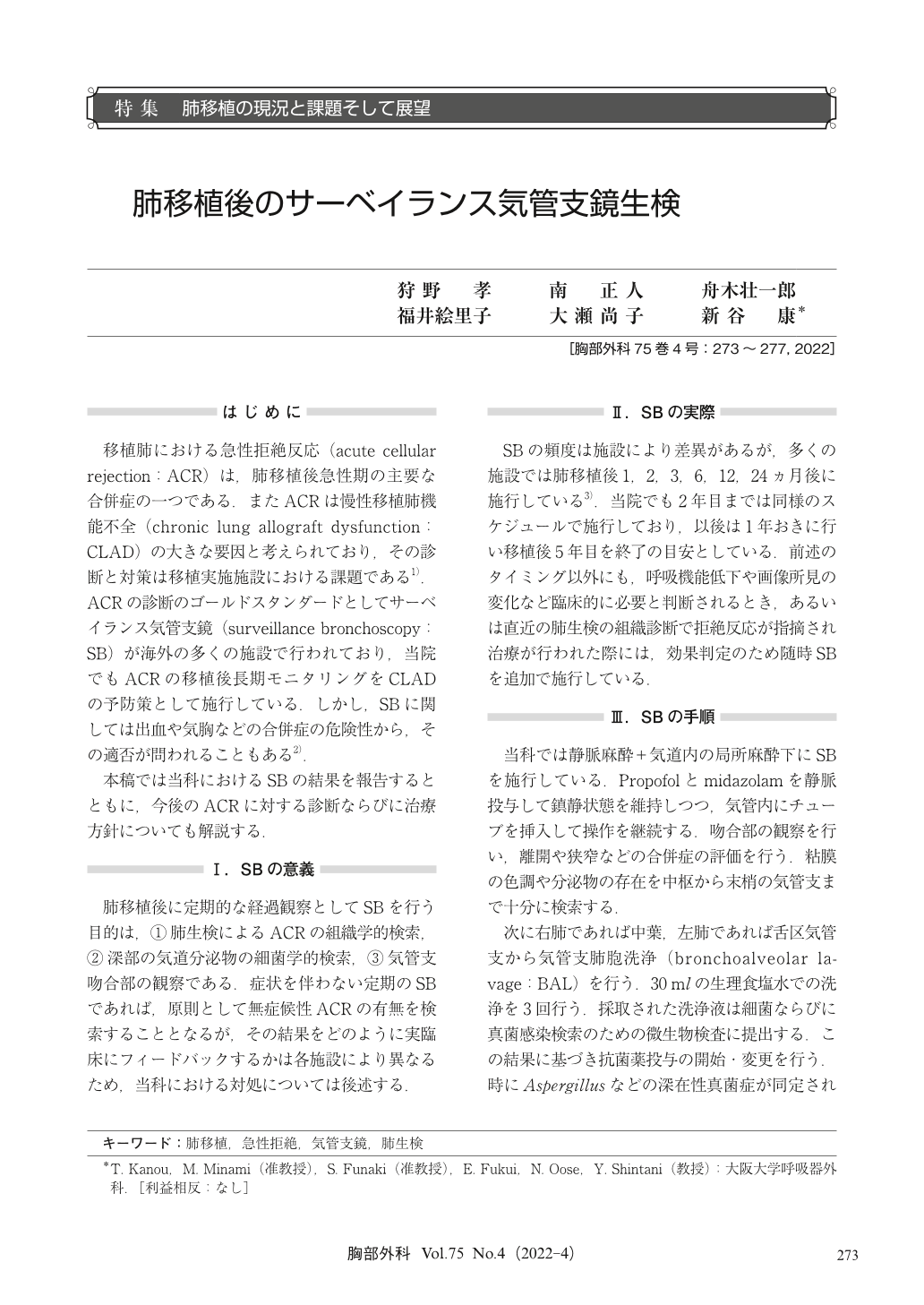
移植肺における急性拒絶反応(acute cellular rejection:ACR)は,肺移植後急性期の主要な合併症の一つである.またACRは慢性移植肺機能不全(chronic lung allograft dysfunction:CLAD)の大きな要因と考えられており,その診断と対策は移植実施施設における課題である1).ACRの診断のゴールドスタンダードとしてサーベイランス気管支鏡(surveillance bronchoscopy:SB)が海外の多くの施設で行われており,当院でもACRの移植後長期モニタリングをCLADの予防策として施行している.しかし,SBに関しては出血や気胸などの合併症の危険性から,その適否が問われることもある2).
Acute cellular rejection (ACR) is one of the major complications of the acute phase after lung transplantation. In addition, ACR is considered to be a major cause of chronic lung allograft dysfunction (CLAD). Therefore, the diagnosis and treatment for ACR are major issues at transplantation facilities. Surveillance bronchoscopy (SB) is performed at many institutions as the golden standard for ACR diagnosis, and our hospital also implements long-term post-transplant monitoring of ACR as a preventive measure for CLAD. However, the suitability of SB may be questioned due to the risk of complications such as bleeding and pneumothorax. Here, we would like to report the results of SB in our department and discuss future diagnosis and treatment policy for ACR.
© Nankodo Co., Ltd., 2022