Japanese
English
- 有料閲覧
PPV購入案内
1,650円 (1,500円+税10%) こちらは、746ページから751ページの文献です。購入には医書.jp本会員登録が必要です。
会員登録完了後に改めて上記「購入サイトへ」を選択してください。
または「購入サイトへ」選択後に「購入ログイン」、「新規会員登録」の順に進んでください。
会員登録について詳しくはをご確認ください。
- Abstract 文献概要
- 1ページ目 Look Inside
- 参考文献 Reference
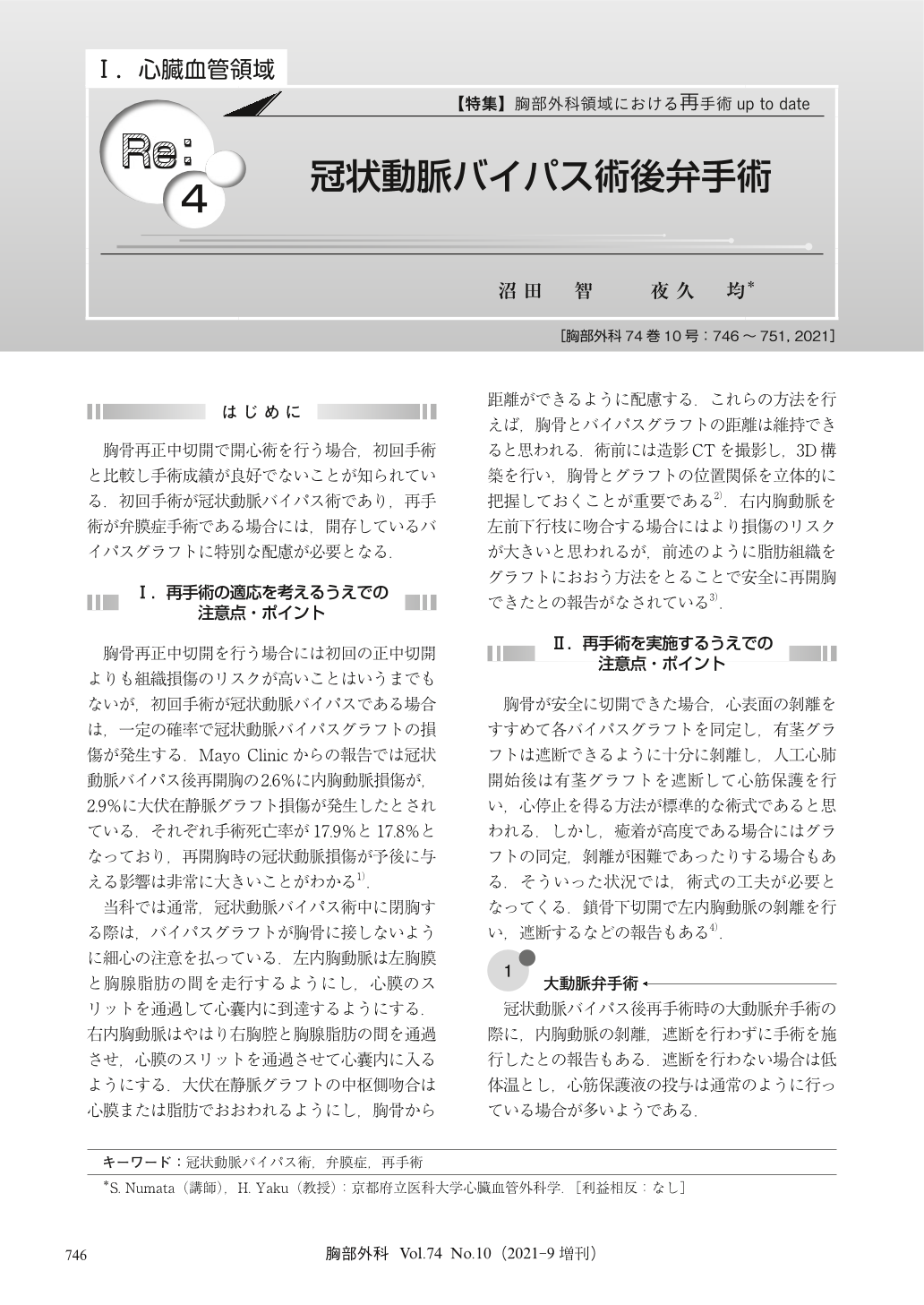
胸骨再正中切開で開心術を行う場合,初回手術と比較し手術成績が良好でないことが知られている.初回手術が冠状動脈バイパス術であり,再手術が弁膜症手術である場合には,開存しているバイパスグラフトに特別な配慮が必要となる.
It has been reported that there are some risks of coronary artery graft injury while redo sternotomy was required for valve surgery after coronary artery bypass grafting (CABG). Also it is well known that clinical results after graft injury was poor. For avoiding graft injury, coronary artery graft must be placed away from the sternum at the time of initial CABG. For redo sternotomy, 3-dimensional-computed tomography can be useful.
For aortic valve surgery after CABG, treatment of patent in-situ graft have to be discussed. For common practice, dissecting and clamping the patent in-situ graft during cardiac arrest were required. However, there are some reports showing good clinical results with moderate hypothermia, non-dissection and non-clamping graft. Furthermore, less mobidity rate results of transcatheter aortic valve implantation (TAVI) after CABG was reported.
For mitral valve surgery after CABG, right mini-thoracotomy was reported as preferred procedure recently. Dissection area could be reduced than re-median sternotomy, although clamping aorta and patent graft were technically difficult. Two procedures were reported such as hypothermia and ventricular fibrillation or normothermia and beating heart. MitraClip procedure can be considered for high risk patients.
Newly developed surgical and catheter technique may change the strategy for heart valve disease after CABG.
© Nankodo Co., Ltd., 2021