Japanese
English
- 有料閲覧
PPV購入案内
1,320円 (1,200円+税10%) こちらは、121ページから129ページの文献です。購入には医書.jp本会員登録が必要です。
会員登録完了後に改めて上記「購入サイトへ」を選択してください。
または「購入サイトへ」選択後に「購入ログイン」、「新規会員登録」の順に進んでください。
会員登録について詳しくはをご確認ください。
- Abstract 文献概要
- 1ページ目 Look Inside
- 参考文献 Reference
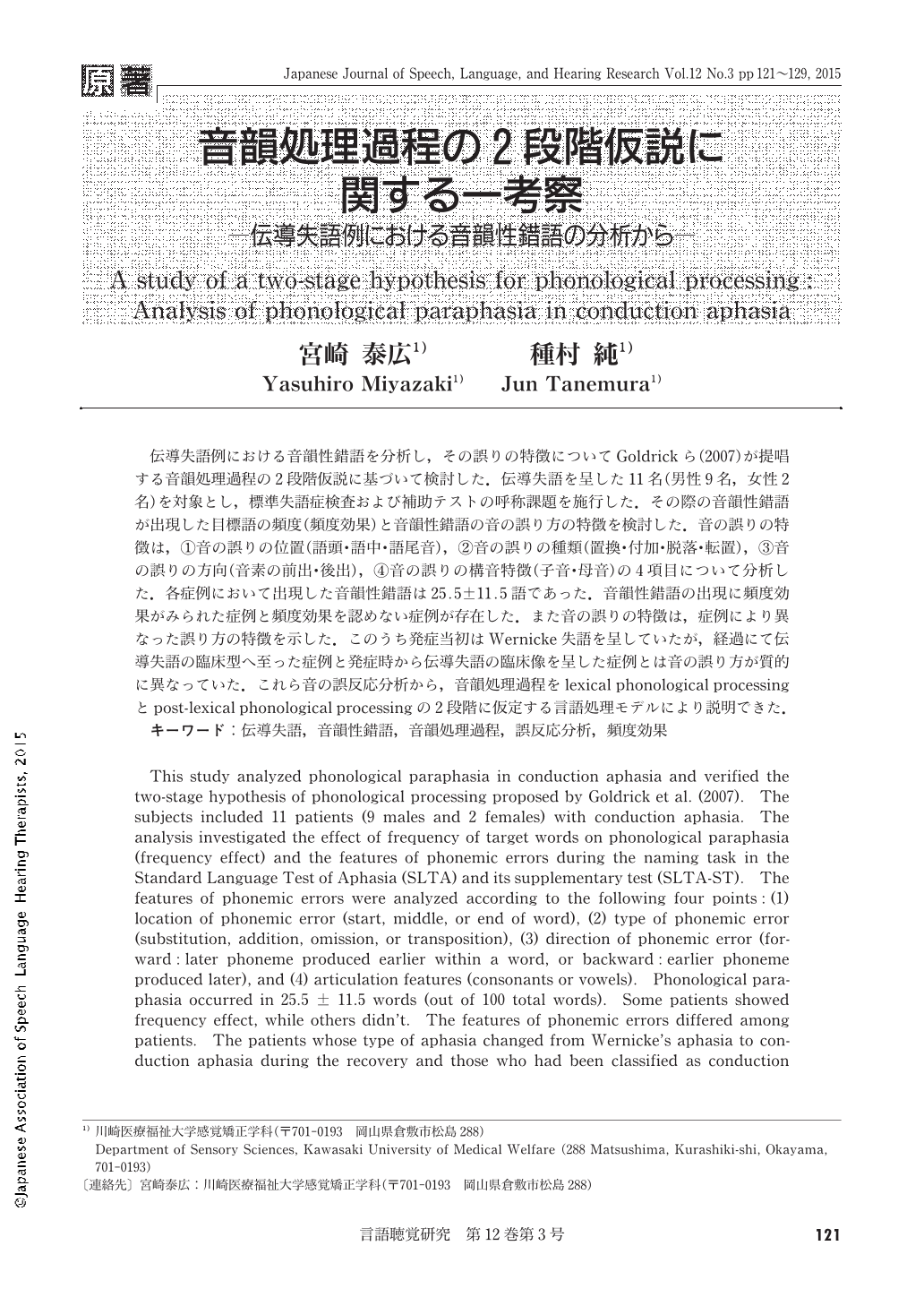
伝導失語例における音韻性錯語を分析し,その誤りの特徴についてGoldrickら(2007)が提唱する音韻処理過程の2段階仮説に基づいて検討した.伝導失語を呈した11名(男性9名,女性2名)を対象とし,標準失語症検査および補助テストの呼称課題を施行した.その際の音韻性錯語が出現した目標語の頻度(頻度効果)と音韻性錯語の音の誤り方の特徴を検討した.音の誤りの特徴は,①音の誤りの位置(語頭・語中・語尾音),②音の誤りの種類(置換・付加・脱落・転置),③音の誤りの方向(音素の前出・後出),④音の誤りの構音特徴(子音・母音)の4項目について分析した.各症例において出現した音韻性錯語は25.5±11.5語であった.音韻性錯語の出現に頻度効果がみられた症例と頻度効果を認めない症例が存在した.また音の誤りの特徴は,症例により異なった誤り方の特徴を示した.このうち発症当初はWernicke失語を呈していたが,経過にて伝導失語の臨床型へ至った症例と発症時から伝導失語の臨床像を呈した症例とは音の誤り方が質的に異なっていた.これら音の誤反応分析から,音韻処理過程をlexical phonological processingとpost-lexical phonological processingの2段階に仮定する言語処理モデルにより説明できた.
This study analyzed phonological paraphasia in conduction aphasia and verified the two-stage hypothesis of phonological processing proposed by Goldrick et al. (2007). The subjects included 11 patients (9 males and 2 females) with conduction aphasia. The analysis investigated the effect of frequency of target words on phonological paraphasia (frequency effect) and the features of phonemic errors during the naming task in the Standard Language Test of Aphasia (SLTA) and its supplementary test (SLTA-ST). The features of phonemic errors were analyzed according to the following four points: (1) location of phonemic error (start, middle, or end of word), (2) type of phonemic error (substitution, addition, omission, or transposition), (3) direction of phonemic error (forward: later phoneme produced earlier within a word, or backward: earlier phoneme produced later), and (4) articulation features (consonants or vowels). Phonological paraphasia occurred in 25.5±11.5 words (out of 100 total words). Some patients showed frequency effect, while others didn't. The features of phonemic errors differed among patients. The patients whose type of aphasia changed from Wernicke's aphasia to conduction aphasia during the recovery and those who had been classified as conduction aphasia from the onset were qualitatively different. These features of phonemic errors can be explained by a language processing model which postulates that there are two stages for phonological processing: lexical phonological processing and post-lexical phonological processing.
Copyright © 2015, Japanese Association of Speech-Language-Hearing Therapists. All rights reserved.