Japanese
English
- 有料閲覧
PPV購入案内
1,320円 (1,200円+税10%) こちらは、1327ページから1336ページの文献です。購入には医書.jp本会員登録が必要です。
会員登録完了後に改めて上記「購入サイトへ」を選択してください。
または「購入サイトへ」選択後に「購入ログイン」、「新規会員登録」の順に進んでください。
会員登録について詳しくはをご確認ください。
- Abstract 文献概要
- 1ページ目 Look Inside
- 参考文献 Reference
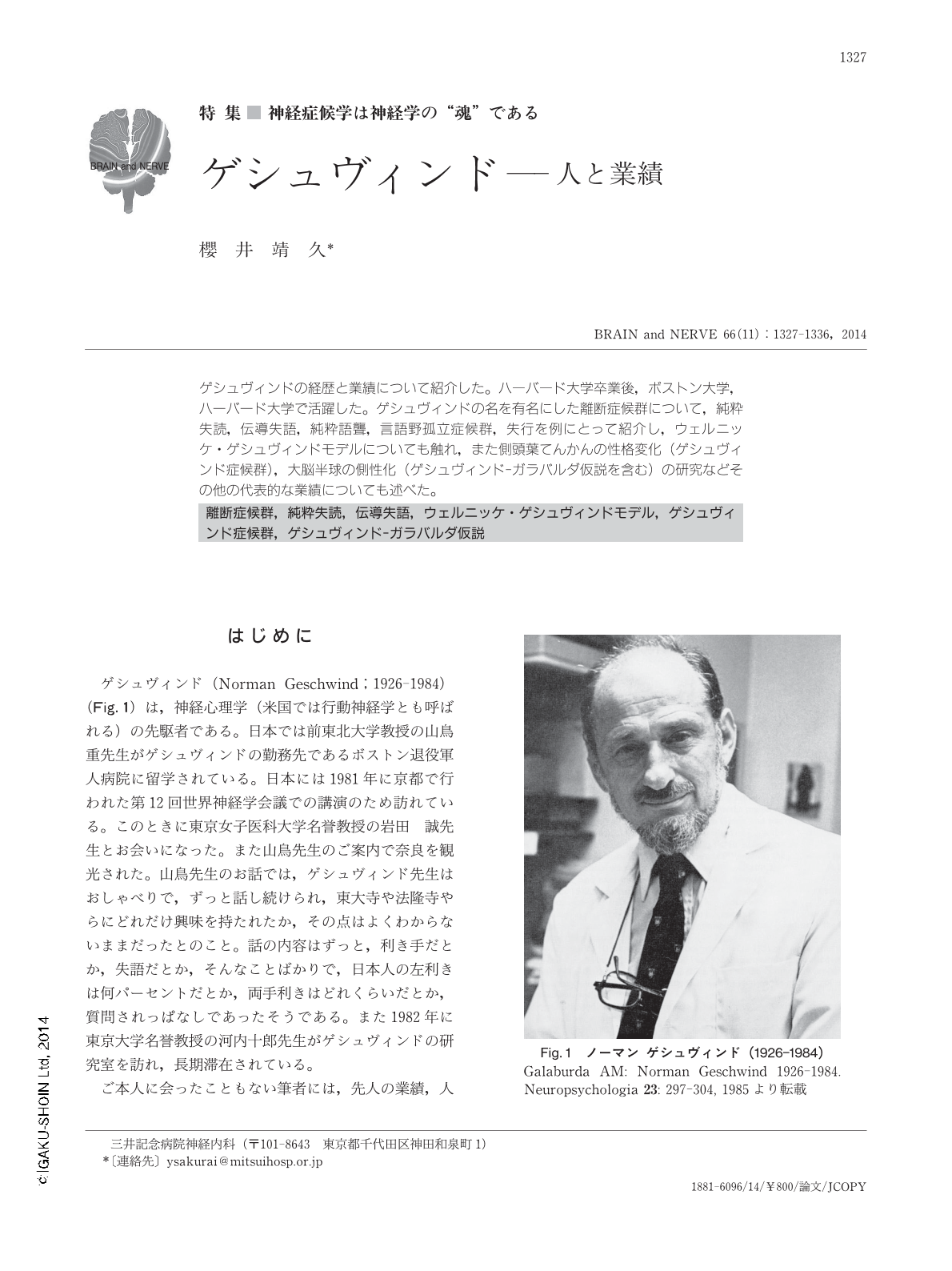
ゲシュヴィンドの経歴と業績について紹介した。ハーバード大学卒業後,ボストン大学,ハーバード大学で活躍した。ゲシュヴィンドの名を有名にした離断症候群について,純粋失読,伝導失語,純粋語聾,言語野孤立症候群,失行を例にとって紹介し,ウェルニッケ・ゲシュヴィンドモデルについても触れ,また側頭葉てんかんの性格変化(ゲシュヴィンド症候群),大脳半球の側性化(ゲシュヴィンド-ガラバルダ仮説を含む)の研究などその他の代表的な業績についても述べた。
Abstract
Norman Geschwind was an outstanding American neurologist. He first majored in psychology and then medicine at Harvard University. After graduation, he received neurological training at Beth Israel Hospital, the National Hospital at Queen Square in London, and Boston City Hospital, under the guidance of Denny-Brown, Charles Symonds, and Fred Quadfasel. He later moved to the Boston Veterans Administration Hospital, and established the Boston University Aphasia Research Center with Edith Kaplan. This center played a cardinal role in aphasia research in the United States. In 1969, Geschwind became a Professor at Harvard Medical School. Disconnection syndromes, which made Geschwind's name famous worldwide in the field of neurology, are reviewed here in regard to pure alexia, conduction aphasia, pure word deafness, isolation of the speech area, and apraxia, with reference to the Wernicke-Geschwind model. Other contributions by Geschwind are also described, such as behavioral changes in temporal lobe epilepsy (Geschwind syndrome) and cerebral lateralization, including the Geschwind-Galaburda hypothesis.
Copyright © 2014, Igaku-Shoin Ltd. All rights reserved.