Japanese
English
- 有料閲覧
PPV購入案内
1,320円 (1,200円+税10%) こちらは、105ページから117ページの文献です。購入には医書.jp本会員登録が必要です。
会員登録完了後に改めて上記「購入サイトへ」を選択してください。
または「購入サイトへ」選択後に「購入ログイン」、「新規会員登録」の順に進んでください。
会員登録について詳しくはをご確認ください。
- Abstract 文献概要
- 1ページ目 Look Inside
- 参考文献 Reference
- サイト内被引用 Cited by
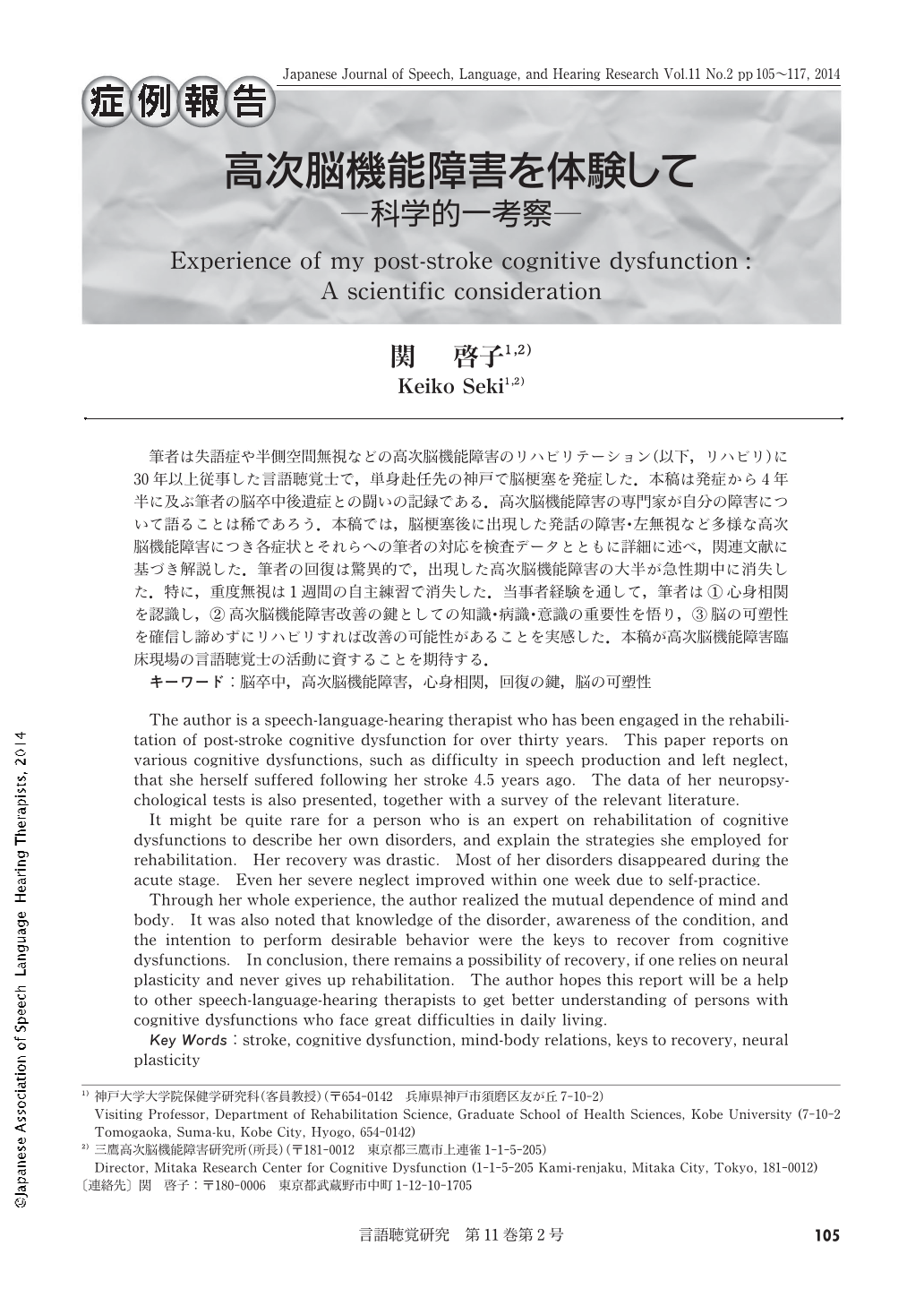
筆者は失語症や半側空間無視などの高次脳機能障害のリハビリテーション(以下,リハビリ)に30年以上従事した言語聴覚士で,単身赴任先の神戸で脳梗塞を発症した.本稿は発症から4年半に及ぶ筆者の脳卒中後遺症との闘いの記録である.高次脳機能障害の専門家が自分の障害について語ることは稀であろう.本稿では,脳梗塞後に出現した発話の障害・左無視など多様な高次脳機能障害につき各症状とそれらへの筆者の対応を検査データとともに詳細に述べ,関連文献に基づき解説した.筆者の回復は驚異的で,出現した高次脳機能障害の大半が急性期中に消失した.特に,重度無視は1週間の自主練習で消失した.当事者経験を通して,筆者は①心身相関を認識し,②高次脳機能障害改善の鍵としての知識・病識・意識の重要性を悟り,③脳の可塑性を確信し諦めずにリハビリすれば改善の可能性があることを実感した.本稿が高次脳機能障害臨床現場の言語聴覚士の活動に資することを期待する.
The author is a speech-language-hearing therapist who has been engaged in the rehabilitation of post-stroke cognitive dysfunction for over thirty years. This paper reports on various cognitive dysfunctions, such as difficulty in speech production and left neglect, that she herself suffered following her stroke 4.5 years ago. The data of her neuropsychological tests is also presented, together with a survey of the relevant literature.
It might be quite rare for a person who is an expert on rehabilitation of cognitive dysfunctions to describe her own disorders, and explain the strategies she employed for rehabilitation. Her recovery was drastic. Most of her disorders disappeared during the acute stage. Even her severe neglect improved within one week due to self-practice.
Through her whole experience, the author realized the mutual dependence of mind and body. It was also noted that knowledge of the disorder, awareness of the condition, and the intention to perform desirable behavior were the keys to recover from cognitive dysfunctions. In conclusion, there remains a possibility of recovery, if one relies on neural plasticity and never gives up rehabilitation. The author hopes this report will be a help to other speech-language-hearing therapists to get better understanding of persons with cognitive dysfunctions who face great difficulties in daily living.
Copyright © 2014, Japanese Association of Speech-Language-Hearing Therapists. All rights reserved.