Japanese
English
- 有料閲覧
PPV購入案内
1,320円 (1,200円+税10%) こちらは、113ページから121ページの文献です。購入には医書.jp本会員登録が必要です。
会員登録完了後に改めて上記「購入サイトへ」を選択してください。
または「購入サイトへ」選択後に「購入ログイン」、「新規会員登録」の順に進んでください。
会員登録について詳しくはをご確認ください。
- Abstract 文献概要
- 1ページ目 Look Inside
- 参考文献 Reference
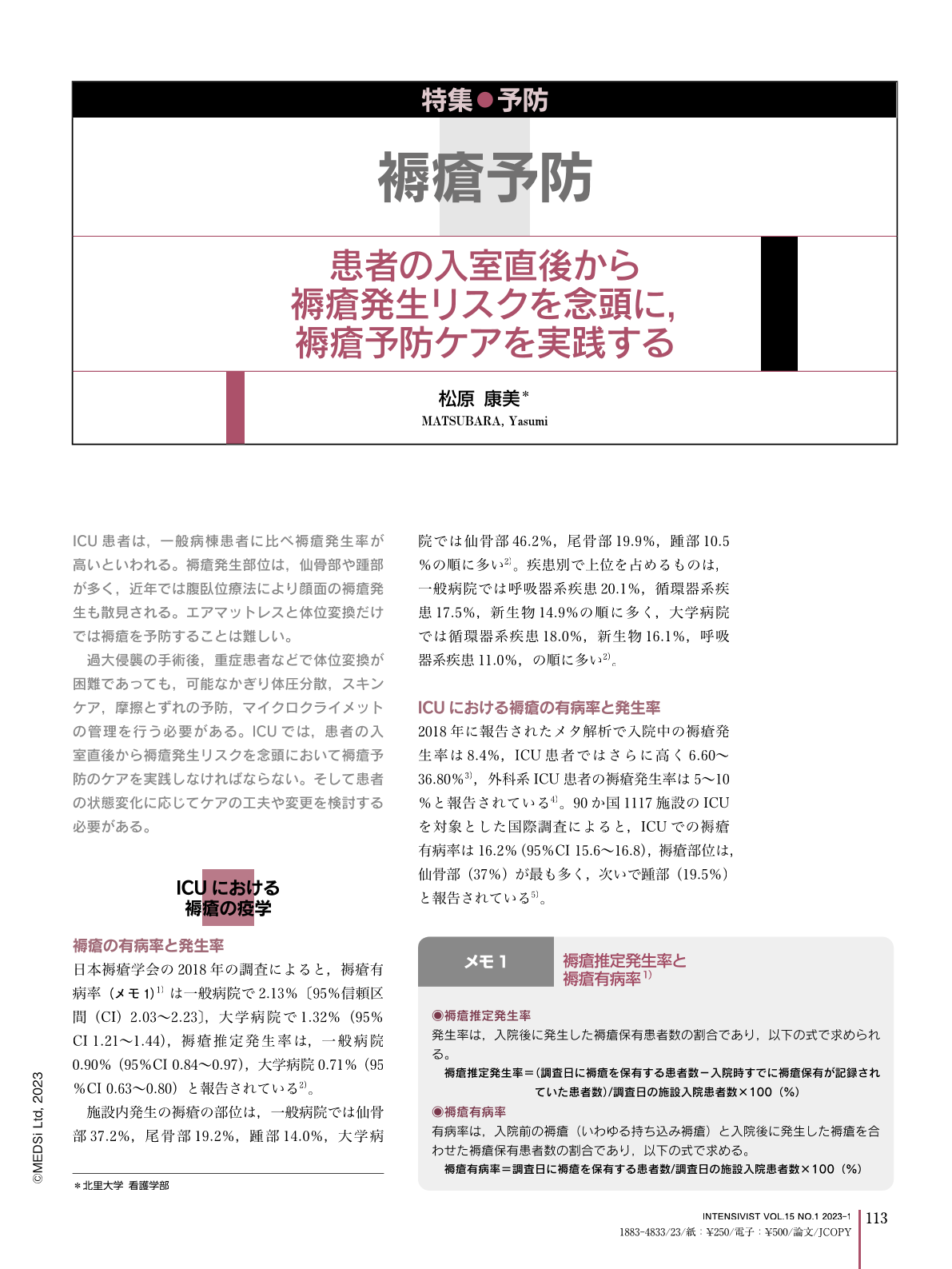
ICU患者は,一般病棟患者に比べ褥瘡発生率が高いといわれる。褥瘡発生部位は,仙骨部や踵部が多く,近年では腹臥位療法により顔面の褥瘡発生も散見される。エアマットレスと体位変換だけでは褥瘡を予防することは難しい。
過大侵襲の手術後,重症患者などで体位変換が困難であっても,可能なかぎり体圧分散,スキンケア,摩擦とずれの予防,マイクロクライメットの管理を行う必要がある。ICUでは,患者の入室直後から褥瘡発生リスクを念頭において褥瘡予防のケアを実践しなければならない。そして患者の状態変化に応じてケアの工夫や変更を検討する必要がある。
The incidence of pressure injuries in patients in the ICU is said to be higher than that in general wards. Pressure injuries occur most frequently in the sacral and heel regions, and recently, have also been reported on the face due to prone position therapy. Air mattresses and repositioning alone are not sufficient to prevent pressure injuries. After highly invasive surgical procedures, it is difficult to change the body position of critically ill patients. Dispersion of pressure, skin care, prevention of friction and shearing, and microclimate management are needed as much as possible. In the ICU, pressure injury prevention should be performed immediately upon admission. Prevention of pressure injuries should be considered when changing care according to changes in the patient's condition.
Copyright © 2023, MEDICAL SCIENCES INTERNATIONAL, LTD. All rights reserved.