Japanese
English
- 有料閲覧
PPV購入案内
1,320円 (1,200円+税10%) こちらは、62ページから72ページの文献です。購入には医書.jp本会員登録が必要です。
会員登録完了後に改めて上記「購入サイトへ」を選択してください。
または「購入サイトへ」選択後に「購入ログイン」、「新規会員登録」の順に進んでください。
会員登録について詳しくはをご確認ください。
- Abstract 文献概要
- 1ページ目 Look Inside
- 参考文献 Reference
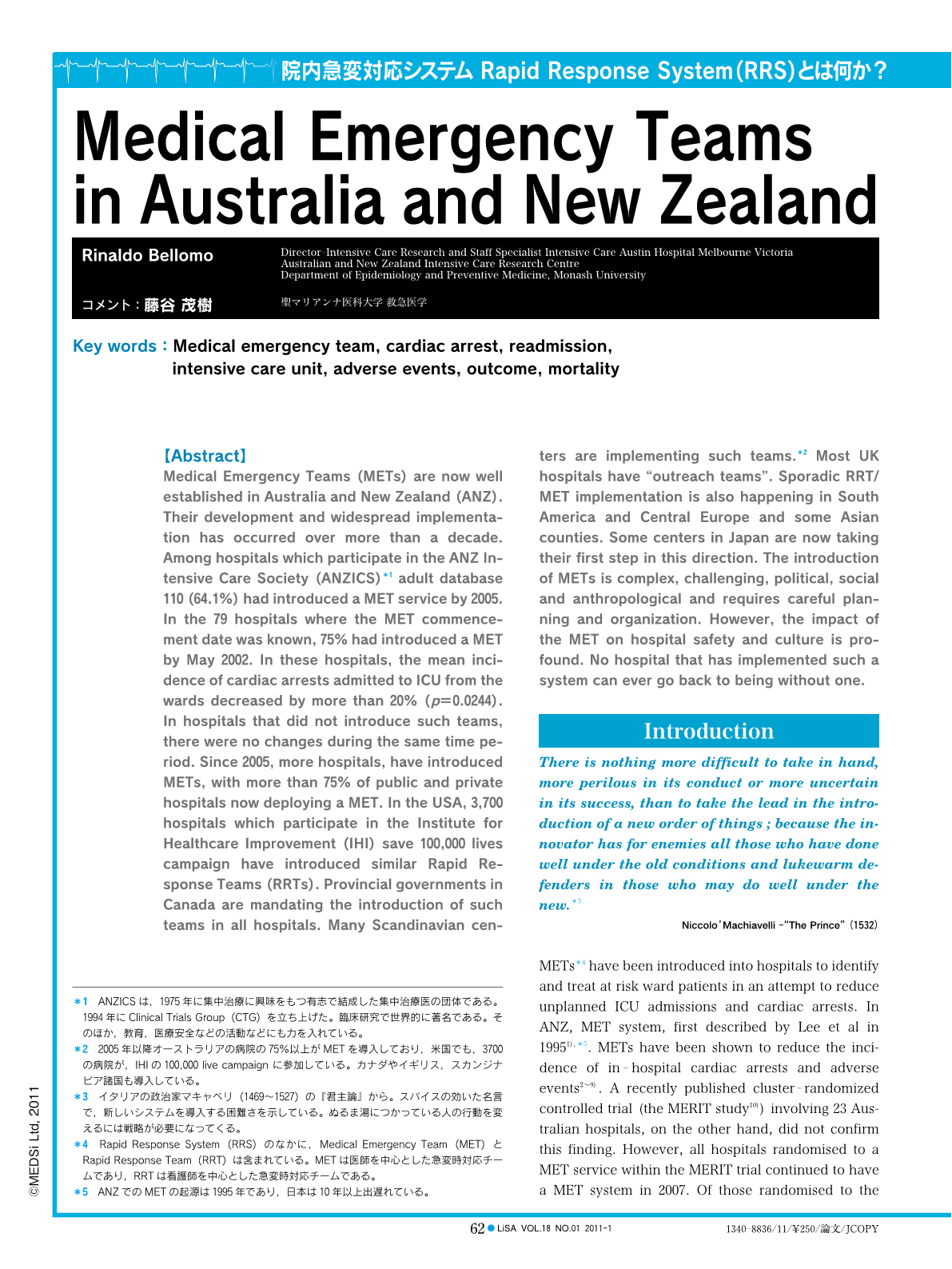
Medical Emergency Teams (METs) are now well established in Australia and New Zealand (ANZ). Their development and widespread implementation has occurred over more than a decade. Among hospitals which participate in the ANZ Intensive Care Society (ANZICS)*1 adult database 110 (64.1%) had introduced a MET service by 2005. In the 79 hospitals where the MET commencement date was known, 75% had introduced a MET by May 2002. In these hospitals, the mean incidence of cardiac arrests admitted to ICU from the wards decreased by more than 20% (p=0.0244). In hospitals that did not introduce such teams, there were no changes during the same time period. Since 2005, more hospitals, have introduced METs, with more than 75% of public and private hospitals now deploying a MET. In the USA, 3,700 hospitals which participate in the Institute for Healthcare Improvement (IHI) save 100,000 lives campaign have introduced similar Rapid Response Teams (RRTs). Provincial governments in Canada are mandating the introduction of such teams in all hospitals. Many Scandinavian centers are implementing such teams.*2 Most UK hospitals have “outreach teams”. Sporadic RRT/MET implementation is also happening in South America and Central Europe and some Asian counties. Some centers in Japan are now taking their first step in this direction. The introduction of METs is complex, challenging, political, social and anthropological and requires careful planning and organization. However, the impact of the MET on hospital safety and culture is profound. No hospital that has implemented such a system can ever go back to being without one.
Copyright © 2011, "MEDICAL SCIENCES INTERNATIONAL, LTD." All rights reserved.