Japanese
English
- 有料閲覧
PPV購入案内
1,320円 (1,200円+税10%) こちらは、245ページから249ページの文献です。購入には医書.jp本会員登録が必要です。
会員登録完了後に改めて上記「購入サイトへ」を選択してください。
または「購入サイトへ」選択後に「購入ログイン」、「新規会員登録」の順に進んでください。
会員登録について詳しくはをご確認ください。
- Abstract 文献概要
- 1ページ目 Look Inside
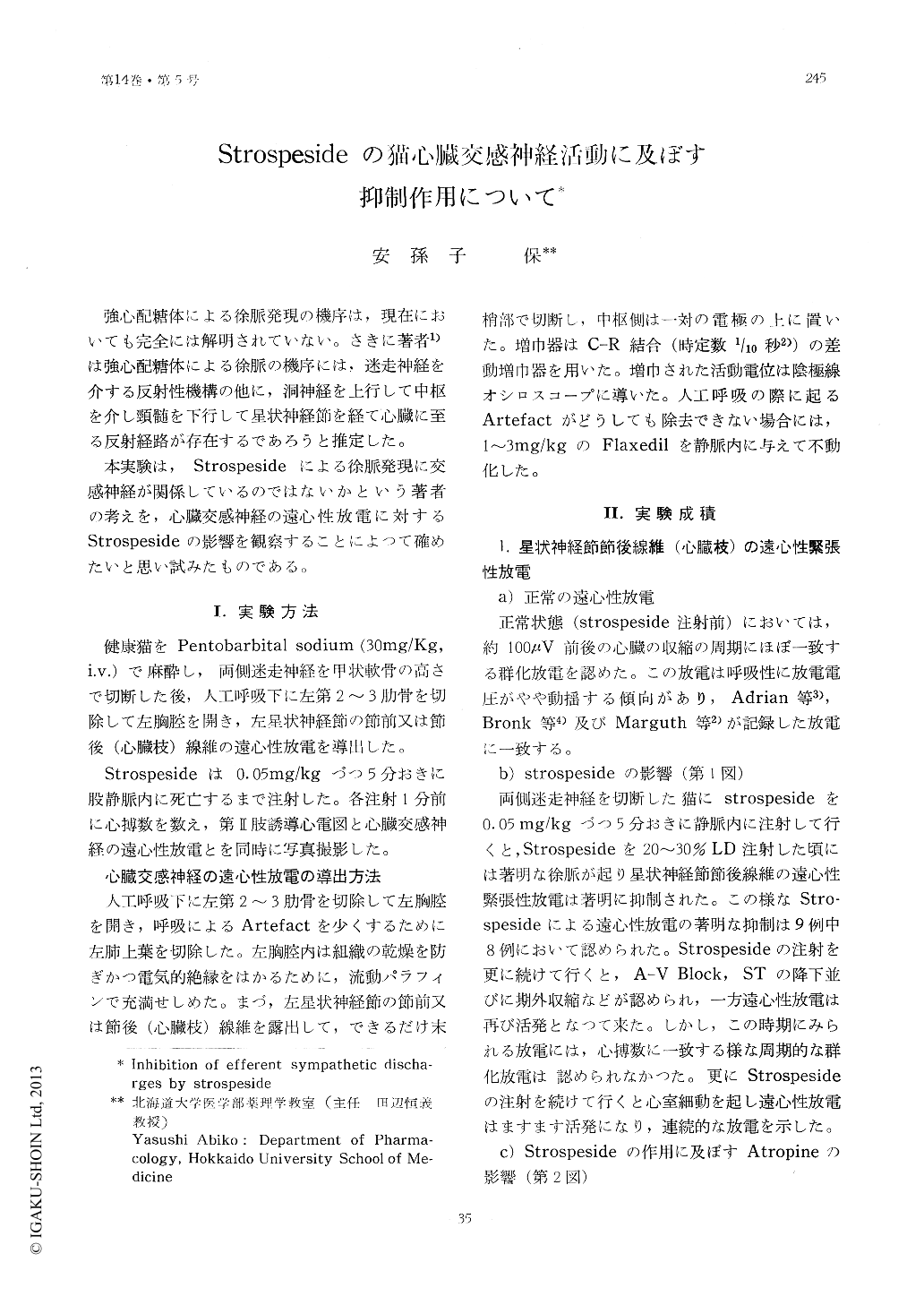
強心配糖体による徐脈発現の機序は,現在においても完全には解明されていない。さきに著者1)は強心配糖体による徐脈の機序には,迷走神経を介する反射性機構の他に,洞神経を上行して中枢を介し頸髄を下行して星状神経節を経て心臓に至る反射経路が存在するであろうと推定した。
本実験は,Strospesideによる徐脈発現に交感神経が関係しているのではないかという著者の考えを,心臓交感神経の遠心性放電に対するStrospesideの影響を観察することによつて確めたいと思い試みたものである。
In order to investigate the extravagal mechanism of bradycardia produced by cardiac gly-cosides, the present animal experiment was conducted using strospeside as a cardiac glyco-side in cats anesthetized with pentobarbital sodium.
In vagotomized cats, 20-30% LD of strospeside produced slowing in the heart rate and an inhibition of the efferent discharges in the pre-and postganglionic stellate fibers. Atropin-e (0.1mg/kg) did not prevent bradycardia, nor did it modify the inhibitory effect of stros-peside on efferent discharges in the postganglionic stellate fibers in vagotomized cats.
From the foregoing results, it was concluded that sympathetic cardiac nerves play an important role in the production of bradycardia by strospeside as an extravagal factor.
Copyright © 1963, THE ICHIRO KANEHARA FOUNDATION. All rights reserved.