Japanese
English
- 販売していません
PPV購入案内
都合により販売していません- Abstract 文献概要
- 1ページ目 Look Inside
- 参考文献 Reference
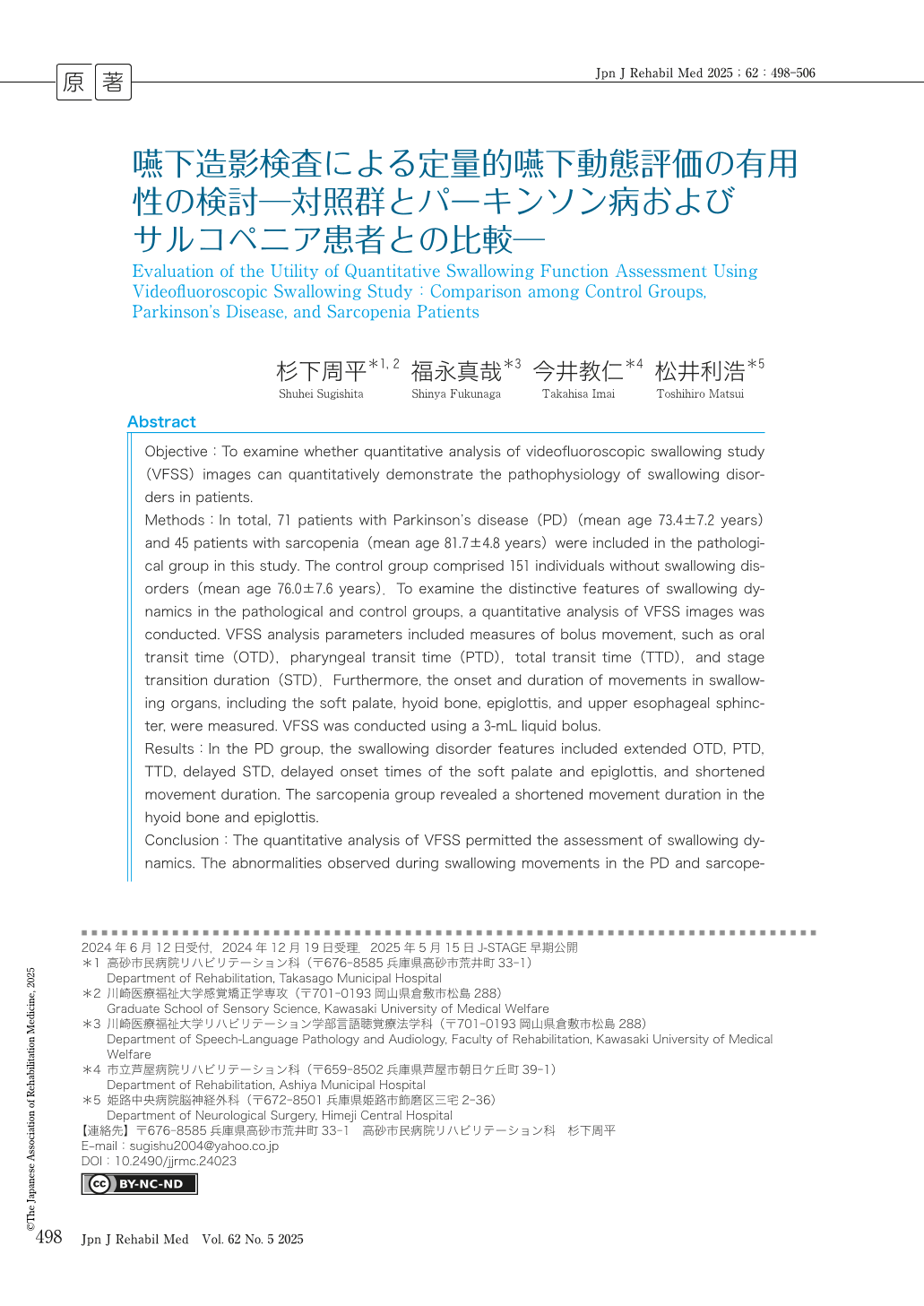
要旨 目的:嚥下造影検査(VF)は嚥下障害の診断や治療法の決定において重要な情報源となる.現行の評価法は主観的要素が強く,客観的評価の臨床活用が望まれる.本研究では嚥下障害の対照群と疾患群との比較研究から,疾患群の嚥下障害の病態を定量的に示すことを目指した.
方法:対象は,経口摂取可能な60歳以上の男女で,対照群として嚥下障害を認めない者151名(76.0±7.6歳),疾患群として,VFにて誤嚥を認めないパーキンソン病患者(PD群)71名(73.4±7.2歳)とサルコペニア群45名(81.7±4.8歳)とした.VFの解析項目は,食塊の口腔通過時間,咽頭通過時間,総通過時間,そして嚥下反射惹起時間,軟口蓋,喉頭蓋,食道入口部の動作開始時間と動作時間である.VFは3mLの液体を用いて車いす座位で実施した.計測値は対照群と疾患群で多変量線形回帰分析を用いて比較した.
結果:PD群では,対照群に比較して口腔通過時間,咽頭通過時間,総通過時間が延長し,嚥下反射惹起時間は遅延,動作時間は軟口蓋,喉頭蓋で短縮,動作開始時間は軟口蓋と喉頭蓋で遅延していた.サルコペニア群では,動作時間が舌骨,喉頭蓋で短縮していた.
結論:VF画像に定量評価を加え,対照群と比較することで,疾患の特徴を反映した嚥下障害の病態を客観的に示すことができた.本手法は,嚥下障害の病態理解に有用であり,さらなる研究を進める意義がある.
Abstract Objective: To examine whether quantitative analysis of videofluoroscopic swallowing study (VFSS) images can quantitatively demonstrate the pathophysiology of swallowing disorders in patients.
Methods: In total, 71 patients with Parkinson's disease (PD) (mean age 73.4±7.2years) and 45 patients with sarcopenia (mean age 81.7±4.8years) were included in the pathological group in this study. The control group comprised 151 individuals without swallowing disorders (mean age 76.0±7.6years). To examine the distinctive features of swallowing dynamics in the pathological and control groups, a quantitative analysis of VFSS images was conducted. VFSS analysis parameters included measures of bolus movement, such as oral transit time (OTD), pharyngeal transit time (PTD), total transit time (TTD), and stage transition duration (STD). Furthermore, the onset and duration of movements in swallowing organs, including the soft palate, hyoid bone, epiglottis, and upper esophageal sphincter, were measured. VFSS was conducted using a 3-mL liquid bolus.
Results: In the PD group, the swallowing disorder features included extended OTD, PTD, TTD, delayed STD, delayed onset times of the soft palate and epiglottis, and shortened movement duration. The sarcopenia group revealed a shortened movement duration in the hyoid bone and epiglottis.
Conclusion: The quantitative analysis of VFSS permitted the assessment of swallowing dynamics. The abnormalities observed during swallowing movements in the PD and sarcopenia groups indicated specific pathophysiologies of these conditions, underscoring the utility of VFSS image analysis in understanding swallowing disorders.
Copyright © 2025, The Japanese Association of Rehabilitation Medicine. All rights reserved.