Japanese
English
- 有料閲覧
PPV購入案内
1,320円 (1,200円+税10%) こちらは、666ページから672ページの文献です。購入には医書.jp本会員登録が必要です。
会員登録完了後に改めて上記「購入サイトへ」を選択してください。
または「購入サイトへ」選択後に「購入ログイン」、「新規会員登録」の順に進んでください。
会員登録について詳しくはをご確認ください。
- Abstract 文献概要
- 1ページ目 Look Inside
- 参考文献 Reference
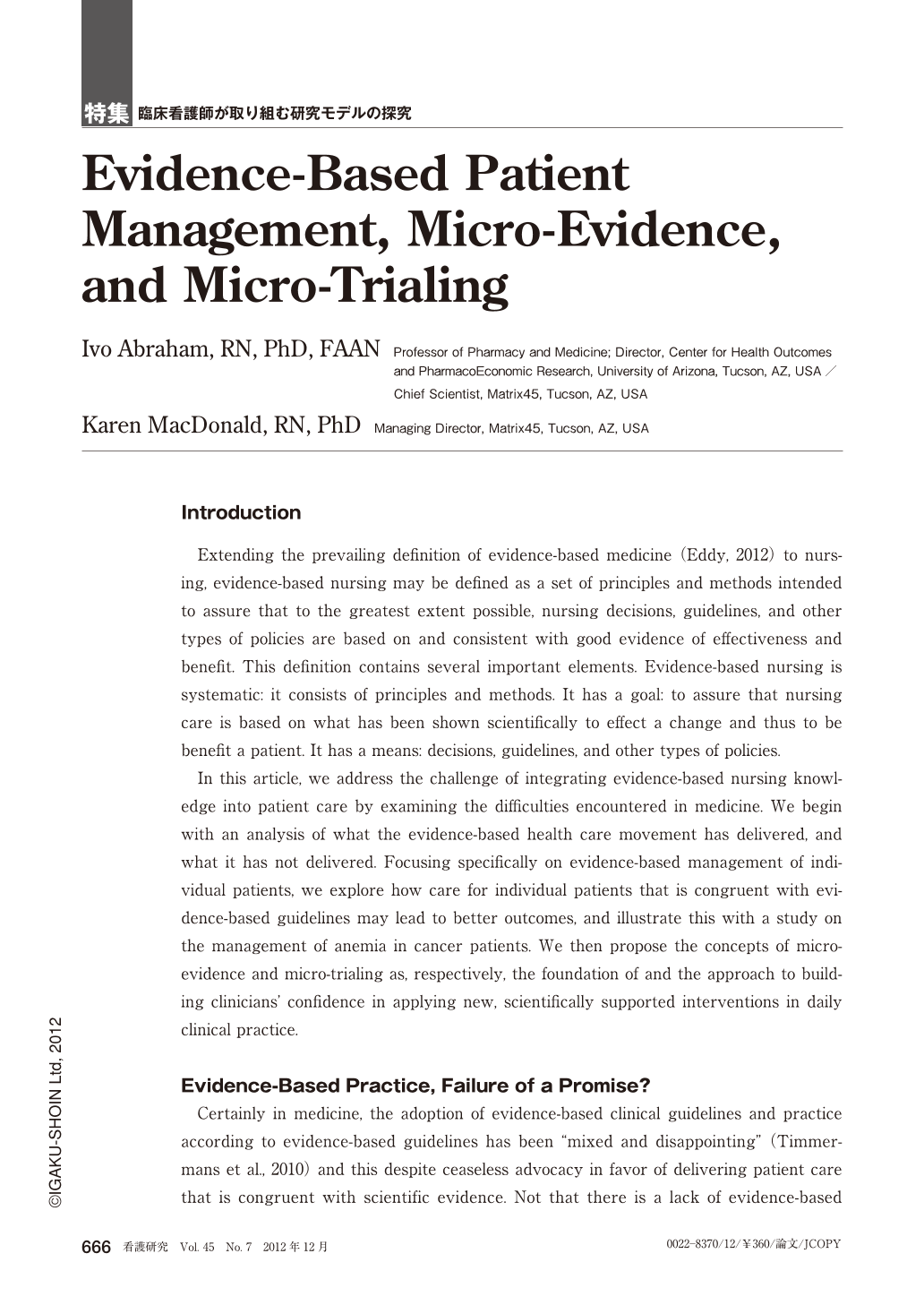
Introduction
Extending the prevailing definition of evidence-based medicine (Eddy, 2012) to nursing, evidence-based nursing may be defined as a set of principles and methods intended to assure that to the greatest extent possible, nursing decisions, guidelines, and other types of policies are based on and consistent with good evidence of effectiveness and benefit. This definition contains several important elements. Evidence-based nursing is systematic: it consists of principles and methods. It has a goal: to assure that nursing care is based on what has been shown scientifically to effect a change and thus to be benefit a patient. It has a means: decisions, guidelines, and other types of policies.
In this article, we address the challenge of integrating evidence-based nursing knowledge into patient care by examining the difficulties encountered in medicine. We begin with an analysis of what the evidence-based health care movement has delivered, and what it has not delivered. Focusing specifically on evidence-based management of individual patients, we explore how care for individual patients that is congruent with evidence-based guidelines may lead to better outcomes, and illustrate this with a study on the management of anemia in cancer patients. We then propose the concepts of micro-evidence and micro-trialing as, respectively, the foundation of and the approach to building clinicians' confidence in applying new, scientifically supported interventions in daily clinical practice.
Copyright © 2012, Igaku-Shoin Ltd. All rights reserved.