Japanese
English
- 有料閲覧
PPV購入案内
1,320円 (1,200円+税10%) こちらは、1031ページから1036ページの文献です。購入には医書.jp本会員登録が必要です。
会員登録完了後に改めて上記「購入サイトへ」を選択してください。
または「購入サイトへ」選択後に「購入ログイン」、「新規会員登録」の順に進んでください。
会員登録について詳しくはをご確認ください。
- Abstract 文献概要
- 1ページ目 Look Inside
I.はじめに
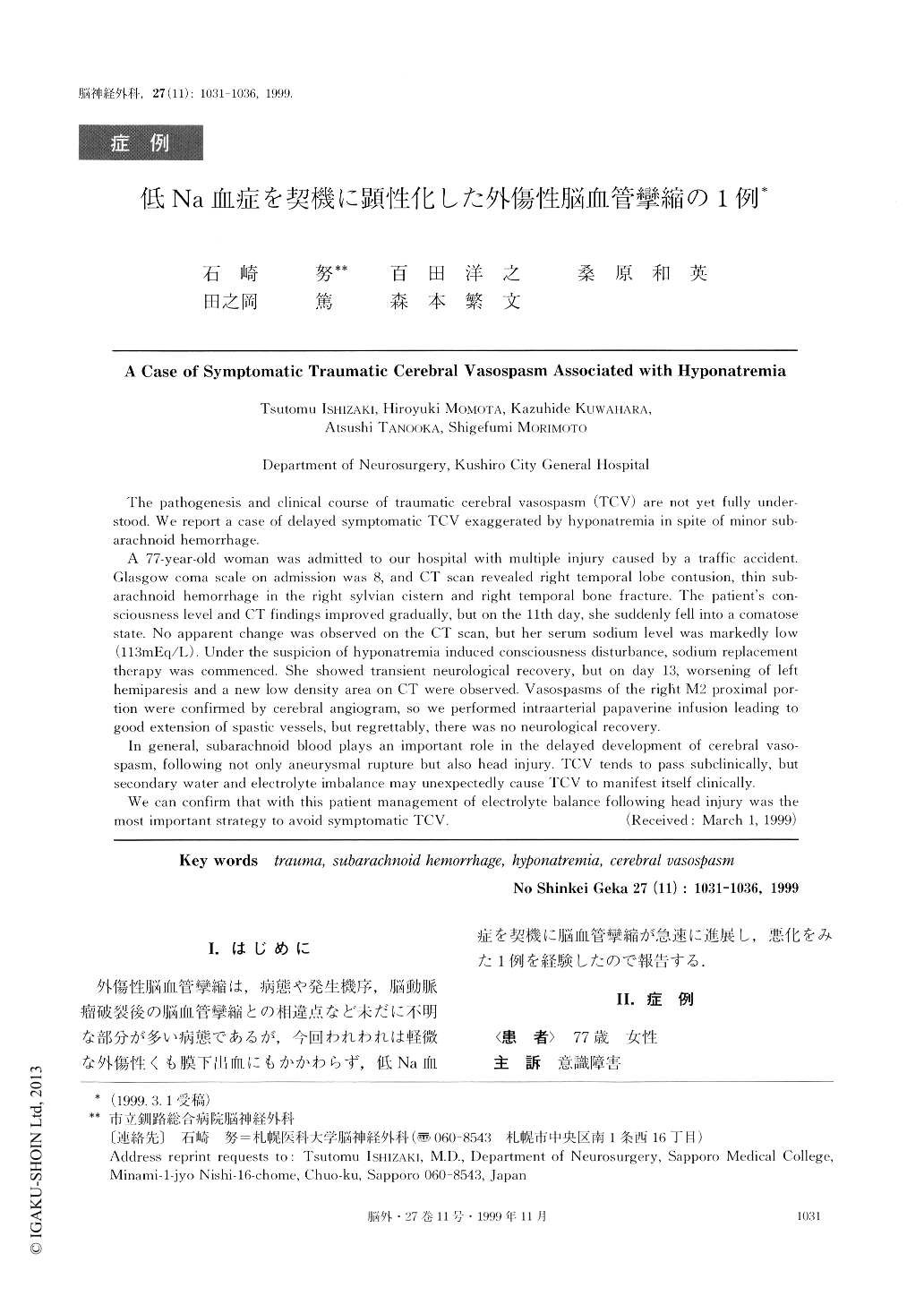
外傷性脳血管攣縮は,病態や発生機序,脳動脈瘤破裂後の脳血管攣縮との相違点など未だに不明な部分が多い病態であるが,今回われわれは軽微な外傷性くも膜下出血にもかかわらず,低Na血症を契機に脳血管攣縮が急速に進展し,悪化をみた1例を経験したので報告する.
The pathogenesis and clinical course of traumatic cerebral vasospasm (TCV) are not yet fully under-stood. We report a case of delayed symptomatic TCV exaggerated by hyponatremia in spite of minor sub-arachnoid hemorrhage.
A 77-year-old woman was admitted to our hospital with multiple injury caused by a traffic accident.Glasgow coma scale on admission was 8, and CT scan revealed right temporal lobe contusion, thin sub-arachnoid hemorrhage in the right sylvian cistern and right temporal bone fracture. The patient's con-sciousness level and CT findings improved gradually, but on the 11th day, she suddenly fell into a comatosestate. No apparent change was observed on the CT scan, but her serum sodium level was markedly low (113mEg/L). Under the suspicion of hyponatremia induced consciousness disturbance, sodium replacementtherapy was commenced. She showed transient neurological recovery, but on day 13, worsening of lefthemiparesis and a new low density area on CT were observed. Vasospasms of the right M2 proximal por-tion were confirmed by cerebral angiogram, so we performed intraarterial papaverine infusion leading togood extension of spastic vessels, but regrettably, there was no neurological recovery.
In general, subarachnoid blood plays an important role in the delayed development of cerebral vaso-spasm, following not only aneurysmal rupture but also head injury. TCV tends to pass subclinically, butsecondary water and electrolyte imbalance may unexpectedly cause TCV to manifest itself clinically. We can confirm that with this patient management of electrolyte balance following head injury was themost important strategy to avoid symptomatic TCV.
Copyright © 1999, Igaku-Shoin Ltd. All rights reserved.