Japanese
English
- 有料閲覧
PPV購入案内
1,320円 (1,200円+税10%) こちらは、501ページから505ページの文献です。購入には医書.jp本会員登録が必要です。
会員登録完了後に改めて上記「購入サイトへ」を選択してください。
または「購入サイトへ」選択後に「購入ログイン」、「新規会員登録」の順に進んでください。
会員登録について詳しくはをご確認ください。
- Abstract 文献概要
- 1ページ目 Look Inside
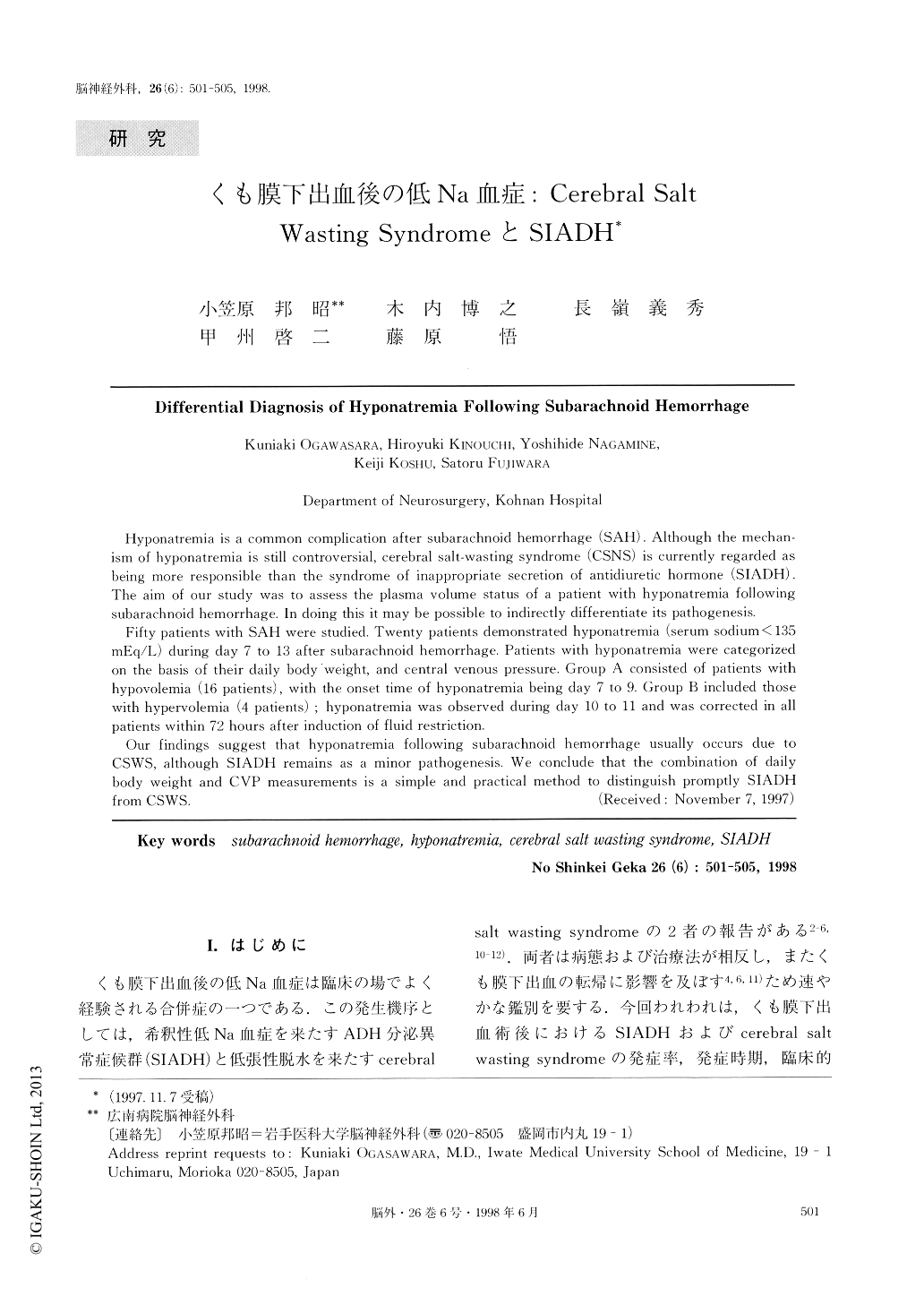
I.はじめに
くも膜下出血後の低Na血症は臨床の場でよく経験される合併症の一つである.この発生機序としては,希釈性低Na血症を来たすADH分泌異常症候群(SIADH)と低張性脱水を来たすcerebralsalt wasting syndromeの2者の報告がある2-6,10-12).両者は病態および治療法が相反し,またくも膜下出血の転帰に影響を及ぼす4,6,11)ため速やかな鑑別を要する.今回われわれは,くも膜下出血術後におけるSIADHおよびcerebral saltwasting syndromeの発症率,発症時期,臨床的鑑別法につき検討した.
Hyponatremia is a common complication after subarachnoid hemorrhage (SAH). Although the mechan-ism of hyponatremia is still controversial, cerebral salt-wasting syndrome (CSNS) is currently regarded asbeing more responsible than the syndrome of inappropriate secretion of antidiuretic hormone (SIADH).The aim of our study was to assess the plasma volume status of a patient with hyponatremia followingsubarachnoid hemorrhage. In doing this it may be possible to indirectly differentiate its pathogenesis.
Fifty patients with SAH were studied. Twenty patients demonstrated hyponatremia (serum sodium<135mEq/L) during day 7 to 13 after subarachnoid hemorrhage. Patients with hyponatremia were categorizedon the basis of their daily body weight, and central venous pressure. Group A consisted of patients withhypovolemia (16 patients), with the onset time of hyponatremia being clay 7 to 9. Group B included thosewith hypervolemia (4 patients); hyponatremia was observed during clay 10 to 11 and was corrected in allpatients within 72 hours after induction of fluid restriction.
Our findings suggest that hyponatremia following subarachnoid hemorrhage usually occurs due toCSWS, although SIADH remains as a minor pathogenesis. We conclude that the combination of dailybody weight and CVP measurements is a simple and practical method to distinguish promptly SIADHfrom CSWS.
Copyright © 1998, Igaku-Shoin Ltd. All rights reserved.