Japanese
English
- 有料閲覧
PPV購入案内
1,320円 (1,200円+税10%) こちらは、717ページから722ページの文献です。購入には医書.jp本会員登録が必要です。
会員登録完了後に改めて上記「購入サイトへ」を選択してください。
または「購入サイトへ」選択後に「購入ログイン」、「新規会員登録」の順に進んでください。
会員登録について詳しくはをご確認ください。
- Abstract 文献概要
- 1ページ目 Look Inside
I.はじめに
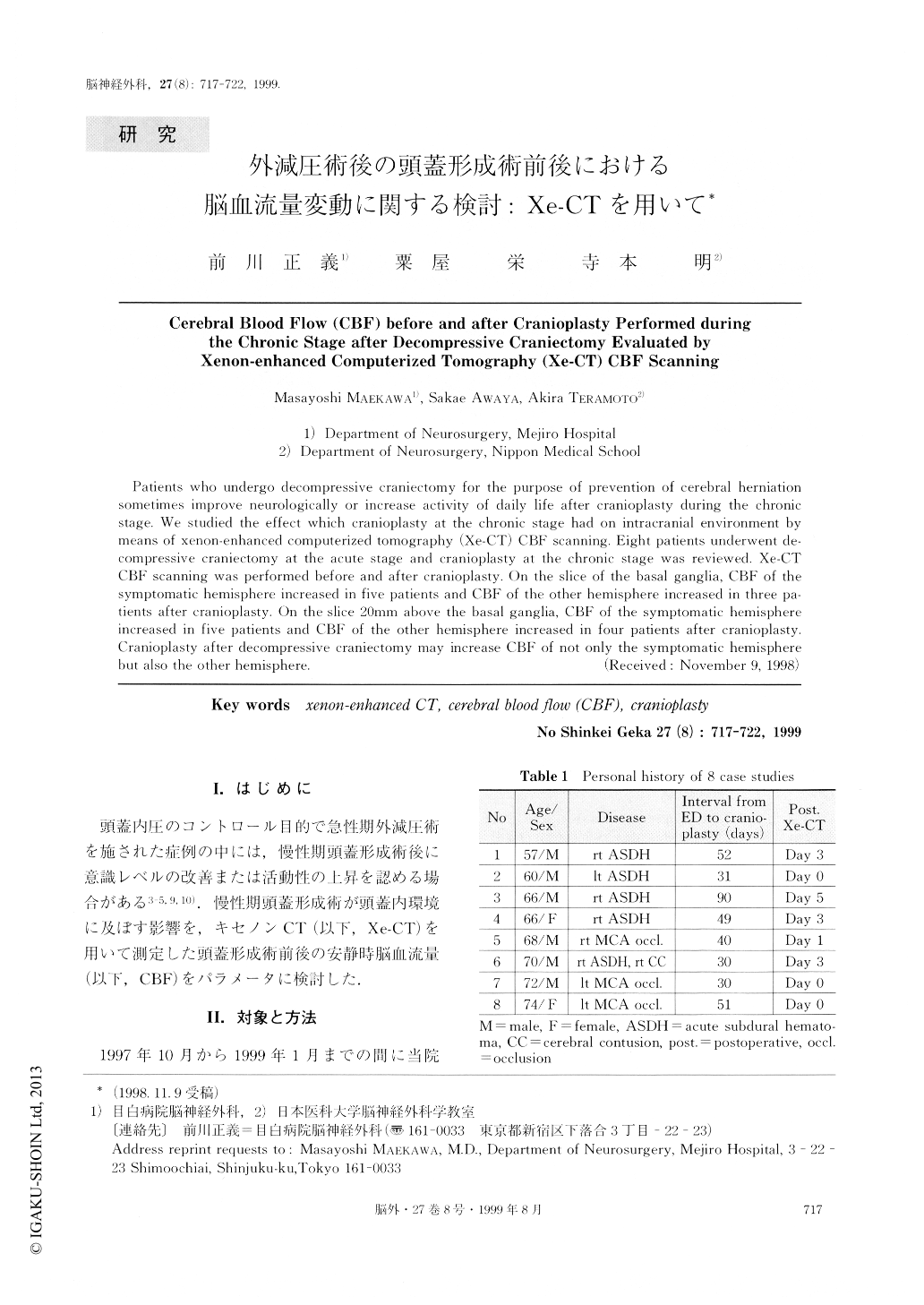
頭蓋内圧のコントロール目的で急性期外減圧術を施された症例の中には,慢性期頭蓋形成術後に意識レベルの改善または活動性の上昇を認める場合がある3,5,9,10).慢性期頭蓋形成術が頭蓋内環境に及ぼす影響を,キセノンCT(以下,Xe-CT)を用いて測定した頭蓋形成術前後の安静時脳血流量(以下,CBF)をパラメータに検討した.
Patients who undergo decompressive craniectomy for the purpose of prevention of cerebral herniationsometimes improve neurologically or increase activity of daily life after cranioplasty during the chronicstage. We studied the effect which cranioplasty at the chronic stage had on intracranial environment bymeans of xenon-enhanced computerized tomography (Xe-CT) CBF scanning. Eight patients underwent de-compressive craniectomy at the acute stage and cranioplasty at the chronic stage was reviewed. Xe-CT CBF scanning was performed before and after cranioplasty. On the slice of the basal ganglia, CBF of thesymptomatic hemisphere increased in five patients and CBF of the other hemisphere increased in three pa-tients after cranioplasty. On the slice 20mm above the basal ganglia, CBF of the symptomatic hemisphereincreased in five patients and CBF of the other hemisphere increased in four patients after cranioplasty. Cranioplasty after decompressive craniectomy may increase CBF of not only the symptomatic hemisphere but also the other hemisphere.
Copyright © 1999, Igaku-Shoin Ltd. All rights reserved.