Japanese
English
- 有料閲覧
PPV購入案内
1,320円 (1,200円+税10%) こちらは、57ページから61ページの文献です。購入には医書.jp本会員登録が必要です。
会員登録完了後に改めて上記「購入サイトへ」を選択してください。
または「購入サイトへ」選択後に「購入ログイン」、「新規会員登録」の順に進んでください。
会員登録について詳しくはをご確認ください。
- Abstract 文献概要
- 1ページ目 Look Inside
I.はじめに
頭蓋内出血や脳虚血症状の既往がない高齢者のモヤモヤ病に脳塞栓症が合併した症例を経験した.急性期超選択的局所線溶療法にて,閉塞していた左中大脳動脈の再開通が得られ,神経脱落所見なく回復した.残存する左中大脳動脈狭窄に対して施行した慢性期STA-MCAanastomosis後に,バイパス血管のSTAが塞栓によって閉塞するという稀な事象も合併した.2度目の超選択的局所線溶療法では完全な再開通が得られず,左前頭葉に脳梗塞を惹起し,軽度運動性失語症が残存した.
本症例に対して,若干の文献的考察も含めて検討したので報告する.
We reported a rare case of Moyamoya disease in the aged associated with cerebral embolism.
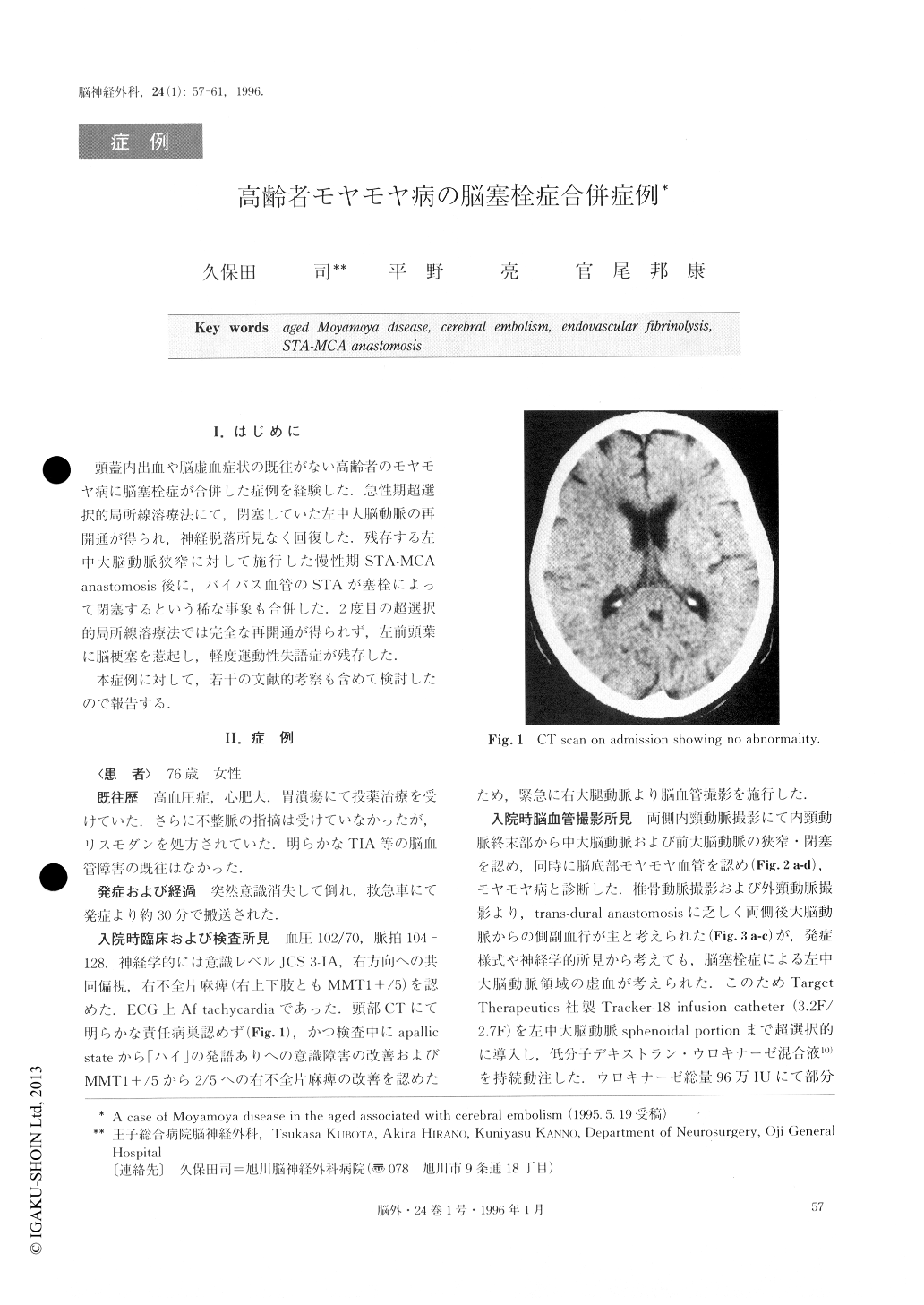
A 76-year-old female was brought into our hospital by ambulance 30 min after an attack of fainting. She had no past history of cerebrovascular disease. On admission her consciousness level was JCS 3-IA and she showed Rt. hemiparesis. ECG exhibited Af tachy-cardia. No abnormal region was recognized on brain CT. Emergency cerebral angiograms (AG) disclosed that unexpectedly she had Moyamoya disease. Stenotic or occluded lesions were seen from bilateral IC termin-al portions to MCA and ACA, and basal moyamoya vessels were visualized. Transdural anastomosis was poor and posterior circulation was the main source of collateral flow. Mode of onset and neurological signs suggested that the cause of the attack was Lt. MCA occlusion at its sphenoidal portion by cardiogenic embolism. Superselective endovascular fibrinolysis was carried out by the use of urokinase and low molecular weight Dextran and Lt. MCA was able to be recanal-ized. She was recovered without neurological deficit. Lt. STA-MCA anastomosis and encephalo-myo-synangiosis was performed in the chronic stage because stenosis had remained in Lt. MCA and hypo-perfusion in bilateral frontal lobes was presented on SPECT. Post-operative AG demonstrated that Lt. MCA was occluded but Lt. frontal lobe was supplied with plenty of blood flow from Lt. STA. During the next day morning, she had another attack of fainting and showed moderate consciousness disturbance and motor aphasia. No abnormal change was noticed on brain CT. Emergency AG revealed that Lt. STA had become stuffed up with emboli and bypass flow had dis-appeared. Superselective endovascular fibrinolysis was able to recanalize the blood flow imperfectly, but mild motor apasia remained due to Lt. frontal infarction.
Copyright © 1996, Igaku-Shoin Ltd. All rights reserved.