Japanese
English
- 有料閲覧
PPV購入案内
1,320円 (1,200円+税10%) こちらは、1057ページから1062ページの文献です。購入には医書.jp本会員登録が必要です。
会員登録完了後に改めて上記「購入サイトへ」を選択してください。
または「購入サイトへ」選択後に「購入ログイン」、「新規会員登録」の順に進んでください。
会員登録について詳しくはをご確認ください。
- Abstract 文献概要
- 1ページ目 Look Inside
- 参考文献 Reference
Ⅰ.はじめに
「自国人の移植は自国内で」といったイスタンブール宣言や2010年7月に改正臓器移植法が施行されて以来,本邦における心臓移植の症例数は増加している.これに伴い,移植待機患者や移植までのつなぎとしての植え込み型補助人工心臓(ventricular assist device:VAD)装着患者の増加が見込まれている.VAD装着患者には脳塞栓症が多いことが知られているが,具体的な血栓の性質,血管内治療の手術手技に関する報告は少ない.今回,われわれはVAD装着患者が急性期脳塞栓症を発症し,血栓吸引術を行い奏功した1例を経験したので文献的考察を加味して報告する.
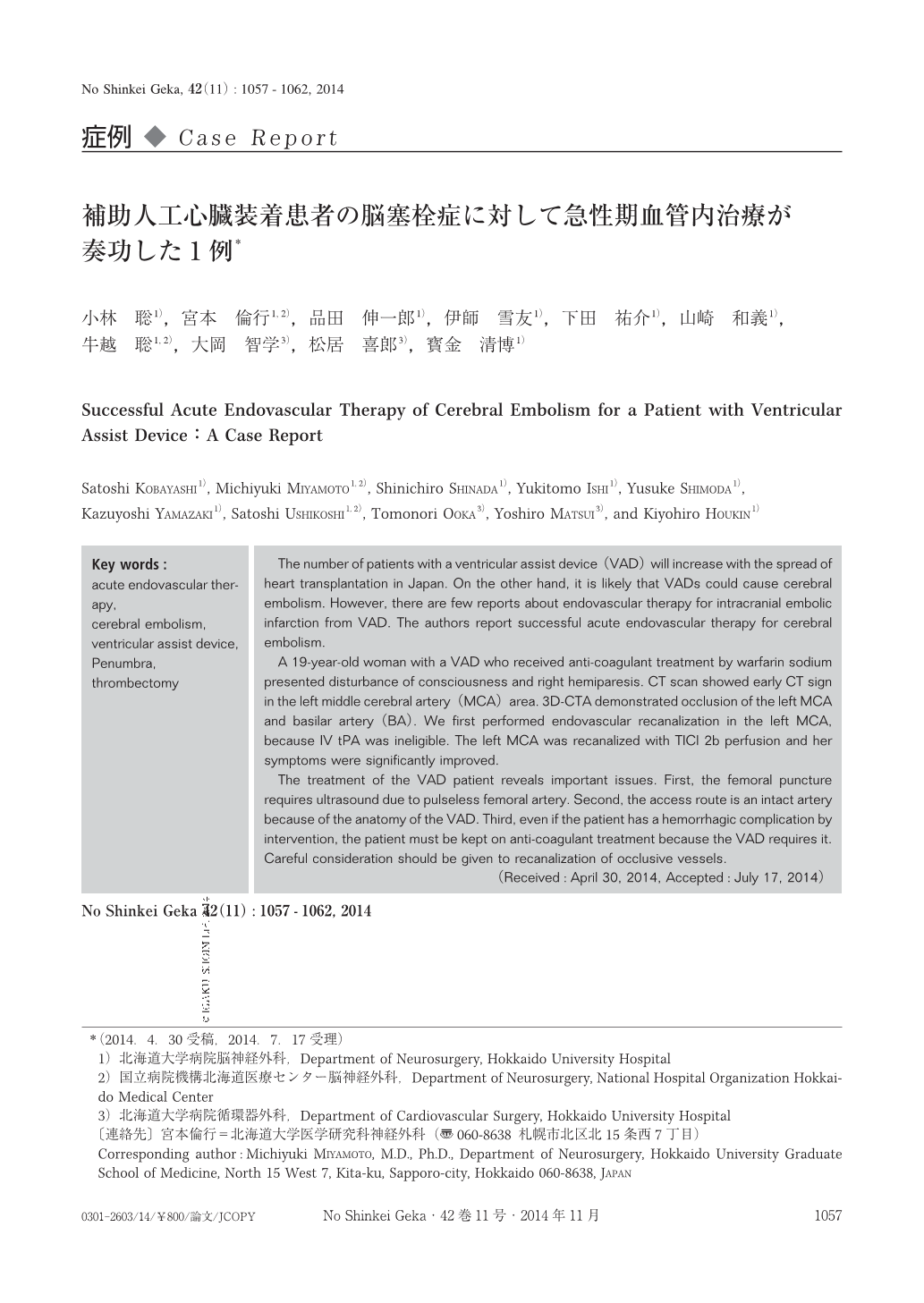
The number of patients with a ventricular assist device(VAD)will increase with the spread of heart transplantation in Japan. On the other hand, it is likely that VADs could cause cerebral embolism. However, there are few reports about endovascular therapy for intracranial embolic infarction from VAD. The authors report successful acute endovascular therapy for cerebral embolism.
A 19-year-old woman with a VAD who received anti-coagulant treatment by warfarin sodium presented disturbance of consciousness and right hemiparesis. CT scan showed early CT sign in the left middle cerebral artery(MCA)area. 3D-CTA demonstrated occlusion of the left MCA and basilar artery(BA). We first performed endovascular recanalization in the left MCA, because IV tPA was ineligible. The left MCA was recanalized with TICI 2b perfusion and her symptoms were significantly improved.
The treatment of the VAD patient reveals important issues. First, the femoral puncture requires ultrasound due to pulseless femoral artery. Second, the access route is an intact artery because of the anatomy of the VAD. Third, even if the patient has a hemorrhagic complication by intervention, the patient must be kept on anti-coagulant treatment because the VAD requires it. Careful consideration should be given to recanalization of occlusive vessels.
Copyright © 2014, Igaku-Shoin Ltd. All rights reserved.