Japanese
English
- 有料閲覧
PPV購入案内
1,320円 (1,200円+税10%) こちらは、491ページから496ページの文献です。購入には医書.jp本会員登録が必要です。
会員登録完了後に改めて上記「購入サイトへ」を選択してください。
または「購入サイトへ」選択後に「購入ログイン」、「新規会員登録」の順に進んでください。
会員登録について詳しくはをご確認ください。
- Abstract 文献概要
- 1ページ目 Look Inside
I.はじめに
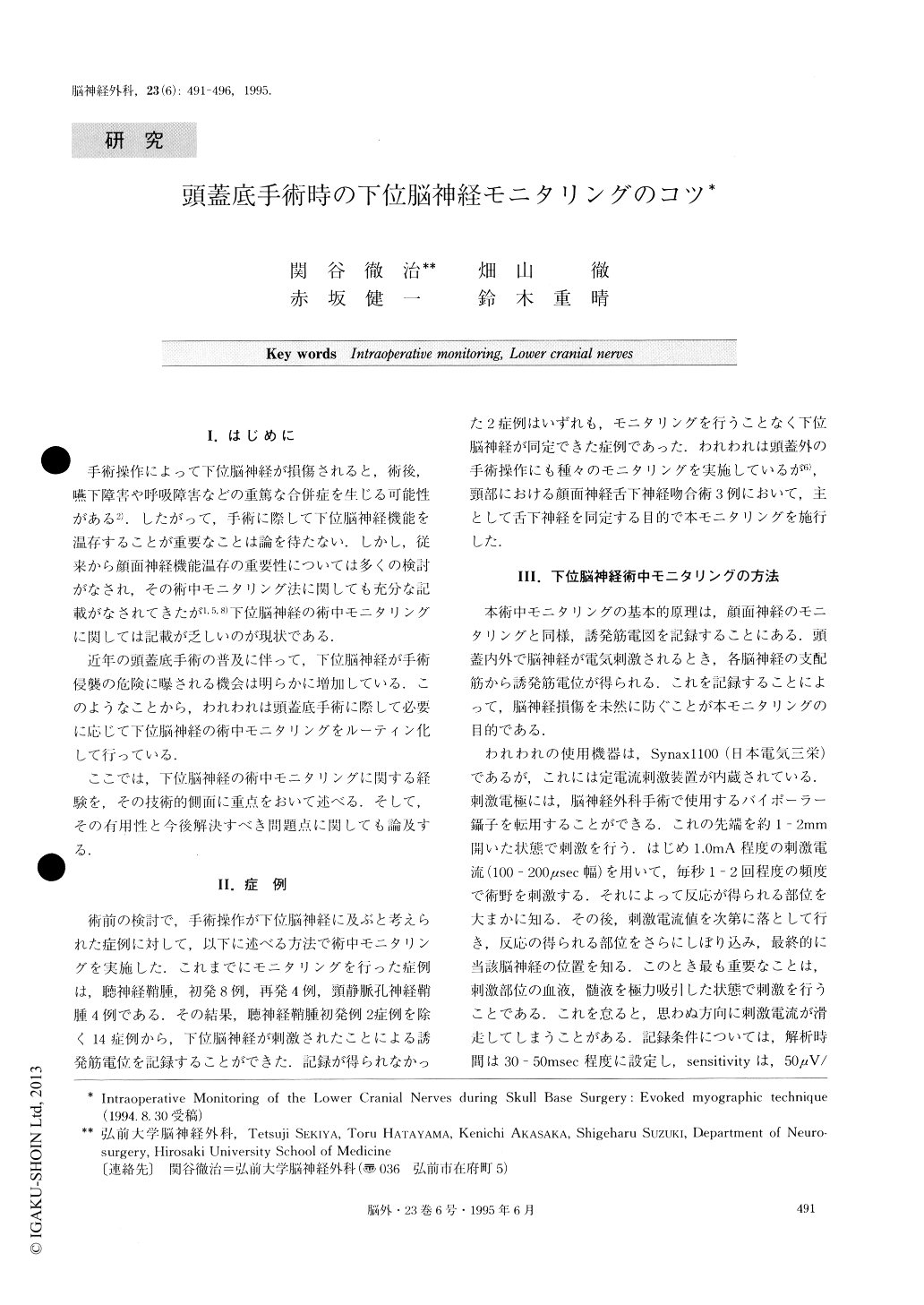
手術操作によって下位脳神経が損傷されると,術後,嚥下障害や呼吸障害などの重篤な合併症を生じる可能性がある2).したがって,手術に際して下位脳神経機能を温存することが重要なことは論を待たない.しかし,従来から顔面神経機能温存の重要性については多くの検討がなされ,その術中モニタリング法に関しても充分な記載がなされてきたが1,5,8)下位脳神経の術中モニタリングに関しては記載が乏しいのが現状である.
近年の頭蓋底手術の普及に伴って,下位脳神経が手術侵襲の危険に曝される機会は明らかに増加している.このようなことから,われわれは頭蓋底手術に際して必要に応じて下位脳神経の術中モニタリングをルーティン化して行っている.
Functional preservation of the lower cranial nerves is an important issue in the surgery of the skull base to avoid postoperative serious complications such as aspiration pneumonia and respiratory disorders.
We presented our experience of intraoperative moni-toring of the lower cranial nerves during skull base surgery. The evoked electromyographic (EMG) activi-ties were successfully recorded from the muscles inner-vated by the lower cranial nerves. These EMG record-ings are helpful to guide the surgeon intraoperatively and to avoid careless severing of these nerves.
Although the glossopharyngeal nerve that innervates only one small muscle in the pharynx (M. stylopharyn-geus) cannot be monitored with the evoked EMG tech-nique described in this paper, the position of this nerve can be deduced from the position of the vagus nerve.
Copyright © 1995, Igaku-Shoin Ltd. All rights reserved.