Japanese
English
- 有料閲覧
PPV購入案内
1,320円 (1,200円+税10%) こちらは、61ページから65ページの文献です。購入には医書.jp本会員登録が必要です。
会員登録完了後に改めて上記「購入サイトへ」を選択してください。
または「購入サイトへ」選択後に「購入ログイン」、「新規会員登録」の順に進んでください。
会員登録について詳しくはをご確認ください。
- Abstract 文献概要
- 1ページ目 Look Inside
I.はじめに
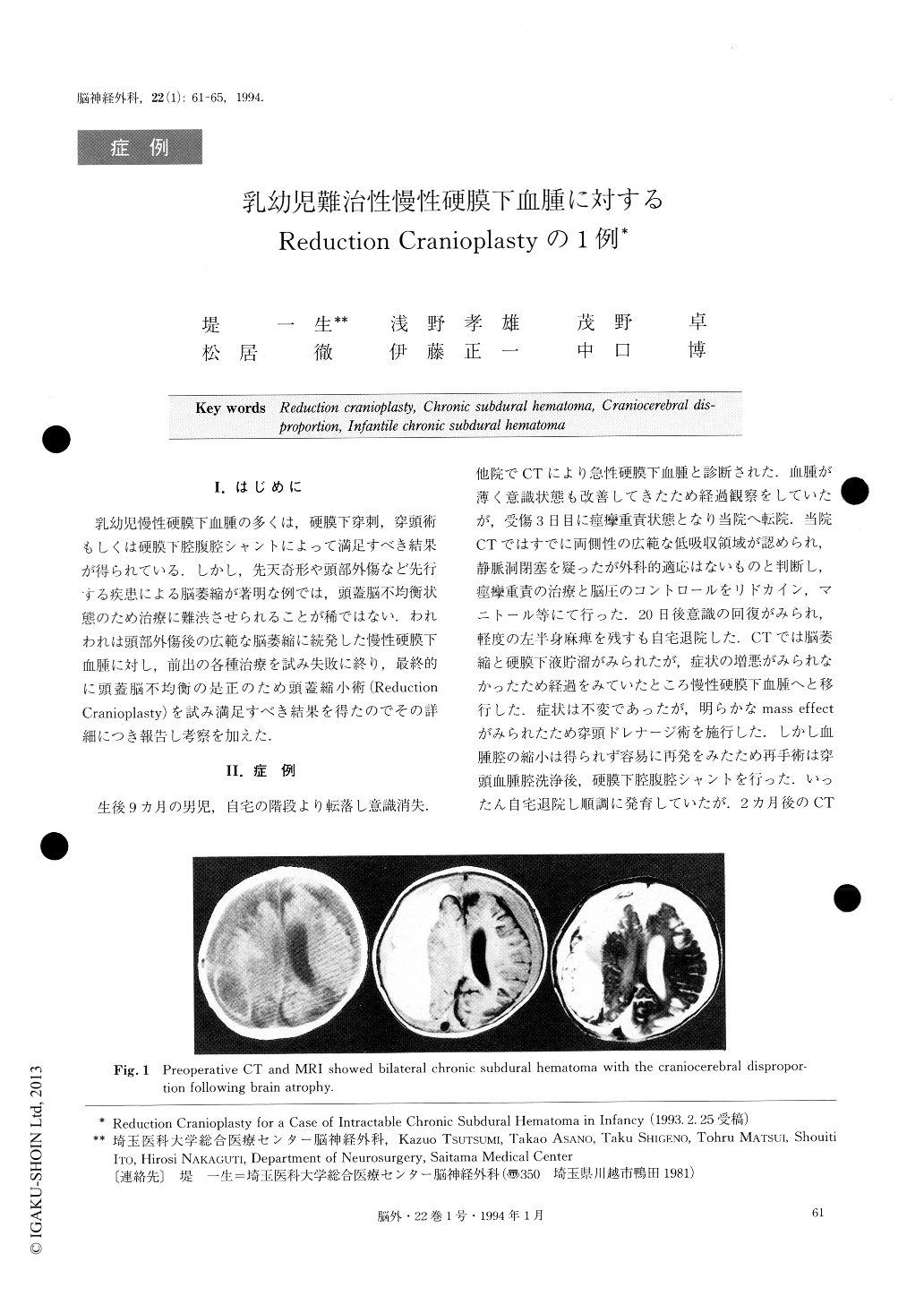
乳幼児慢性硬膜下血腫の多くは,硬膜下穿刺,穿頭術もしくは硬膜下腔腹腔シャントによって満足すべき結果が得られている.しかし,先天奇形や頭部外傷など先行する疾患による脳萎縮が著明な例では,頭蓋脳不均衡状態のため治療に難渋させられることが稀ではない.われわれは頭部外傷後の広範な脳萎縮に続発した慢性硬膜下血腫に対し,前出の各種治療を試み失敗に終り,最終的に頭蓋脳不均衡の是正のため頭蓋縮小術(Reduction Cranioplasty)を試み満足すべき結果を得たのでその詳細につき報告し考察を加えた.
Although almost all infants suffering chronic subdu-ral hematomas (CSDH) are successfully treated by established methods such as a subdural puncture, burr holes and shunting procedures, infantile CSDH with progressive craniocerebral disproportion requires a spe-cial therapeutical regimen. Clinical efforts such as reduc-tion cranioplasty have been made as a treatment for these cases. This is a case report of a 9-month-old male infant with an intractable CSDH, bilateral and large, and subsequent brain atropy caused by traumatic head in-jury. Excellent results were obtained by a modified reduc-tion cranioplasty.
In brief, the patient was supine-positioned with a 20-degree flexion of the head in an attempt to obtain a large operative field. Bicoronal skin incision was combined with an additional linear one on the midline (T-shaped incision). Bilateral frontoparietal craniotomy with perios-teum was made to keep the midline bony bridge over-lying the superior sagittal sinus (SSS). The resulting ex-tensive dural opening allowed complete evacuation of the subdural hematoma. Thereafter, the anterior part, ca. 4cm in width, of the bony bridge was removed in order to make the remaining bone able to be manipulated and connected to the frontal bone. Prior to this stage, SSS close to the crista galli was ligated and cut with the falx to avoid postoperative kinking. The dura mater was su-tured so as not to leave an excessive subdural space. The bone flaps were trimmed to complete a good-shaped re-construction. Finally, the excessive scalp was removed because the original scalp was too large for the recon-structed skull.
As to the reduction cranioplasty, we stressed several important points such as reducing intraoperative blood loss and preventing kinking of the SSS. As explained above, we developed a modified method. In the present report, we emphasized its usefullness in a treatment of infantile patients with an intractable CSDH and subse-quent craniocerebral disproportion.
Copyright © 1994, Igaku-Shoin Ltd. All rights reserved.